

why journalists need to understand grammar to write accurately about violence
- Written by: Annabelle Lukin, Associate Professor in Linguistics, Macquarie University
The recent killing of unarmed Palestinians by Israeli forces has sparked not only a reasonable outcry, but commentary on the language journalists use to report these events.
For instance, writer and English professor Moustafa Bayoumi, of City University of New York, wrote:
It is the peculiar fate of oppressed people everywhere that when they are killed, they are killed twice: first by bullet or bomb, and next by the language used to describe their deaths.
Read more: US can no longer be counted on to end Israel-Palestinian conflict
Bayoumi draws attention to one of the most important but contested roles of modern journalism: the act of putting political violence into words.
The bad news for journalists is there is no neutral mode. If your words sound neutral, it’s likely you’ve simply avoided laying responsibility for the killings, or have imputed responsibility only indirectly.
Linguistically, there are many ways of doing this.
Grammatical voice
One well-known grammatical structure is the passive voice. While it is well known, it is largely misunderstood. For example, Bayoumi criticised a New York Times tweet that construed the killing of Palestinian protesters in the following way:
Bayoumi, like many commentators on Twitter, took umbrage as this reporting, arguing that with these words the perpetrators of the violence were not made visible. The accompanying image, which shows Palestinians but not Israeli soldiers, echoes this choice.
Bayoumi wrongly called this structure the passive voice. The passive voice version would look like this:
Dozens of Palestinians have been killed in protests as the US prepares to open its Jerusalem Embassy.
The passive voice puts the object of the action first. More specifically, the passive voice involves making the object of the action the subject of the clause. We use it to give more prominence to the people or things affected by an action.
Because the passive voice puts the people or things acted on before the verb, writers have a choice about whether or not to name the agent of the action. The passive voice lets you leave out the agent: in my example above, the Palestinians were killed, but who or what killed them is not mentioned.
Equally, you can put the agent in the clause, as urged by many on Twitter. In these examples, “Israeli soldiers” and “Israeli forces” are named as the perpetrators.
Active, passive and middle voice
The headline of the The New York Times article actually identified the perpetrator and opted for active voice:
Israel Kills Dozens at Gaza Border as US Embassy Opens in Jerusalem
Active voice is a structure where the agent of the action is also the subject of the clause.
The active and passive voices have something important in common: they construe action as involving two participants: one that carries out the action, the other that is affected by the action. These kinds of actions are called “transitive”.
The New York Times’ tweet – “Palestinians have died …” – construed the killing of Palestinians by Israeli soldiers using the “middle voice” or “intransitive” structure.
By construing the violence in this way, The New York Times offered its readers one and only one participant: Palestinians, who died without reference to any cause.
Laying responsibility with something that is not human
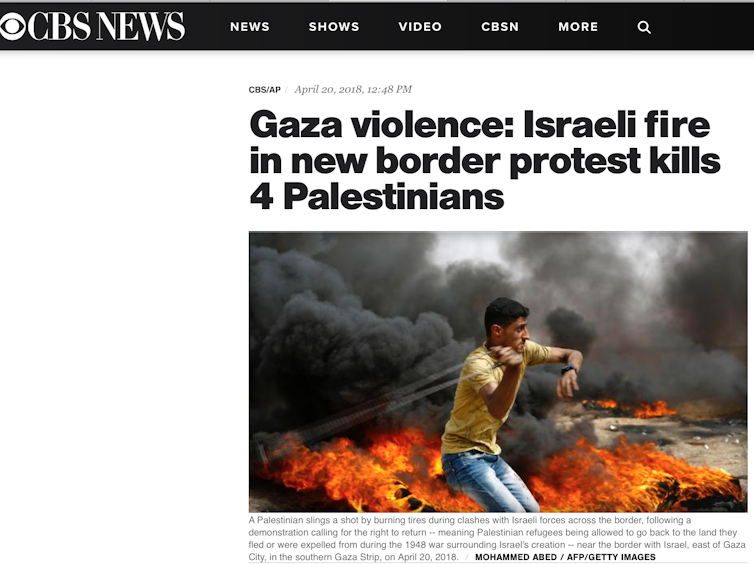
Another way to avoid making the perpetrators visible is to assign responsibility to a non-human entity. CBS news, for instance, recently gave further killings of Palestinians by Israeli soldiers the following headline:
Israeli fire in new border protest kills 4 Palestinians
 Recent CBS Headline.
CBS
Recent CBS Headline.
CBS
Rather than putting responsibility on people, journalists gave responsibility to “Israeli fire”. Grammatically, the action of “firing” has been turned into a noun and put in the grammatical role of agent.
This has the effect of taking responsibility away from humans, which avoids any suggestion of intention. Let’s note also that CBS coupled this indirect way of construing agency with an image showing a Palestinian as an agent of violence.
Here’s a common variation on this theme, from the Gulf News:
16 Palestinians killed in clashes near Israel border
The headline uses passive voice and leaves out the agent of the action. Instead, the deaths are explained as a consequence of “clashes”. Not only is human agency avoided, but the violence is construed as between two equal parties, involved in bi-directional action.
Given 60 Palestinians were killed, but no Israelis, the idea this was a fight on equal terms is a bit of a stretch.
Main versus dependent clauses
Yet another way of avoiding making the perpetrators of an act of killing visible is the choice to distribute the information across two separate clauses.
For example, USA Today reported:
Israeli troops fire on Palestinian protesters, leaving at least 14 dead near Gaza border.
By using two clauses, these journalists separated the actions of Israeli troops from their consequences. The action of firing on Palestinians is put into one clause, while the effect of this action happens in a separate clause.
Note the grammatical choice to put the deaths of 14 Palestinians in a dependent clause.
This grammatical choice means the actions of Israeli troops are given prominence (by occupying the main clause in this structure), while the deaths of Palestinians, which are the direct and predictable result of these actions, are construed as secondary, as if an unfortunate byproduct of these actions.
The causal link between what the Israeli troops did and the consequence is even more attenuated by the choice of lexical verb. To “leave dead” is not the same as “to kill”. To “leave (them) dead” turns the action of killing into an adjective describing the victims of the action.
These few examples are the tip of the iceberg. A fuller discussion of the many and varied ways journalists avoid attributing responsibility for the deaths in political violence is available in my forthcoming book.
Why aren’t journalists taught about the mechanics of grammar?
Despite the importance of understanding the invisible machinery of language, few journalism or communications students are taught the intricate patterns from which they must choose in the act of writing a news story.
Journalism educators might eschew this knowledge. But journalists cannot get away from the effects of these linguistic structures on the meanings they give to important events. It’s better to know their implications rather than be at their mercy.
Authors: Annabelle Lukin, Associate Professor in Linguistics, Macquarie University


 Daily Bulletin


