

where do clouds come from and why do they have different shapes?
- Written by: Robert Lawry, Hydrologist, Australian Bureau of Meteorology
This is an article from Curious Kids, a series for children. The Conversation is asking kids to send in questions they’d like an expert to answer. All questions are welcome – serious, weird or wacky! You might also like the podcast Imagine This, a co-production between ABC KIDS listen and The Conversation, based on Curious Kids.
Where do clouds come from and why do they all have different shapes? – Ryan Potts, age 7, Canberra.
Hi Ryan, great question!
When it comes to understanding clouds, it helps first to understand water.
You know the water you drink out of a glass? That’s liquid water. There is also solid water, such as ice from the freezer or a slushy.
But water also exists as a gas. It’s called water vapour. You can’t can’t see, taste or feel this water but it’s everywhere. It’s all around you right now. Water vapour is in the air we breathe. When it’s warm and there is a lot of water vapour in the air, it can feel very sticky and sweaty.
Read more: Curious Kids: Why do you blink when there is a sudden loud noise close by?
Now let’s go back to clouds.
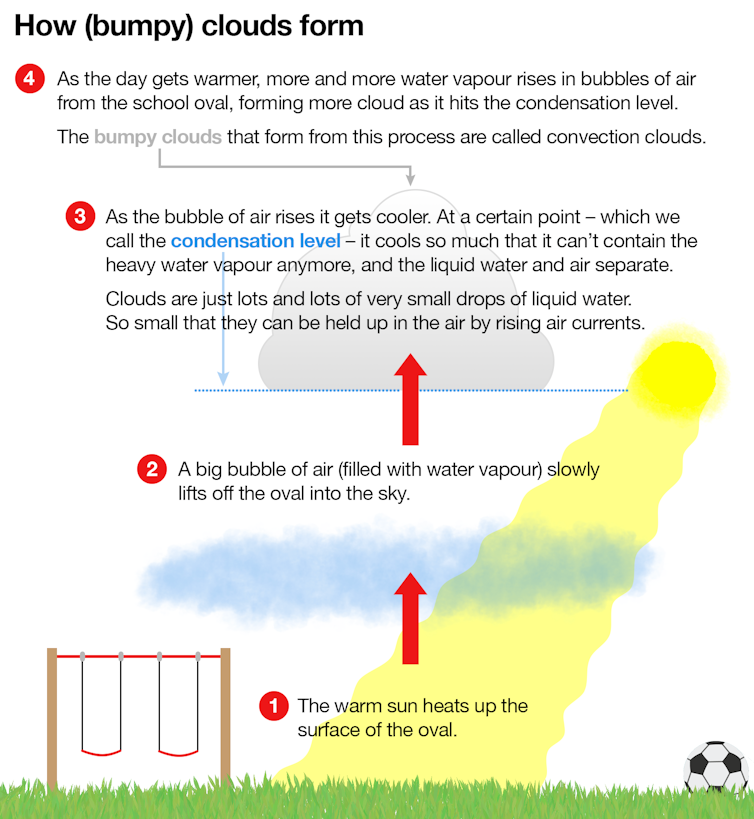
For clouds to form, air needs to be cooled to a temperature at which the water vapour turns into liquid water. The best way to do this is to make the air rise, because the higher we go in the atmosphere the colder the temperature. There are many reasons air might lift, but one reason is because during the day the sun heats up the surfaces around us.
Imagine the oval near your school on a warm day. Starting in the morning the sun warms the surface of the oval and before too long the entire oval is warming up.
Warm air weighs less than cooler air. So a big bubble of warm air, filled with water vapour, slowly lifts off your school oval.
As the bubble of air (filled with water vapour) rises upwards, it starts to cool down. The higher it goes the cooler it gets.
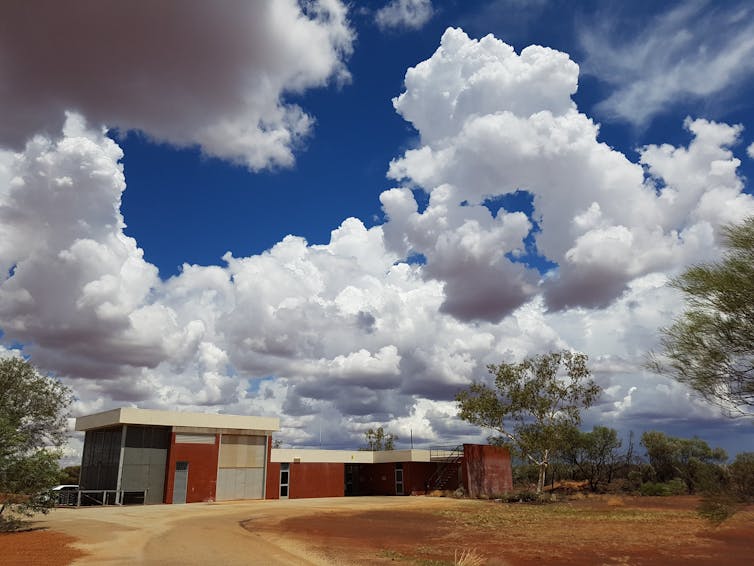 Bubbles of warm air that have reached and passed beyond the condensation level.
Robert Lawry, Author provided
Bubbles of warm air that have reached and passed beyond the condensation level.
Robert Lawry, Author provided
Eventually, well off the ground above your school, the bubble of air has cooled so much that the water vapour turns into liquid water. We call this point the condensation level. When the water vapour turns into tiny specks of liquid water, a cloud forms.
Clouds are simply liquid water: very, very small drops of liquid water. So small in fact, that they can be held up in the air by rising air currents.
Back on the school oval: the day keeps getting warmer, more and more bubbles of rising air race upwards, cooling as they rise. When these bubbles of air reach the condensation level, more cloud forms.
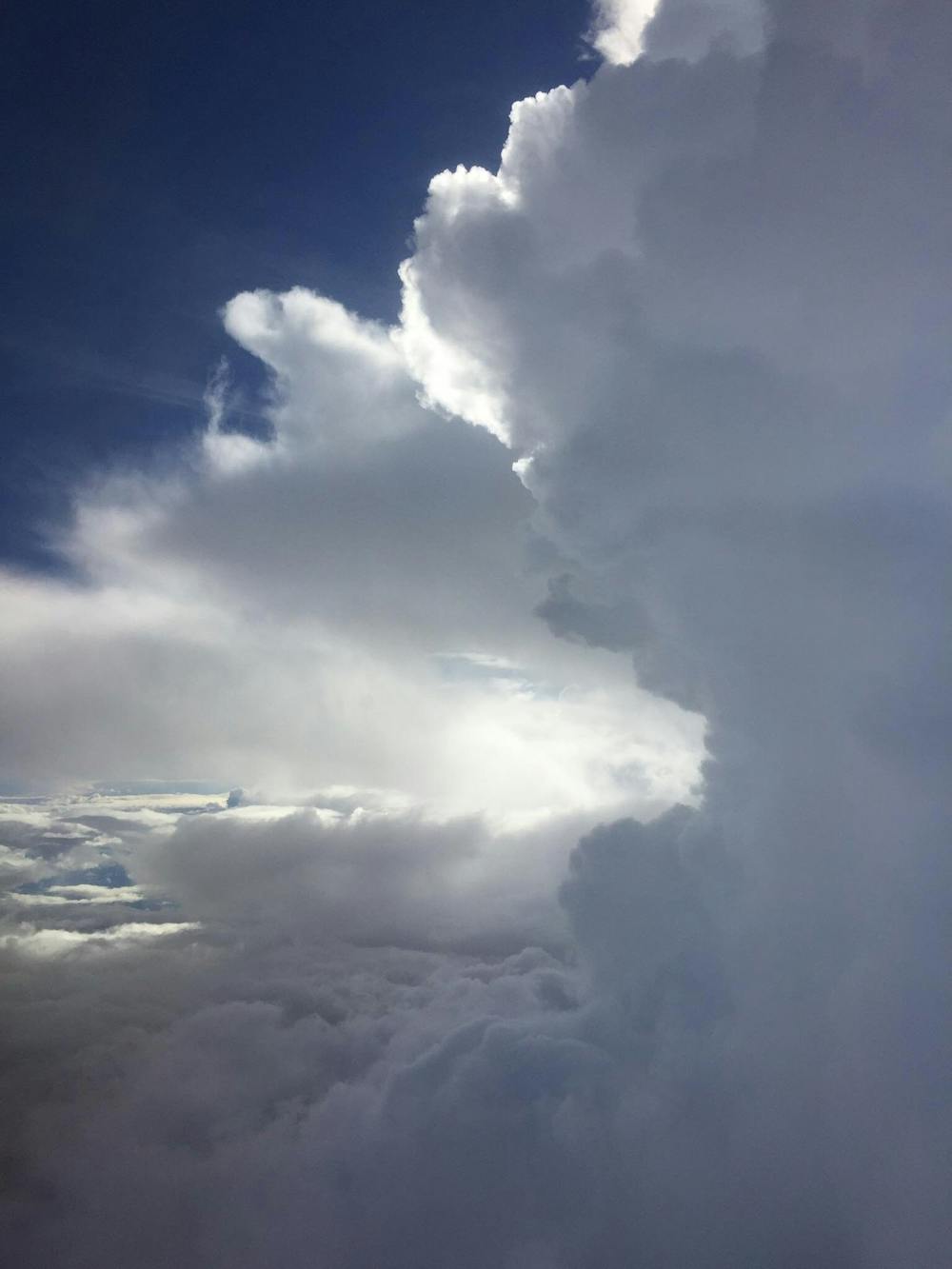 A fluffy, bumpy cloud, formed by rising warm air currents.
Robert Lawry, Author provided
A fluffy, bumpy cloud, formed by rising warm air currents.
Robert Lawry, Author provided
Clouds formed by rising warm air currents are called “convection clouds”. Because of all the rising air coming up, these clouds can be bumpy on the top, sometimes producing very high thick clouds looking like cotton wool or cauliflower heads.
 The Conversation, CC BY-ND
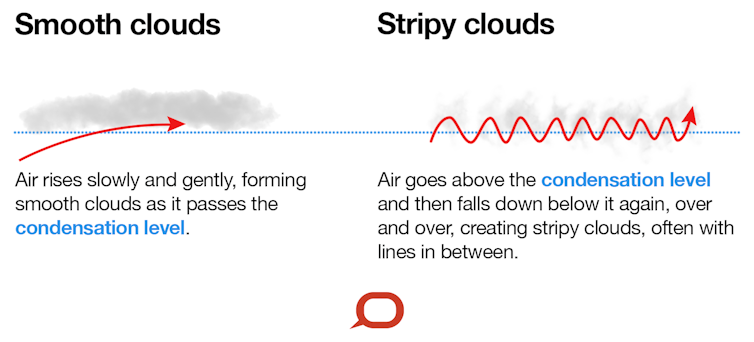
When air rises very slowly and gently over an area and reaches the condensation level you get a cloud that is very smooth looking, like this:
The Conversation, CC BY-ND
When air rises very slowly and gently over an area and reaches the condensation level you get a cloud that is very smooth looking, like this:
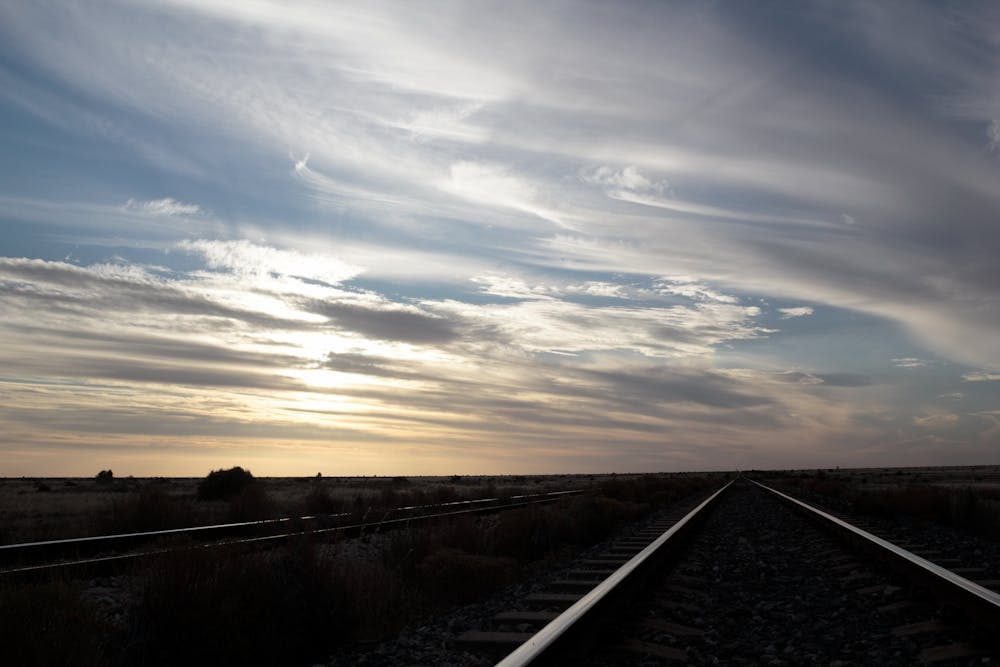 A smooth cloud.
Robert Lawry, Author provided
Sometimes air goes up past the condensation level then falls back below the condensation level, then up, then below, again and again. This creates clouds that are stripy, often with lines between the clouds.
The way the air moves creates all the different clouds we see.
A smooth cloud.
Robert Lawry, Author provided
Sometimes air goes up past the condensation level then falls back below the condensation level, then up, then below, again and again. This creates clouds that are stripy, often with lines between the clouds.
The way the air moves creates all the different clouds we see.
 The Conversation, CC BY-ND
All the grey clouds that you see contain liquid water. However, as we discussed earlier, water can also exist as a solid (ice). Clouds that are very high are extremely cold and may appear pure white. These clouds contain ice.
I used to wonder what it would feel like to touch a cloud. Would it be fluffy? Hard, soft, warm or cold?
Well, we don’t need to wonder. Because every time we see fog, we are looking at cloud.
Fog is simply air that has cooled to the point where the water vapour has turned into liquid water. That forms fog – which is really just a cloud on the ground.
So next time you see fog, go outside and touch a cloud!
The Conversation, CC BY-ND
All the grey clouds that you see contain liquid water. However, as we discussed earlier, water can also exist as a solid (ice). Clouds that are very high are extremely cold and may appear pure white. These clouds contain ice.
I used to wonder what it would feel like to touch a cloud. Would it be fluffy? Hard, soft, warm or cold?
Well, we don’t need to wonder. Because every time we see fog, we are looking at cloud.
Fog is simply air that has cooled to the point where the water vapour has turned into liquid water. That forms fog – which is really just a cloud on the ground.
So next time you see fog, go outside and touch a cloud!
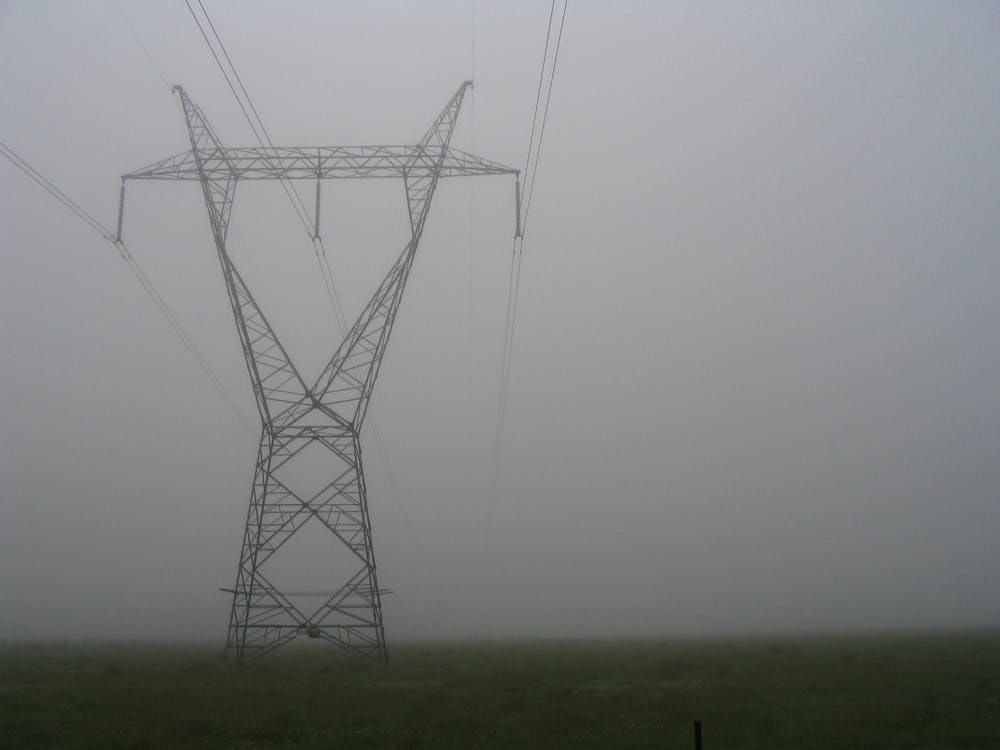 Fog is really just cloud at ground level.
Robert Lawry, Author provided
Read more:
Curious Kids: Why don't dogs live as long as humans?
Hello, curious kids! Have you got a question you’d like an expert to answer? Ask an adult to send your question to us. They can:
* Email your question to curiouskids@theconversation.edu.au
* Tell us on Twitter by tagging @ConversationEDU with the hashtag #curiouskids, or
* Tell us on Facebook
Fog is really just cloud at ground level.
Robert Lawry, Author provided
Read more:
Curious Kids: Why don't dogs live as long as humans?
Hello, curious kids! Have you got a question you’d like an expert to answer? Ask an adult to send your question to us. They can:
* Email your question to curiouskids@theconversation.edu.au
* Tell us on Twitter by tagging @ConversationEDU with the hashtag #curiouskids, or
* Tell us on Facebook
 CC BY-ND
Please tell us your name, age, and which city you live in. You can send an audio recording of your question too, if you want. Send as many questions as you like! We won’t be able to answer every question but we will do our best.
CC BY-ND
Please tell us your name, age, and which city you live in. You can send an audio recording of your question too, if you want. Send as many questions as you like! We won’t be able to answer every question but we will do our best.
Authors: Robert Lawry, Hydrologist, Australian Bureau of Meteorology


 Daily Bulletin


