

The war in Syria may be ending, but is likely to bring a fresh wave of suffering
- Written by: Mehmet Ozalp, Associate Professor in Islamic Studies, Director of The Centre for Islamic Studies and Civilisation and Executive Member of Public and Contextual Theology, Charles Sturt University
As the war in Syria comes to its final stages, the future of the country and the whole region hangs in the balance. As Syrian President Bashar al-Assad consolidates his power by defeating all opposition, resistance runs the risk of transforming into a new wave of organised terrorism.
My analysis at the beginning of 2018 predicted an imminent end to the conflict, with Assad victorious over the rebels. The final stage of the war was foreseen to be fought over the critical city and province of Idlib, the stronghold of the rebel groups. The capture of Idlib would cement Assad’s control of Western Syria demarcated by the Euphrates River.
Read more: The Syrian 'hell on earth' is a tangle of power plays unlikely to end soon
Idlib and Daraa were the first places where the civil war broke out back in 2011. Daraa fell to Assad’s forces in July 2018. Inevitably, Idlib was next in line.
Since 2015, Idlib has served as a repository of insurgents escaping Assad’s forces. The strategy of Assad was clear: to overwhelm opposition forces in every city with Russian air support; destroy as many of the armed rebels as possible; allow remaining armed rebels to move to Idlib as a temporary safe haven and then launch a final attack on Idlib to wipe out all armed opposition. The plan followed exactly this path, and worked.
Millions of displaced civilians have also moved to Idlib, escaping the war elsewhere. The United Nations has warned an attack on Idlib could be “the worst humanitarian catastrophe of the 21st century”.
In July 2018, the world and the US administration waited nervously to see what the Trump-Putin Helsinki summit would bring for Syria. But the Syria issue was overshadowed by the issue of Russian meddling with the 2016 US elections and Trump astonishingly choosing to believe Putin rather than his own intelligence aides over the matter.
Read more: In the outrage over the Trump-Putin meeting, important questions were overlooked
The relative insignificance of Syria during the summit, coupled with Trump’s lack of strategic insight, must have reconfirmed with Putin that the US was continuing to take a back seat in Syria. Soon after the summit, Assad and Russia intensified their preparations to attack Idlib.
Other key people in the US administration were not as uninterested as Trump. Security adviser John Bolton, Defence Secretary Jim Mattis as well as other European powers issued repeated warnings against the use of chemical weapons.
In response, Russia has launched a PR campaign claiming that the US and Western bloc countries used a staged chemical attack as a pretext to strike Assad. At the same time, Russia was busy reinforcing its naval forces in the Mediterranean by adding 10 more battleships to its sizeable fleet.
Having pacified the US and its Western allies, Russia, Iran and Turkey met in Tehran in early September to decide the fate of Idlib and its inhabitants. Putin publicly rejected Turkish President Recep Tayyip Erdogan’s call for a ceasefire.
About a week later, Putin and Erdogan met. Putin announced an agreement between Russia and Turkey to create “a demilitarised zone of a depth of 15-20km, with the withdrawal from there of radically minded rebels, including al-Nusra”.
No-one is sure who the “radically minded rebels” are, but Turkey will act as a guarantor in the demilitarisation process, relying on its significant influence over the rebel groups.
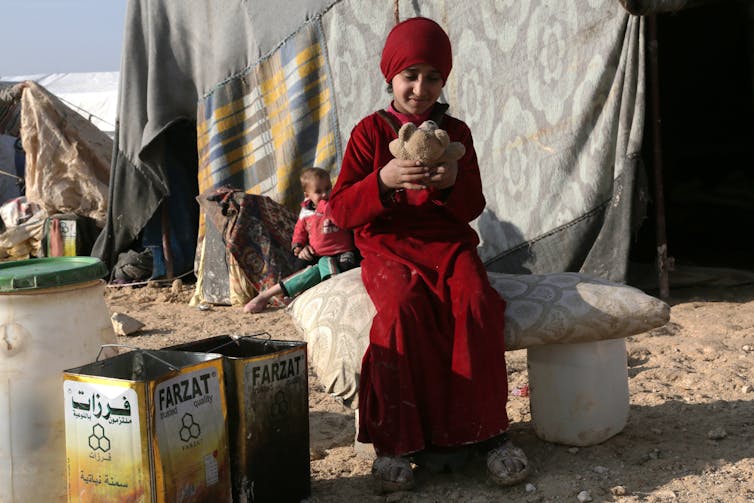 A young refugee plays with a teddy bear on the Syrian-Turkish border. The Syrian war has seen more than 3.5 million people seek refuge in Turkey.
AAP/EPA/ Zein Alrifaii
A young refugee plays with a teddy bear on the Syrian-Turkish border. The Syrian war has seen more than 3.5 million people seek refuge in Turkey.
AAP/EPA/ Zein Alrifaii
Turkey had no choice. It was facing the real possibility of another wave of hundreds of thousands of displaced civilians adding to the 3.5 million Syrians seeking refuge in Turkey. More importantly, escaped jihadist operatives were likely to regroup in Turkey, creating a massive internal security threat to that country.
As the first group started to leave the demilitarised zone on September 30, a small group of refugees returned to Syria from Lebanon. These are certainly good signs, but they don’t mean the war has ended. There is not even an official ceasefire in place, and the UN continues to issue warnings that Syria is still too dangerous a place to live and operate.
What is certain is that all parties, including Turkey, the US and some opposition groups, have now accepted the inevitability of Assad staying in power as the only legitimate government in Syria. This reality will have two main ramifications.
Read more: Syria, Russia and Turkey – the uneasy alliance reshaping world politics
Firstly, once totally free from armed opposition, Russia through the Assad regime is likely to challenge the US presence in Syria. Russia is not in Syria for a benevolent reason, but chiefly to ensure the permanence of its access to the Mediterranean Sea. A permanent US presence in Syria clashes with this objective.
By the end of 2018, and certainly in 2019, demands for the US to leave Syria will intensify – an eventuality that Trump clearly articulated back in April 2018. The US is likely to withdraw from Syria on the condition that Iran’s influence in the country is contained. Russia and Assad will make promises, but once the US is out, Iran will come back in.
Secondly, the biggest issue facing Syria is the deep feeling of resentment within a large segment of the population. They will question why the war was fought, creating 5 million refugees, displacing 6 million and killing more than 400,000, given that Assad is still in power in the end and Syria is no closer to being a democratic country advancing human rights and progress.
For some, the resentment will remain inward. But for a significant minority, the resentment will brew and turn into an unstoppable rage, perhaps manifesting in the familiar form of suicide bombing squads. They will reorganise themselves and launch a campaign of terrorism focusing mainly on easy civilian targets. This will only serve Assad’s narrative that fighting terrorism has reinforced his claims to legitimacy in the eyes of Syrians and increasingly within the international community.
The campaign of terrorism may inevitably spill over to Russia for staunchly supporting Assad, and to the US and its Western allies for allowing Russia to take the upper hand in Syria, subverting all attempts to get rid of Assad.
Civil war in Syria may be coming to an end with Assad firmly in power, but the resentment it generates is likely to evolve into a new wave of terrorism.
Authors: Mehmet Ozalp, Associate Professor in Islamic Studies, Director of The Centre for Islamic Studies and Civilisation and Executive Member of Public and Contextual Theology, Charles Sturt University


 Daily Bulletin


