

How huge floods and complex infrastructure could have triggered ancient Angkor's demise
- Written by: Dan Penny, Associate Professor, University of Sydney
A series of floods that hit the ancient city of Angkor would have overwhelmed and destroyed its vast water network, according to a new study that provides an explanation for the downfall of the world’s biggest pre-industrial city.
Our research, published in Science Advances, explains how the damage to this vital network would have triggered a series of “cascading failures” that ultimately toppled the entire city. And it holds lessons for today’s cities about the danger posed when crucial infrastructure is overwhelmed.
Angkor, in modern-day Cambodia, was founded in 802 AD and abandoned during the 15th century. Its demise coincided with a period of highly variable rainfall in the late 14th and early 15th centuries, with prolonged droughts and extremely wet years.
We know Angkor’s water distribution network was heavily damaged by flooding during that period. But we didn’t have an explanation of how this triggered the city’s eventual collapse and abandonment.
Angkor is an unusual archaeological site because the remains of the city can still be seen on the ground and, particularly, from the air. It is thus possible to map precisely the constructed features that made up its urban fabric and, from this, to interpret the function and flow of the living city.
We used existing archaeological maps of Angkor to chart the city’s water distribution network, which was made up of hundreds of excavated canals and embankments, temple moats, reservoirs, natural river channels, and other features. This sprawling network, covering more than 1,000 square km, provided both irrigation and flood defence.
We then used a computer model to simulate the effects of flooding, such as would have occurred during huge monsoonal rains, to see how the system would have coped with the biggest deluges.
We found that large floods would have been channelled into just a few major pathways, which would have suffered significant erosion as a result. Other parts of the network, meanwhile, would have had less water flow and would have begun to fill up with sediment.
The resulting feedback loop would have caused damage to cascade through the network, ultimately fragmenting Angkor’s water infrastructure.
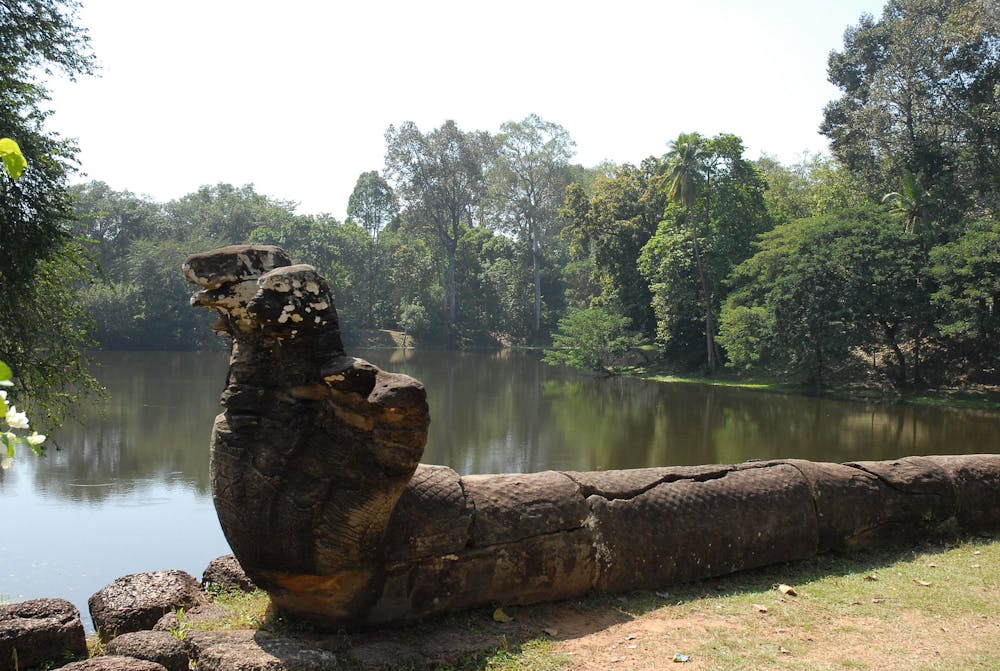 A watery end.
Alcyon/Wikimedia Commons, CC BY-SA
A watery end.
Alcyon/Wikimedia Commons, CC BY-SA
There are two main messages from our research. First, it demonstrates how climatic variability in the 14th and 15th centuries could have triggered the demise of the city.
Second, it shows how Angkor’s fate resonates with today’s concerns about the resilience of our own urban infrastructure – not just to extreme weather (although that is important), but also to other potentially damaging events such as terrorism.
Read more: What's critical about critical infrastructure?
Angkor was once the largest city on Earth. But its huge growth made it unworkable, unwieldy, and ultimately irreparable. Its critical urban infrastructure was both complex and interdependent, meaning that a seemingly small disruption (such as a flood) could fracture the entire network and bring down an entire city.
Ancient Angkor, it seems, experienced the same challenges as modern urban networks. As we move further into a period characterised by extreme weather events, the resilience of our urban infrastructure will be tested.
As cities grow, their infrastructure becomes more complex. Eventually, networks such as roads, water infrastructure or electricity grids reach a critical state that is neither predicted nor designed by those that operate them. In these networks, small errors or outages in one part of the network can quickly propagate to become a much larger failure. One example would be an electrical fault that triggers a wide-scale blackout.
Government agencies around the world have developed or are developing strategies to deal with threats to critical infrastructure, including from terrorism, natural disasters and, increasingly, extreme weather events related to climate change. Resilience can be built into infrastructural networks by increasing redundancy (or alternative flow paths) and emphasising modularity, so that cascading failures, if they occur, can be localised while maintaining the function of the wider network.
Our research on the demise of Angkor’s infrastructure sounds a warning from history about the dangers of the complex urban environments in which most humans now live, and the urgent need to prepare for a more variable future.
Authors: Dan Penny, Associate Professor, University of Sydney


 Daily Bulletin


