

What would a fair energy transition look like?
- Written by: Franziska Mey, Senior Research Consultant, Institute for Sustainable Futures, University of Technology Sydney
Opposition Leader Bill Shorten announced last week that a federal Labor government would create a Just Transition Authority to overseee Australia’s transition from fossil fuels to renewable energy. This echoes community calls for a “fast and fair” energy transition to avoid the worst impacts of climate change.
Read more: Labor's policy can smooth the energy transition, but much more will be needed to tackle emissions
But disruptive change is already here for Australia’s energy sector. 2018 has been a record year for large-scale solar and wind developments and rooftop solar. Renewable energy is now cheaper than new-build coal power generation – and some are saying renewables are now or soon will be cheaper than existing coal-fired power.
Based purely on the technical lifetime of existing power stations, the Australian market operator predicts that 70% of coal-fired generation capacity will be retired in New South Wales, South Australia and Victoria by 2040. If renewables continue to fall in price, it could be much sooner.
We must now urgently decide what a “just” and “fair” transition looks like. There are many Australians currently working in the energy sector – particularly in coal mining – who risk being left behind by the clean energy revolution.
Coal communities face real challenges
The history of coal and industrial transitions shows that abrupt change brings a heavy price for workers and communities. Typically, responses only occur after major retrenchments, when it is already too late for regional economies and labour markets to cope.
Coal communities often have little economic diversity and the flow-on effects to local economies and businesses are substantial. It is easy to find past caseswhere as many as one third of workers do not find alternative employment.
Read more: Energy transitions are nothing new but the one underway is unprecedented and urgent
We often hear about power stations, but there are almost 10 times as many workers in coal mining, where there is a much higher concentration of low and semi-skilled workers. The 2016 Census found almost half of coal workers are machinery operators and drivers.
The demographics of coal mining workers in Australia suggest natural attrition through early retirements will not be sufficient: 60% are younger than 45.
Mining jobs are well paid and jobs in other sectors are very unlikely to provide a similar income, so even under the best scenarios many will take a large pay cut.
Another factor is the long tradition of coal mining that shapes the local culture and identity for these communities. Communities are particularly opposed to change when they experience it as a loss of history and character without a vision for the future.
Lastly, the local environmental impacts of coal mining can’t be neglected. The pollution of land, water and air due to mining operations and mining waste have created brownfields and degraded land that needs remediation.
What is a ‘just’ transition?
A just transition to a clean energy economy has many facets. Unions first used the term in the 1980s to describe a program to support workers who lost their jobs. Just transition was recognised in the Paris Agreement as “a just transition of the workforce and the creation of decent work and quality jobs”.
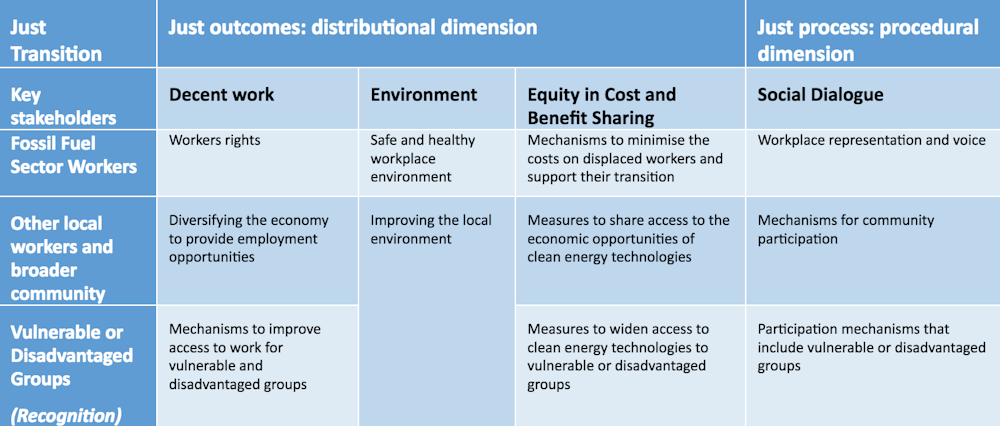
However, using the concept of energy justice, there are three main aspects which have to be considered for workers, communities and disadvantaged groups:
distributing benefits and costs equally,
a participatory process that engages all stakeholders in the decision making, and
recognising multiple perspectives rooted in social, cultural, ethical and gender differences.
A framework developed at the Institute for Sustainable Futures maps these dimensions.
 Institute for Sustainable Futures
A just transition requires a holistic approach that encompasses economic diversification, support for workers to transition to new jobs, environmental remediation and inclusive processes that also address equity impacts for marginalised groups.
The politics of mining regions
If there is not significant investment in transition plans ahead of coal closures, there will be wider ramifications for energy transition and Australian politics.
In Australia, electricity prices have been at the centre of the “climate wars” over the past decade. Even with the steep price rises in recent years, the average household still only pays around A$35 a week. But with the closure of coal power plants at Hazelwood and Liddell, Australia is really only just getting to the sharp end of the energy transition where workers lose jobs.
There are some grounds for optimism. In the La Trobe Valley, an industry wide worker redeployment scheme, investment in community projects and economic incentives appears to be paying dividends with a new electric vehicle facility setting up.
AGL is taking a proactive approach to the closure of Liddelland networks are forming to diversify the local economy. But a wider transition plan and investment coordinated by different levels of government will be needed.
Read more:
What types of people will lead our great energy transition?
We know what is coming: just transition investment is a precondition for the rapid energy transition we need to make, and to minimise the economic and social impacts on these communities.
Institute for Sustainable Futures
A just transition requires a holistic approach that encompasses economic diversification, support for workers to transition to new jobs, environmental remediation and inclusive processes that also address equity impacts for marginalised groups.
The politics of mining regions
If there is not significant investment in transition plans ahead of coal closures, there will be wider ramifications for energy transition and Australian politics.
In Australia, electricity prices have been at the centre of the “climate wars” over the past decade. Even with the steep price rises in recent years, the average household still only pays around A$35 a week. But with the closure of coal power plants at Hazelwood and Liddell, Australia is really only just getting to the sharp end of the energy transition where workers lose jobs.
There are some grounds for optimism. In the La Trobe Valley, an industry wide worker redeployment scheme, investment in community projects and economic incentives appears to be paying dividends with a new electric vehicle facility setting up.
AGL is taking a proactive approach to the closure of Liddelland networks are forming to diversify the local economy. But a wider transition plan and investment coordinated by different levels of government will be needed.
Read more:
What types of people will lead our great energy transition?
We know what is coming: just transition investment is a precondition for the rapid energy transition we need to make, and to minimise the economic and social impacts on these communities.
Authors: Franziska Mey, Senior Research Consultant, Institute for Sustainable Futures, University of Technology Sydney
Read more http://theconversation.com/what-would-a-fair-energy-transition-look-like-107366


 Daily Bulletin


