

why has nobody found any life outside of Earth?
- Written by: Josh Calcino, PhD Candidate, The University of Queensland
Curious Kids is a series for children. Send your question to curiouskids@theconversation.edu.au. You might also like the podcast Imagine This, a co-production between ABC KIDS listen and The Conversation, based on Curious Kids.
Why has nobody found any life outside of Earth? – Anna G, age 12, Strathfield, Sydney.
Anna, thank you for your amazing question.
Astronomers like us are hunting for “Earth-like” planets, but they’re not easy to find. And the conditions needed life for to exist have to be just right.
It’s likely that if such a planet exists, it will be outside our Solar System, and it’s very hard to study planets so far away.
But before we go on, it helps to remember how big the Universe is.
Our place in the Universe
Earth is inside our Solar System, along with the other planets (like Mars, Mercury, and Jupiter) orbiting a star we call the Sun.
But our Solar System is just one of many inside the huge Milky Way galaxy. And the Milky Way is just one of many, many galaxies in the Universe. Plus, we have no way of knowing exactly how big the Universe is beyond what we can directly see.
So while there may be life on other planets, it could be in another solar system in a different part of the Milky Way galaxy. Or in another galaxy far, far away.
We don’t have the technology yet to study such far away planets. But we are still trying to collect what clues we can using the technology we’ve got.
Read more: Curious Kids: Where are all the other galaxies hidden?
What makes a planet liveable? Follow the water
Much of the search for life has focused on trying to find liquid water, because it is essential for all life forms here on Earth.
Cells are mostly made up of water. Many of the chemical reactions that occur in our metabolism can only occur in the presence of water because it is an incredibly good solvent (meaning it will happily dissolve most things you put in it).
And water is very common. In fact, the components that make up water (hydrogen and oxygen) are the first and third most abundant elements in the Milky Way galaxy.
Oxygen loves grabbing onto other elements to make different chemicals. This means that we find water almost everywhere we look, from the surface of planets in our Solar System, to the depths of interstellar space.
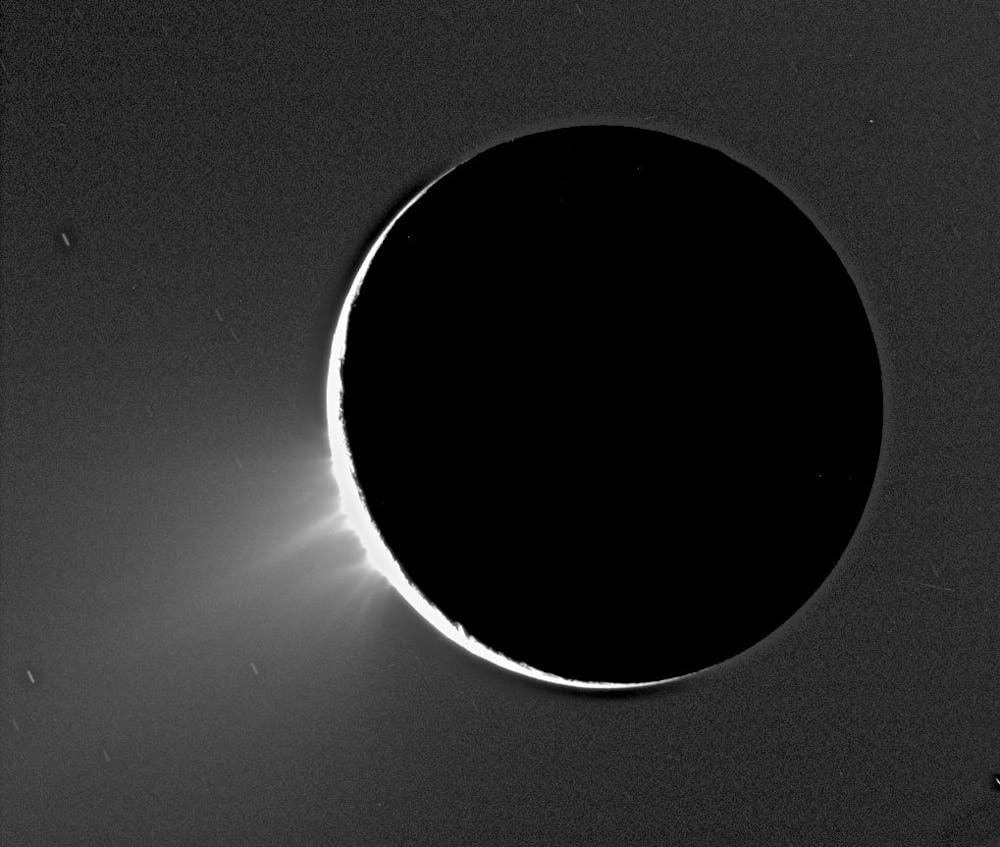 Fountains of water expel out from Saturn’s icy moon, Enceladus.
NASA/JPL/Space Science Institute
Fountains of water expel out from Saturn’s icy moon, Enceladus.
NASA/JPL/Space Science Institute
But for life as we know it to exist, you would need a planet where water exists in a liquid state. Otherwise your cells would freeze or boil away.
Earth is in a perfect position from our Sun to support water in a liquid state. Astronomers call this ideal location from a star the “habitable” or “Goldilocks zone”.
Scientists last year discovered that there is permanent liquid water on Mars, which made a lot of people very excited. Water is also inside craters on Mercury, and there are vast water oceans on some of Jupiter’s and Saturn’s moons.
But we still haven’t found life on Mars, or any other planet in our Solar System.
Read more: Curious Kids: What plants could grow in the Goldilocks zone of space?
What about outside our Solar System?
Planets outside our Solar System are called exoplanets. They orbit their own stars (as you know, our Sun is really just a big star).
For example, there is an exoplanet called Kepler-22b, which is in the habitable zone of another star called Kepler-22. Kepler 22b is bigger than Earth.
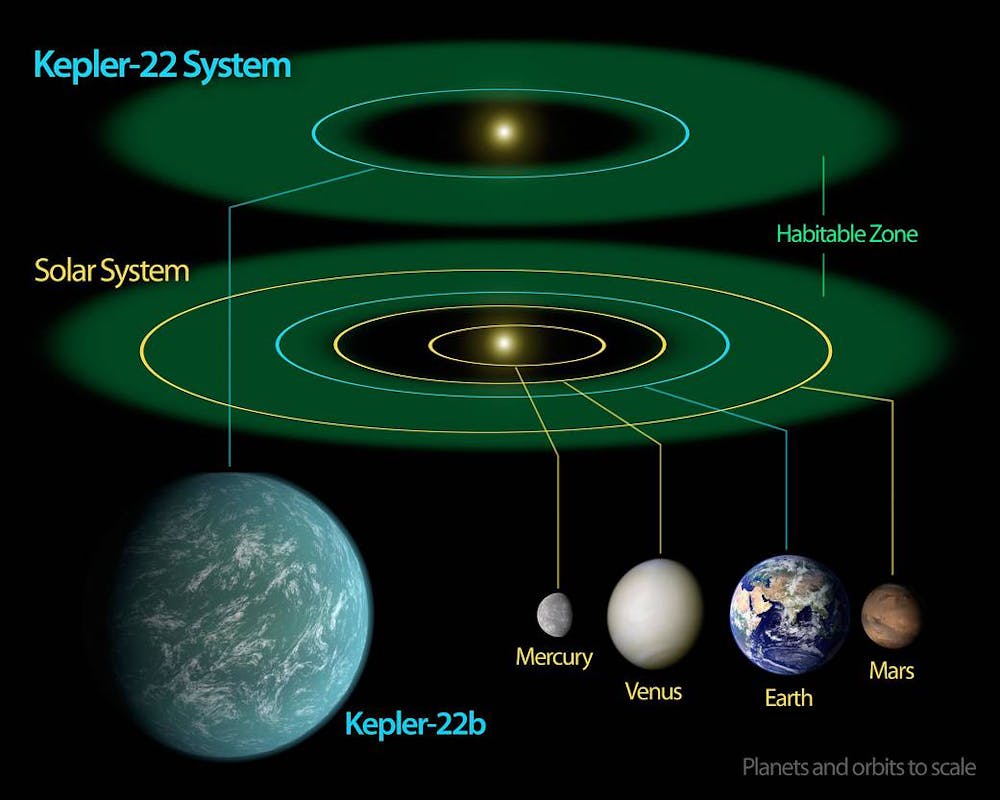 An artist’s depiction of Kepler 22b, an exoplanet in the habitable zone of a star called Kepler 22.
NASA/Ames/JPL-Caltech
An artist’s depiction of Kepler 22b, an exoplanet in the habitable zone of a star called Kepler 22.
NASA/Ames/JPL-Caltech
Fainter stars have habitable zones that are closer to them and brighter stars have their habitable zones further away.
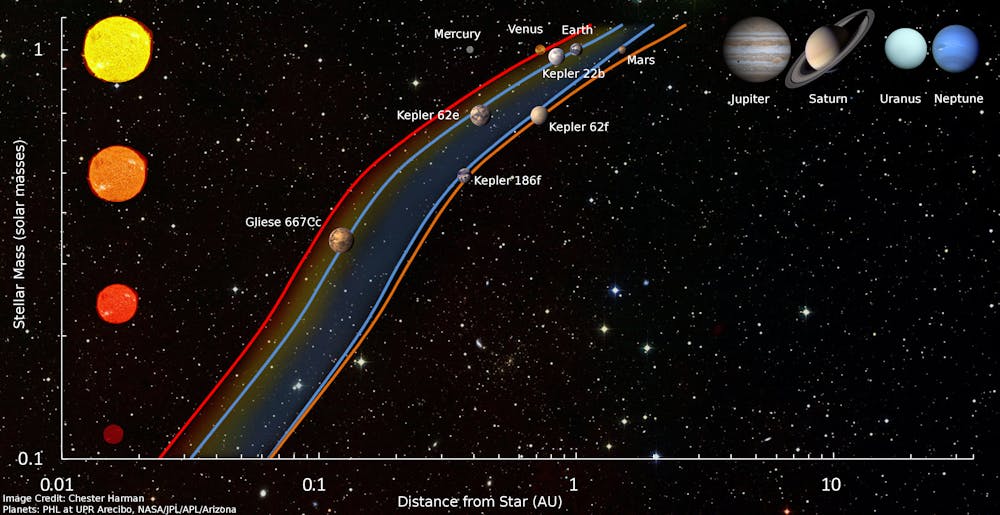 A star’s habitable zone (shown here between the orange and red lines) ultimately depends upon how bright and hot the star is.
Sonny Harman
A star’s habitable zone (shown here between the orange and red lines) ultimately depends upon how bright and hot the star is.
Sonny Harman
Finding a world within a star’s habitable zone where liquid water can exist would be a great start to finding life. Unfortunately, we have not perfected the technology for it yet.
But finding a planet with the right conditions for life isn’t enough; we need to be able to detect signatures of life itself (scientists call these “biosignatures”). For example, we can look at a planet’s atmosphere and see what gasses are in it. If we found a planet with lots of oxygen, we can infer there may be life there.
At the moment, it is not possible to detect biosignatures on Earth-like planets around others stars.
Maybe, Anna, you might be the one of the scientists who develops the technology that makes all this possible, and will discover the first inhabited world beyond Earth.
Read more: Curious Kids: what started the Big Bang?
Hello, curious kids! Have you got a question you’d like an expert to answer? Ask an adult to send your question to us. You can:
* Email your question to curiouskids@theconversation.edu.au * Tell us on Twitter by tagging @ConversationEDU with the hashtag #curiouskids, or * Tell us on Facebook
 CC BY-ND
Please tell us your name, age and which city you live in. You can send an audio recording of your question too, if you want. Send as many questions as you like! We won’t be able to answer every question but we will do our best.
CC BY-ND
Please tell us your name, age and which city you live in. You can send an audio recording of your question too, if you want. Send as many questions as you like! We won’t be able to answer every question but we will do our best.
Authors: Josh Calcino, PhD Candidate, The University of Queensland
Read more http://theconversation.com/curious-kids-why-has-nobody-found-any-life-outside-of-earth-105128


 Daily Bulletin


