

how to stop Australian miners abroad being linked to death and destruction
- Written by: Julia Dehm, Lecturer, La Trobe University
Australian companies dominate African mining. The Department of Foreign Affairs and Trade counts 175 ASX-listed companies operating in 35 African countries. Professional services company PwC reckons there are more than 200, and that “a golden age of Australia-Africa relations has begun”.
But Australian miners also arguably stand implicated in both human rights and environmental abuses in pursuit of Africa’s mineral wealth.
The Human Rights Law Centre has documented serious human rights abuses in the overseas operations of a number of prominent Australian companies. The International Consortium of Investigative Journalists has linked Australian mining operations to deaths, destruction and displacement across Africa.
Right now the spotlight is on a bitter dispute between local people in the Xolobeni region on the east coast of South Africa and an Autralian-created mining company that wants to excavate a strip of coastal land, 22 km long and 1.5 km wide, for titanium.
 The Xolobeni mine is about 200 km south of Durban in South Africa’s Eastern Cape province.
www.mineralcommodities.com
The Xolobeni mine is about 200 km south of Durban in South Africa’s Eastern Cape province.
www.mineralcommodities.com
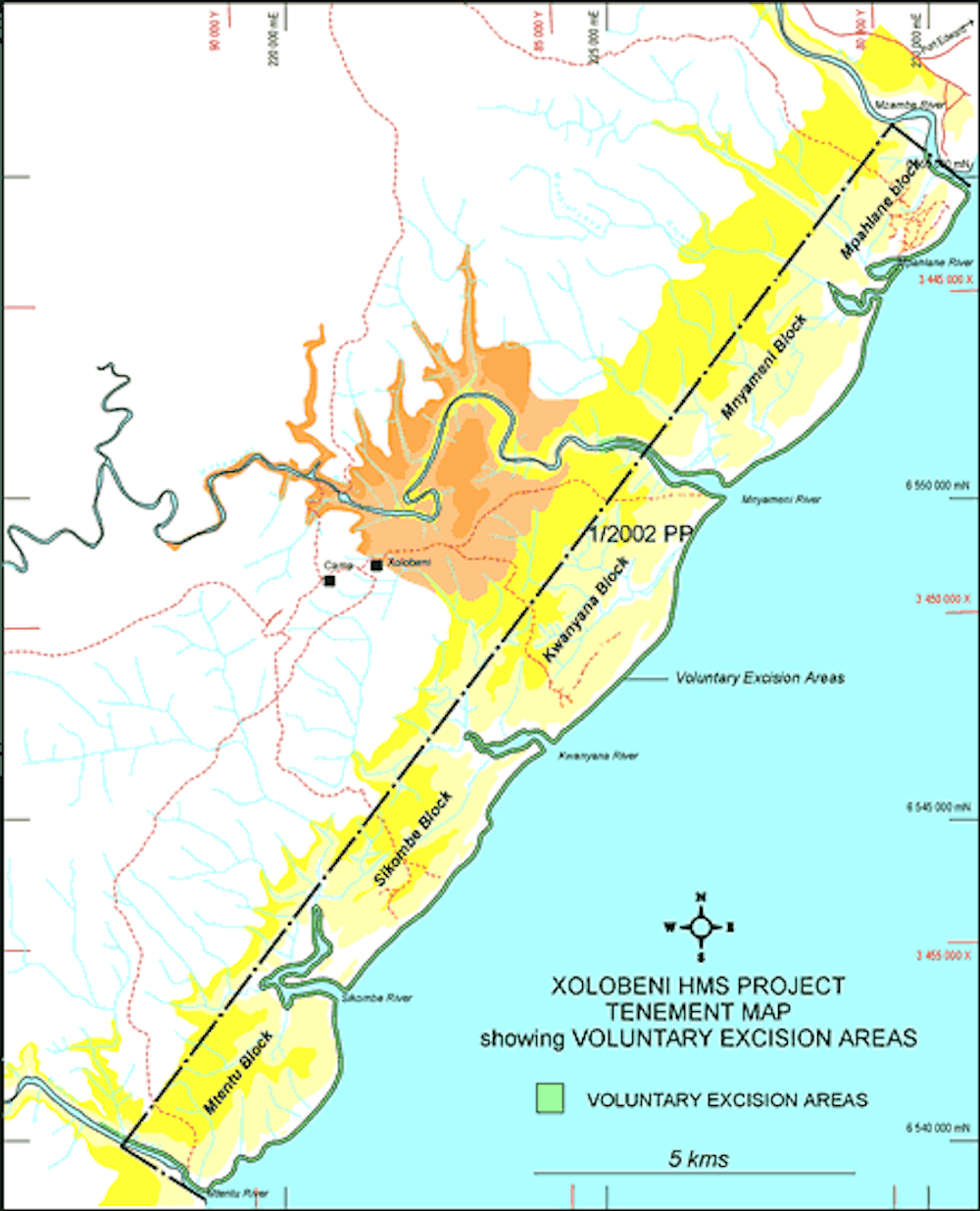 The proposed mine area is 22 km long and 1.5 km wide.
www.mineralcommodities.com
The proposed mine area is 22 km long and 1.5 km wide.
www.mineralcommodities.com
The mining company, Transworld Energy and Mineral Resources, was until 2016 a subsidiary of Australian company Mineral Commodities Limited. The local community’s fight against Transworld goes back more than a decade. Last week a “consultation” meeting ended with police firing stun grenades.
In November the mine’s opponents won an important legal battle when the High Court of South Africa (Gauteng Division, Pretoria) ruled the local community needed to give free and informed consent to the project.
The ruling was based on a specific South African law. But the right of Indigenous peoples to give free, prior and informed consent to projects affecting their lands is also recognised by the United Nations Declaration on the Rights of Indigenous Peoples.
Despite the Australian government endorsing the UN declaration – along with the UN Guiding Principles on Business and Human Rights and the OECD Guidelines for Multinational Enterprises, which also covers human rights obligations – there is no real legal obligation for Australian companies operating overseas to abide by such principles.
Conflict and consent
Transworld first sought the right to mine the Xolobeni territory in 2007. Locals formed the Amadiba Crisis Committee to oppose the mine shortly thereafter.
After Transworld filed a new application for mining rights in March 2015, the Amadiba Crisis Committee joined together with other groups and 89 residents to claim their rights to the land according to customary law. They filed their claim in March 2016.
Around the same time the Amadiba Crisis Committee’s chairman, Sikhosiphi Rhadebe, was shot dead at his home. No one has been arrested for his murder, so it’s impossible to say what motivated his killers. But the mine proposal has led to significant conflict within the community.
Read more: How South Africa's mining industry can change its ways
Some locals believe the mine will benefit them. Those opposed to the mine fear it will force them off their land, disrupt livelihoods based on agriculture and eco-tourism, and harm the community’s whole culture.
They point to the effects of similar strip-mining operations, such as Rio Tinto’s mine near Richards Bay, 400 kilometres north. The South African Human Rights Commission has documented adverse social, economic and ecological impacts across the country.
Under South Africa’s Mineral and Petroleum Resources Development Act, property holders only need to be “consulted” before a mining licence is granted. But Judge Annali Basson ruled in November that customary rights were guaranteed by the Interim Protection of Informal Rights to Law Act 1996.
Read more: Why South African community's win against mining company matters
This law, designed to protect those discriminated against during the apartheid era, provides that “no person may be deprived of any informal right to land without his or her consent”. On that basis the court ruled a mining right could not be granted unless the community made a communal decision to consent. The the minister for mineral resources is appealing the decision.
Lacklustre accountability
Australian human rights and environmental groups called on Mineral Commodities to drop its plans for Xolobeni back in May 2016. They also called on the Australian government to make companies more accountable for monitoring and enforcing human rights standards in their overseas operations.
The federal government has had a “National Contact Point” for the OECD Guidelines since 2002. But an independent review in 2017 found the initiative “significantly lacking”.
How the National Contact Point handled a submission from representatives of the Xolobeni community in 2013 demonstrates its limitations. It did not accept the complaint under the guidelines because the submission opposed all mining. This meant there was no community interest in a “mediation process that carries with it even the remotest possibility of accommodation between the mining company and local residents”.
In June 2017 the Australian government established an advisory group for implementing the UN Guiding Principles on Business and Human Rights. The group quickly recommended developing a national action plan, in line with international standards. But in October the government announced it was “not proceeding with a national action plan at this time”.
We can do better
Other countries are doing more.
France has introduced a “duty of vigilance” law requiring companies ensure their supply chains respect labour and other human rights.
In Switzerland there is a push for a constitutional amendment obliging Swiss companies to incorporate respect for human rights and the environment in all their activities.
Canada is soon to appoint an independent Canadian Ombudsperson for Responsible Enterprise to investigate allegations of human rights abuses linked to Canadian corporate activity overseas.
It’s increasingly recognised on a purely pragmatic level there are legal, reputational and financial risks if companies attempt to operate without community consent. Studies show the huge financial costs of conflicts with Indigenous communities, which can delay projects significantly.
Australia law makers, therefore, can do both local communities overseas and domestic investors at home a favour by putting in place adequate mechanisms to ensure Australian companies cause no harm overseas.
Authors: Julia Dehm, Lecturer, La Trobe University


 Daily Bulletin


