

why the 2 million target is on scientifically shaky ground
- Written by: Tim Doherty, Research Fellow, Deakin University
The Australian government’s target of killing 2 million feral cats by 2020 attracted significant public interest and media attention when it was unveiled in 2015.
But in our new research, published today in Conservation Letters, we explain why it has a shaky scientific foundation.
The target was developed for the Threatened Species Strategy. At the time of its launch in 2015, there was no reliable estimate of the size of Australia’s feral cat population. Figures of between 5 million and 18 million were quoted, but their origin is murky: it’s possible they came from a single estimate of feral cat density in Victoria, extrapolated across the continent.
A recent review estimated a much smaller population size — probably varying from 2 million to 6 million, depending on environmental conditions. Using this estimate, the proportion of Australia’s cat population to be killed under the government’s target is now likely in the range 32-95%, rather than 11-40% based on the original population estimate.
Read more: Australia's species need an independent champion
Targets for the removal of pest animals should consider how they will affect an animal’s current and future population size. But because a scientific justification for the 2 million target was never provided, it is unclear whether or how the revised estimate would alter the target.
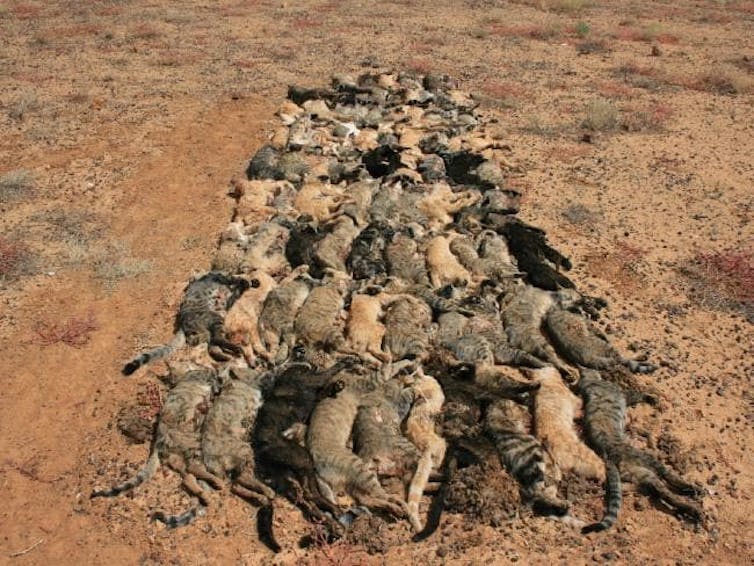 Feral cats culled in Queensland.
http://www.couriermail.com.au/news/queensland/news-story/746d8ad0366fe9f64ea9c26d36a41a37
Feral cats culled in Queensland.
http://www.couriermail.com.au/news/queensland/news-story/746d8ad0366fe9f64ea9c26d36a41a37
Hitting the target, missing the point
For cat control to have a lasting effect on feral populations, it needs to be intense, sustained, and carried out over large areas. This is because cats can rapidly reproduce and re-invade areas. To benefit threatened species, cat control also needs to be undertaken in areas that contain — or could potentially contain — native species that are threatened by cats.
Research commissioned by the government conservatively estimated that around 211,500 feral cats were killed in 12 months in 2015–16 (ranging between around 135,500 and 287,600). This estimate was used to report that the first-year target to kill 150,000 cats was met with room to spare.
The benefit to threatened species of achieving this target is unclear, because we don’t know if the control efforts had a measurable effect on cat populations; whether they took place in areas that would benefit threatened species; or how (or if) the target and related activities contributed to the estimated 211,500 cat deaths.
Around 75% of the killed cats were attributed to shooting by farmers and hunters. It is questionable whether such approaches could keep pace with high rates of population growth and re-invasion from surrounding areas.
These and other issues were known before the target was set, leading experts to recommend that an overall cat culling target should not be set.
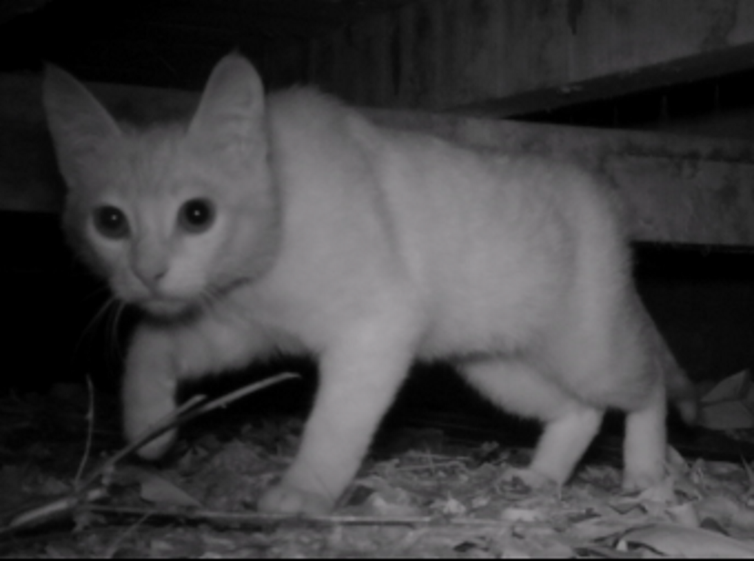 Cat image captured using camera traps in the Hawkesbury region, NSW.
Western Sydney University
Cat image captured using camera traps in the Hawkesbury region, NSW.
Western Sydney University
Shifting focus
The focus on killing cats risks distracting attention from other threats to native wildlife. These threats include habitat loss, which has been largely overlooked in the Threatened Species Strategy.
Habitat loss is politically sensitive because its main driver is the clearing of land to make way for economic activities such as agriculture, urban development, and mining. The strategy mentions feral cats more than 70 times, but habitat loss is mentioned just twice and land clearing not at all. Australia has one of the world’s worst rates of land clearing, which has recently increased in some regions. For instance, clearing of native vegetation in New South Wales rose by 800% between 2013 and 2016.
Read more: Let’s get this straight, habitat loss is the number-one threat to Australia's species
A focus on feral cats is warranted, but not at the expense of tackling other conservation threats too. A comprehensive, integrated approach towards threatened species conservation is essential.
Any upside?
Despite its questionable scientific basis, it is possible that the ambitious nature of the 2 million target has raised the public profile of feral cats as a conservation issue. However, to our knowledge, there has been no attempt to measure the effectiveness of the target in raising awareness or changing attitudes, and so this remains a hypothetical proposition.
Raising awareness about the negative impacts of cats on native wildlife is important.The Threatened Species Strategy has other targets that are more closely linked to conservation outcomes, such as the eradication of cats from five particular islands and the establishment of ten new fenced cat-free exclosures. Achieving these targets will make a small contribution to the culling target, but have a comparatively large benefit for some threatened species.
Read more: For whom the bell tolls: cats kill more than a million Australian birds every day
Australia’s target to kill 2 million feral cats is a highly visible symbol of a broader campaign, but the success of policies aimed at reducing the impacts of feral cats should focus squarely on the recovery of native species.
Authors: Tim Doherty, Research Fellow, Deakin University


 Daily Bulletin


