

Australia needs a national plan to face the growing threat of climate disasters
- Written by: Robert Glasser, Honorary Associate Professor, Australian National University
We are entering a new era in the security of Australia, not because of terrorism, the rise of China, or even the cybersecurity threat, but because of climate change. If the world warms beyond 2℃, as seems increasingly likely, an era of disasters will be upon us, with profound implications for how we organise ourselves to protect Australian lives, property and economic interests, and our way of life.
The early warning of this era is arriving almost daily, in news reports from across the globe of record-breaking heatwaves, prolonged droughts, massive bushfires, torrential flooding, and record-setting storms.
In a new special report from the Australian Strategic Policy Institute, I argue that Australia is not facing up to the pace of these worsening threats. We need a national strategy to deal specifically with climate disaster preparedness.
Read more: Explainer: are natural disasters on the rise?
Even without climate change, the impact of these natural hazards is enormous. More than 500 Australians – roughly the same number who died in the Vietnam War – die each year from heat stress alone. The annual economic costs of natural disasters are projected to increase to A$39 billion by 2050. This is roughly equivalent to what the federal government spends each year on the Australian Defence Force.
Climate change will dramatically increase the frequency and severity of many of these hazards. The number of record hot days in Australia has doubled in the past 50 years, and heatwaves have become longer and hotter. Extreme fire weather days have increased in recent decades in many regions of Australia. Shorter and more intense rainstorms that trigger flash floods and urban flooding are also becoming more frequent, and sea level has been rising at an accelerated rate since 1993.
Australians are already exposed to a wide range of the hazards that climate change is amplifying. Almost 4 million of our people, and about 20% of our national economic output, are in areas with high or extreme risk of tropical cyclones. Meanwhile, 2.2 million people and 11% of economic activity are in places with high or extreme risk of bushfire.
Chronic crisis
As the frequency of extreme events increases, we are likely to see an increase in events happening at the same time in different parts of the country, or events following hard on the heels of previous ones. Communities may weather the first few setbacks but, in their weakened state, be ultimately overwhelmed.
Large parts of the country that are currently marginally viable for agriculture are increasingly likely to be in chronic crisis, from the compounding impacts of the steady rise of temperature, drought and bushfires.
The scale of those impacts will be unprecedented, and the patterns that the hazards take will change in ways that are difficult to predict. Australia’s fire season, for example, is already getting longer. Other research suggests that tropical cyclones are forming further from the Equator as the planet warms, putting new areas of eastern Australia in harm’s way.
This emerging era of disasters will increasingly stretch emergency services, undermine community resilience, and escalate economic costs and losses of life. Federal, state and local governments all need to start preparing now for the unprecedented scale of these emerging challenges.
Queensland as a case study
Queensland’s recent experience illustrates what could lie ahead for all of Australia. Late last year, a major drought severely affected the state. At that time, a senior manager involved in coordinating the state’s rebuilding efforts following Cyclone Debbie commented that his team was in the ironic situation of rebuilding from floods during a drought. The drought was making it difficult to find water to mix with gravel and to suppress the dust associated with rebuilding roads.
The drought intensified, contributing to an outbreak of more than 140 bushfires. This was followed and exacerbated by an extreme heatwave, with temperatures in the 40s that smashed records for the month of November. Bushfire conditions in parts of Queensland were classified as “catastrophic” for the first time since the rating scale was developed in 2009. More than a million hectares of bush and farmland were destroyed – the largest expanse of Queensland affected by fire since records began.
Just days later, Tropical Cyclone Owen approached the Queensland coast, threatening significant flooding and raising the risk of severe mudslides from the charred hillsides. Owen set an Australian record in dumping 681 millimetres of rain in just 24 hours – more than Melbourne usually receives in a year. It did not, however, diminish the drought gripping much of the state.
A few weeks later, record rains flooded more than 13.25 million hectares of Northern Queensland, killing hundreds of thousands of drought-stressed cattle. As two Queensland graziers wrote at the time: “Almost overnight we have transitioned from relative drought years to a flood disaster zone.”
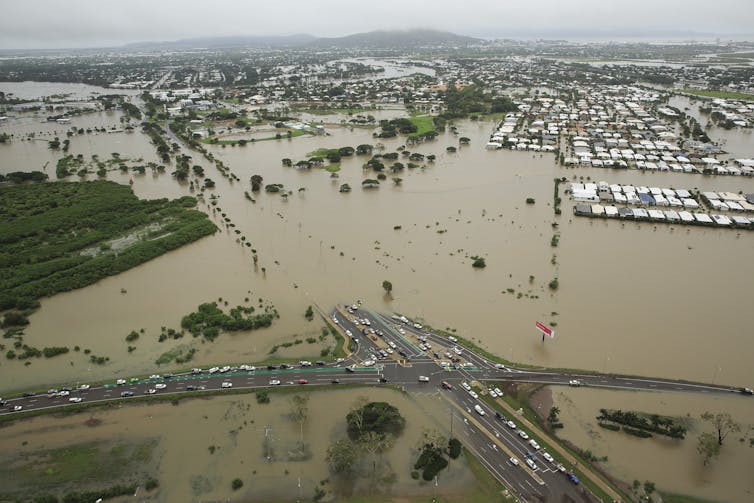 From drought to deluge.
AAP Image/Andrew Rankin
From drought to deluge.
AAP Image/Andrew Rankin
Time to prepare
We need to begin preparing now for this changing climate, by developing a national strategy that outlines exactly how we move on from business as usual and adopt a more responsible approach to climate disaster preparedness.
It makes no sense for the federal government to have two separate strategies (as it currently does) for disaster resilience and climate change adaptation. Given that 90% of major disasters worldwide are from climate-related hazards such as storms, droughts and floods, these two strategies should clearly be merged.
One of the prime objectives of the new strategy should be to scale up Australia’s efforts to prevent hazards from turning into disasters. Currently, the federal government spends 30 times more on rebuilding after disasters than it does on reducing the risks in the first place.
Read more: Properties under fire: why so many Australians are inadequately insured against disaster
Australia should be leading global calls for urgent climate action, not just because we’re so vulnerable to climate hazards, but also for traditional national security reasons. We are the wealthiest nation in a region full of less-developed countries that are hugely vulnerable to climate change. Shocks to their food security, economic interests and political stability will undermine our own national security.
No military alliance, deployment of troops or new weapon system will adequately protect Australia from this rapidly escalating threat. The only effective “forward defence” is to reduce greenhouse gases globally, including in Australia, as quickly as possible. Without far greater ambition on this front, the scale of the disasters that lie ahead will overwhelm even the most concerted efforts to strengthen the resilience of Australian communities.
This is an edited version of an article that originally appeared on The Strategist.
Authors: Robert Glasser, Honorary Associate Professor, Australian National University


 Daily Bulletin


