

young people need better parks to get out and play
- Written by: Deborah Ascher Barnstone, Professor, Associate Head of School, School of Architecture, University of Technology Sydney
Who wants to play sport in the mud and muck? Or have to climb a fence to play?
After an observational, private audit of the condition of Sydney sports facilities, we found that these are the types of choices young people face. To engage more young people in sport, we need to create environments that are youth-centred in terms of quality and accessibility.
Our audit found the quality of almost all of the 26 parks in Sydney’s inner west was substandard.
Read more: Our 'sporting nation' is a myth, so how do we get youngsters back on the field?
Toilet blocks were usually dirty, if available for use at all. Most playing fields were grassy, but with patches of dirt, worn areas and uneven surfaces with no proper water drainage. In many cases, painted lines were badly worn or missing. Court surfaces were in similar disrepair.
But a recent survey of 1,100 people aged 9-17 from the same area suggests design factors related to access, rather than poor-quality facilities, are even greater barriers to sport participation.
Designing better accessibility
We usually think of access in terms of disabled and elderly community members. But urban, neighbourhood and park design affect accessibility for every demographic. Access related to the cost of sport has been well studied and recently addressed in New South Wales with the voucher program, but the design aspects are equally important.
These include: public transport options, location, range of sports, adaptability to weather, lighting and after-dark security, and provision for the sports young people want to play.
Our research confirms the importance of accessibility. Of the survey respondents who were active, 77% said they play at a neighbourhood park, with 72% reporting they walk there.
But 52.2% said they cannot play the sport they’d like in their local area. And 64% reported that where they play is not accessible for unstructured play.
The state of Sydney’s parks
Most public sport facilities in Sydney’s inner west are located in public parks. While greenery around these sports fields and courts makes the environment more attractive, it’s more costly to maintain sport facilities than green space. With limited funds available, councils must prioritise. Since everyone can enjoy the greenery, funds usually go there first.
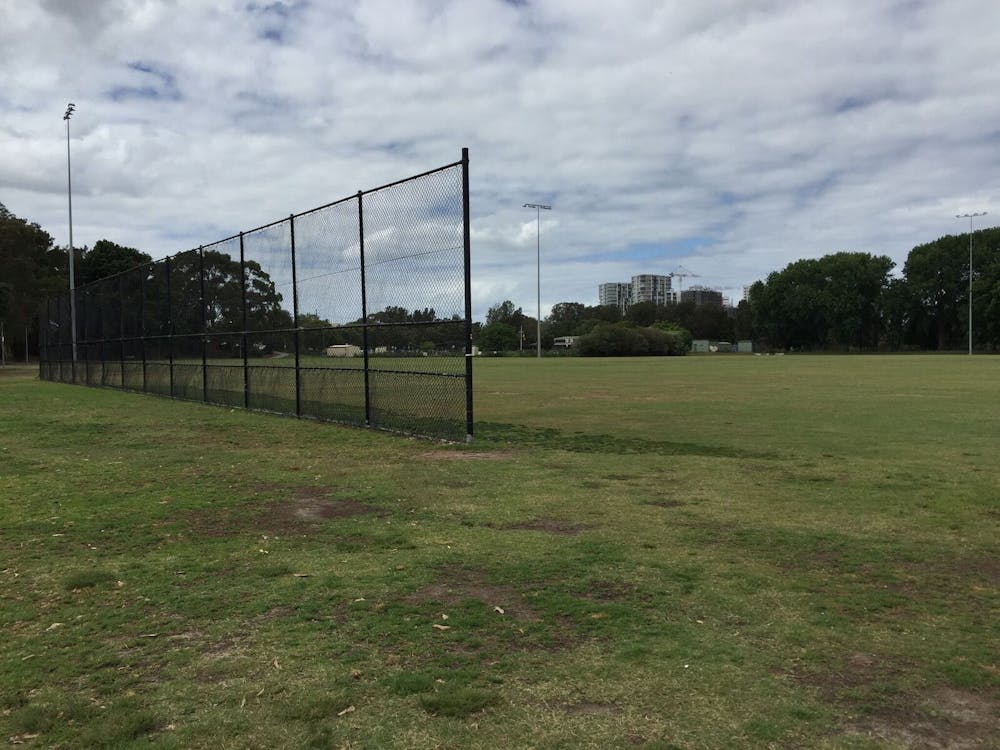 Patches of dirt, worn areas and uneven surfaces are common in the sport facilities in Sydney’s inner west.
Author provided, Author provided
Patches of dirt, worn areas and uneven surfaces are common in the sport facilities in Sydney’s inner west.
Author provided, Author provided
Almost all the parks we audited were largely without fencing or other barriers, which means that, in theory, anyone can use them at any time. Yet many young people complained about fenced and locked facilities, and fields dominated by club programs.
And while our audit found park maintenance to be below standard, most of the young people surveyed didn’t think so: 70% reported the place where they play is clean; 64% said it is well maintained; and 67% said it is safe.
This discrepancy suggests a difference between objective measures of quality and people’s experience of a place.
Design issues
Both perceived quality of and access to the environment can affect physical activity, and our data suggest access is more important for young people.
Being close to residential areas and public transport are important design features. To maximise use, parks and sport facilities must be integrated into neighbourhoods, rather than placed on their edges.
But of the 26 parks we studied only five had adequate public transport access. Five had no public transport access whatsoever. Many were on the edge, rather than in the middle, of a residential neighbourhood.
Read more: Pay to play: is participating in sport becoming too expensive for everyday Australians?
Facilities also tend to accommodate only one or two sports. This may mean they’re being underused and not attracting families with children of different ages or different sport interests.
Another related design issue is the lack of facilities that accommodate the weather. There are very few artificial fields and too many fields sited on floodplains. Only a handful of sport areas are covered to allow for play in bad weather. This was reflected in our survey, as only 36% of young people said they can play sport in any weather.
Parks don’t accommodate free play
Around half of all respondents participated in highly structured coach-led practice at least twice a week and 67.5% engaged in unstructured play for the same amount of time. This shows our parks and green spaces need to be designed for both structured sport and unstructured free play. But designs for unstructured free play are usually directed at young children not adolescents.
And although the audit found footpaths and parking lots were generally well lit, few sports fields had adequate lighting for play at night. Giving teenagers in particular, who are burdened with homework and time constraints, the opportunity to play at almost any hour should increase use.
So what would an ideal sports facility look like?
It would be located in the middle of a neighbourhood with several bus lines and other public transport stops connecting there for better access. Many different sports would be available. It would include a cafe for parents to hang out in and a playground for children who are too young to play sport.
Most importantly, it would be well maintained and beautifully designed so that people would want to be there.
Authors: Deborah Ascher Barnstone, Professor, Associate Head of School, School of Architecture, University of Technology Sydney


 Daily Bulletin


