

Performing Beethoven - what it feels like to embody a master on today's stage
- Written by: Scott Davie, Lecturer in Piano, School of Music, Australian National University
In a series marking the 250th year of his birth, we analyse the brilliance of Ludwig van Beethoven.
When Beethoven died in 1827, thousands of pages of highly notated music were bequeathed to posterity. Yet unlike arts such as painting and sculpture, which communicate directly from the artist to the observer, these otherwise silent pages demand resuscitation. They require performance.
From all accounts, Beethoven was an extraordinary pianist. In playing his own compositions, however, he combined two roles that are now necessarily separate: those of composer and performer.
How, then, might one recapture the essence of Beethoven’s music in modern times?
Playing the part
Performing music is akin to acting, where words by long-dead playwrights are given new life. It is a subtle art, honed over years, and is successful only when the “voice” of the performer finds alignment with that of the author, neither one cancelling out the other.
Similarly, the role of the performer is distinct and important when interpreting classical music. As with drama it has an added power, as both the content of the music and its performance can be art. When the two synthesise, great music can truly live.
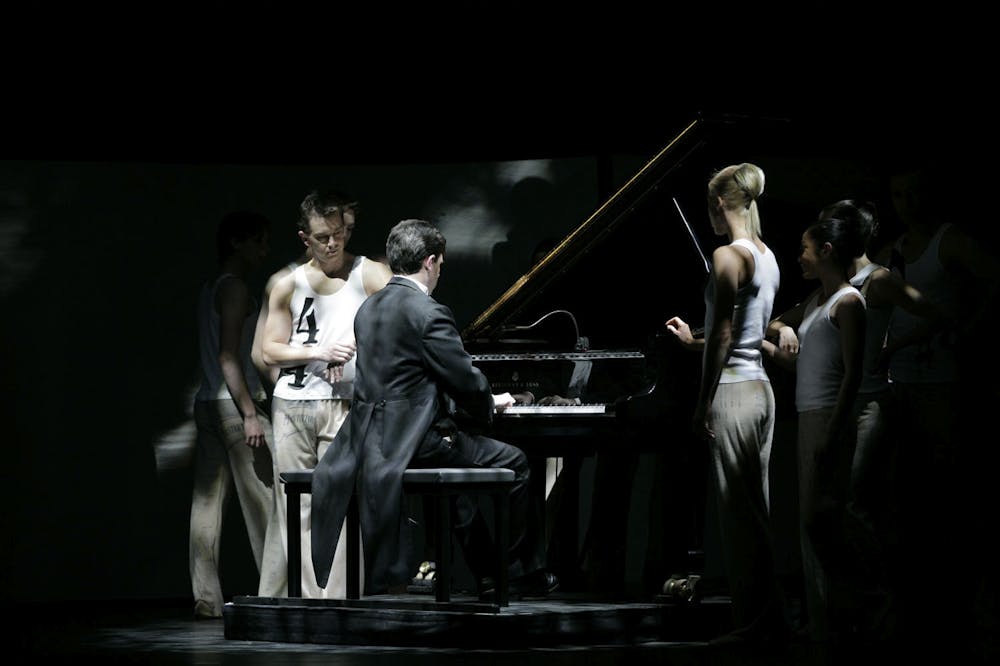 The author at the piano.
Sydney Dance Company/Jeff Busby
The author at the piano.
Sydney Dance Company/Jeff Busby
Finding a composer’s individual voice takes careful study, and Beethoven’s music is a notable case. He lived at a pivotal time, when the role of composers evolved from functionaries of courts and chapels to artists in their own right. Famously, he wrote some of the first music considered “absolute” - music conveying something of great significance, without reference to a programmatic story or other form of text.
Through decades of experience as a pianist, I’ve found Beethoven’s music requires a different approach to that of his Viennese contemporaries. With Mozart, it is often best to stand back, to let the composer do the talking. With Schubert one needs patience, and an empathy for moments of simple bliss.
By contrast, Beethoven’s music needs to be championed. One needs to grasp it with both hands, to join in the fight (so to speak), as the following three examples illustrate.
A virtuoso musician
Beethoven was a virtuoso at the keyboard, as much of his music attests. There are few works harder to perform at the piano than the famous Hammerklavier sonata, and great dexterity and flair are required in works such as the Waldstein and Appassionata sonatas.
Beethoven’s earliest sonatas are dedicated to Joseph Haydn, his “teacher” in Vienna. This could be read as a mark of respect, yet, more cynically, one suspects he was ensuring they caught his eye, for what follows is Beethoven trying to out-Haydn Haydn.
With unassuming simplicity, the C major sonata summarises brilliantly the thematic kernel of its opening movement in just four bars. Yet the phrase simultaneously presents a technical problem that stumps many pianists: clever fingering is required with the right-hand double thirds, or else they’ll never be crisp!
The movement’s following pages at times require the keyboard to be played as if invoking the force of a full symphonic orchestra, while other passages are more soloistic. The unexpected inclusion of a dramatic solo cadenza highlights further the cross-genre “tease” of the musical content.
It’s masterly stuff, and to succeed in performance it’s beneficial to understand the clever wit of its subtext. This includes both the quick moves between soloist and orchestral roles, and the furtive wink back to Haydn, which seems to say “See what I can do? I have no need of a teacher now”.
A philosopher
We don’t often credit the young as capable of profound sentiment, but many of Beethoven’s early works feature moments of the sublime.
Of note is the slow movement of the early Sonata in D major, written when he was 28. However seven years later, the slow movement of the Fourth Piano Concerto reveals Beethoven as a fully matured philosopher.
The orchestra begins with fierce outbursts, yet the piano is unmoved as it responds. At length, the pianist’s passivity and arching melodic lines gain dominance as the orchestra subsides, only to be momentarily undermined by a solo passage of trembling and unresolved harmony.
Eventually, all conflict resolves. As an exchange, the movement is dialectical in its structure. From the viewpoint of the pianist, it is like participating in Greek tragedy; it’s a role that must be played with great conviction for the powerful drama to succeed.
A modernist
Given Beethoven’s iconic status among audiences, it’s easy to forget he was a modernist. Even today, performers flinch at the original final movement of his late B flat major string quartet - a movement that still astounds in its dissonance, and which the composer felt obliged to replace.
Similar glimpses of music’s future lie in other late works, not least the quixotic final set of Bagatelles for piano, published in 1825.
In the last piece, the noisy opening recalls the closing bars of the Ninth Symphony, yet this is but a curtain-raiser to the music’s quiet core. The thematic material is disarmingly simple, consisting initially of offbeat, right-hand chords, while the harmony is rudimentary, the static left-hand part suggesting a rustic drone.
This is music that stretches notions of time, even, in places, apprehending minimalism. Yet moments of profundity are swept away, as it slips into a carefree waltz. The eschewing of complexity is prescient.
To perform this piece well is to be transported and transformed, the audience carried to the long-forgotten realm of a composer who, despite the stresses of his final years, appears to have found peace.
Like J. Alfred Prufrock in T. S. Eliot’s famous poem, it is as if we linger in “the chambers of the sea” for a while. Until the opening bars return to wake us, and we drown.
Authors: Scott Davie, Lecturer in Piano, School of Music, Australian National University


 Daily Bulletin


