

Deputy’s Shift Worker Happiness Index reveals high spirits among shift workers despite rising cost of living
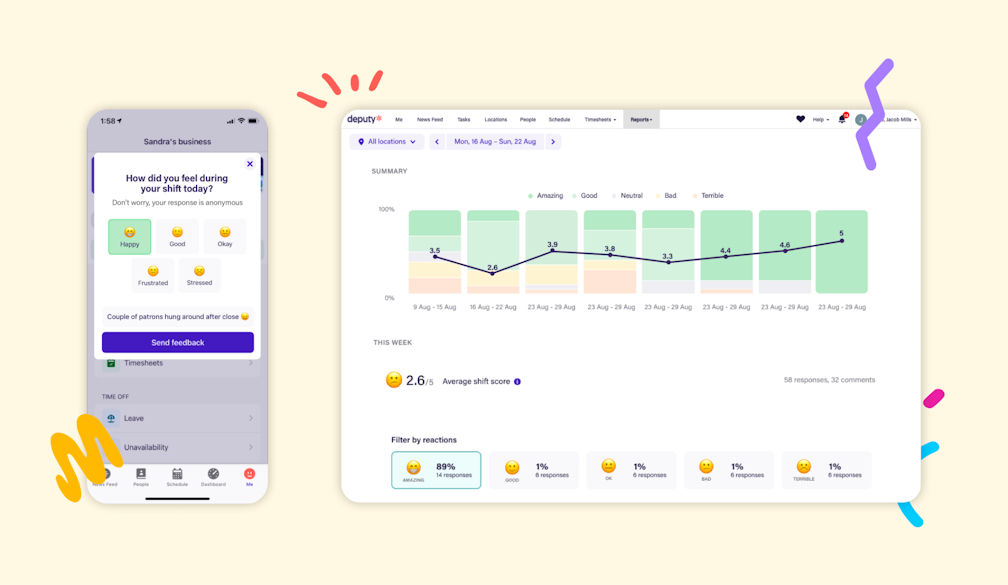
Despite the rising cost of living putting more pressure on hourly workers, data from Deputy’s first-ever Shift Worker Happiness Index shows Australian shift workers are feeling positive, with 83% stating they feel “good” or "amazing" after their shifts.
In healthcare, 40% of shift workers reported feeling “good” after their shifts this year, compared to 38% in the last quarter of 2022. Similarly, 56% of hospitality workers and 46% of services workers reported feeling "amazing" this year, compared to 53% and 37% reporting the same respectively in the last quarter of 2022. In the retail sector, happiness levels have stayed steady, with the same percentage of respondents reporting they felt "amazing" this year as compared to the last quarter of 2022.
Deputy’s Shift Worker Happiness Index measures the feelings hourly workers across these four industries have towards their work. This is the first instalment of the biannual report which tracks the sentiment of these workers using insights collected through Deputy’s Shift Pulse feature. The feature helps businesses easily capture continuous feedback from employees who are able to rate how they felt about their shift on a sliding scale, from “stressed” to "amazing". 846,440 Shift Pulse Survey responses from across Australia were analysed for this report.
Cafe, restaurant and logistics workers are among the happiest in Australia
In the first half of 2023, logistics, distribution, and freight workers were the happiest across all industries, with 93% of these workers either indicating they feel “good” or "amazing" after a shift. Similarly, 87% of delivery and postal service workers indicated the same.
In the hospitality sector, 88% of cafe workers and 87% of restaurant workers reported high spirits after their shifts. As business owners continue to grapple with labour shortages, workers across these two sectors have found themselves working an average of 191 and 163 hours per month respectively, above the full-time equivalent. Given the rising cost of living, the availability of shift work hours may contribute to these workers’ overall happiness levels.
Critical and emergency service workers are among the unhappiest
12% of critical and emergency services workers indicated they are “stressed” or “frustrated” after their shifts, compared to 4% across Australia more broadly. Over the years, these workers have consistently worked long hours, but the situation has become worse with time. While they worked significant overtime last year, putting in 30% more hours than were initially rostered in the first quarter of 2022, this number grew to 31% in the first half of 2023.
While it is clear employees who work significantly long hours are generally unhappy, the data also indicates employees who are being granted too few shift work hours are equally as unhappy.
In fact, retail workers in auto, electronics and appliance stores, who are being granted an average of four shifts a month (well below the average of 17 shifts across the retail sector more broadly) emerged as the unhappiest workers across the country. 15% of employees in this category reported feeling “stressed” or “frustrated” at the end of their shift.
Call centre workers also find themselves in a similar situation. While they are rostered to work an average of 12 hours per shift, workers in this sector are only working seven hours per shift on average, indicating many are being sent home early. This has resulted in 7% indicating they are “stressed” or “frustrated” after their shifts.
“As the cost of living increases, there is a clear appetite among Australian shift workers to put in extra hours at work. Generally, our data shows workers who are being granted more and longer shift work hours are happier. Of course, it is still important for business leaders to strike a balance between capacity and hours rostered, to avoid high levels of stress and burnout, as can be seen among critical and emergency service workers,” said Deepesh Banerji, Chief Product Office at Deputy.
“One way to do this is to schedule shifts in advance. By giving two weeks’ notice of upcoming shifts, workers have enough time to inform their managers should they be unable to commit to a shift and businesses will be able to plan ahead accordingly. This also gives employees the chance to plan their schedules around their personal lives. Amid the ongoing labour shortages across many industries, it’s the little things that make the biggest impact on reducing employee turnover,” he added.
Government workers contribute to low happiness levels in ACT
Happiness levels differed from state to state, with the happiest state being Tasmania, where 88% of workers indicated they feel "amazing" or “good”, closely followed by Northern Territory where 84% of workers indicated the same.
Conversely, the Australian Capital Territory emerged as the unhappiest state, with 6% indicating they are “stressed” or “frustrated”. When looking back at the data by industry sector, 11% of Government workers indicated a similar sentiment, contributing to the overall low levels of happiness in the state.


 Daily Bulletin


