

Callsign Value of Digital Trust Index Report reveals first ever economic value to building digital trust of US$3,000 GDP per capita
- Written by: Daily Bulletin
- Published in News from Asia
Study further found 79% of consumers in Asia Pacific want digital identity system
SINGAPORE - Media OutReach - 16 August 2022 - Callsign, the digital identity pioneer, has released a report quantifying for the first time the value of digital trust to society and the economy. The research reveals the potential to build growth during the current global economic slowdown with a five percentage point increase in digital trust resulting in an average increase in GDP per capita of US$3,000.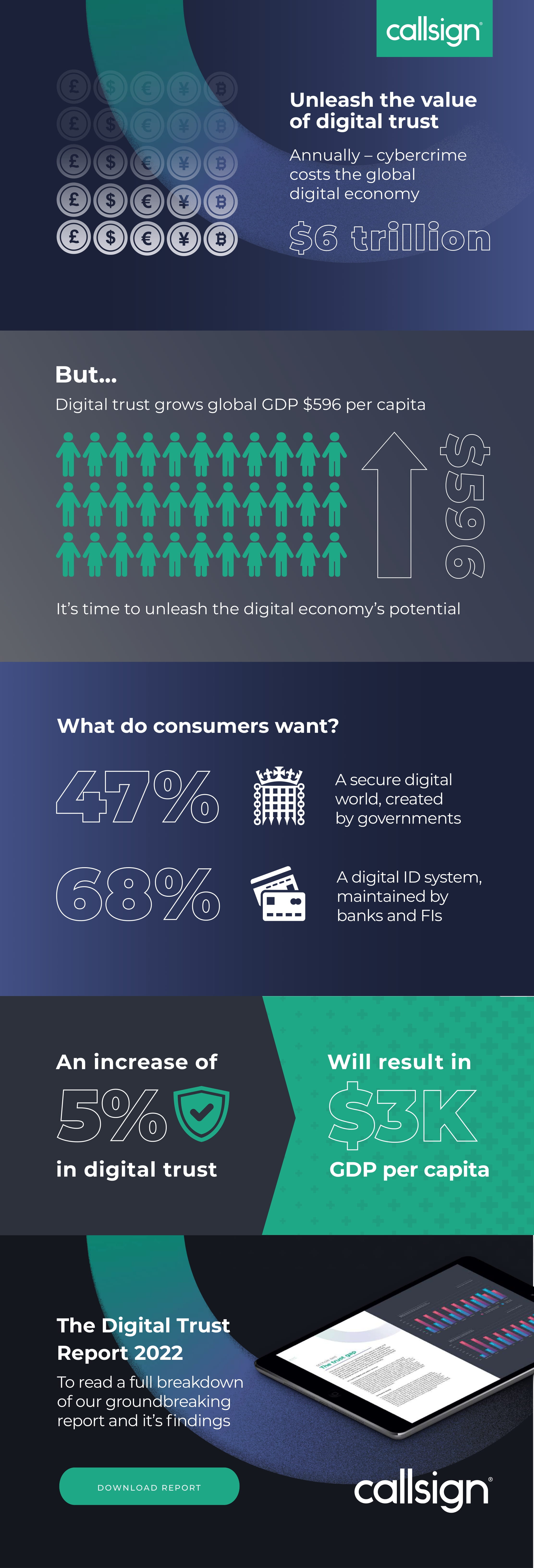
The findings are revealed in The Digital Trust Index: The value of digital trust Report, which is seminal research, conducted by Callsign, the digital trust pioneer, and the Centre for Economics and Business Research (Cebr), into the attitudes and drivers of digital trust across modern economies. The findings are significant if the global economy tips into recession because investing in building digital trust into digital economies has the potential to deliver growth and productivity.
From a global total of 12,500 respondents, 2,500 came from Hong Kong, India, Indonesia, the Philippines, and Singapore.
"This Callsign research reveals the value of building digital trust to the global economy, and reflects the conversations and enquires we are engaging in. Organizations across the globe are looking at digital identity as the foundation to their digital ecosystem– delivering trusted interactions for consumer-to-business as well as business-to-business interactions. The research also demonstrates the negative impact if the industry doesn't take proactive measures to address consumers' building lack of digital trust," says Julie Conroy, Head of Risk Insights at Aite-Novarica Group.
This increase in digital trust in Asia Pacific means a potentially significant increase to the size of the economy in the region. Critical to improving digital trust is the deployment of a regulated digital identity system.
Individual market GDP data points for APAC:
| | 1% increase in digital trust impact on GDP | 5% increase in digital trust impact on GDP |
| Singapore | US$3.4bn | US$17bn |
| Indonesia | US$161bn | US$807bn |
| Philippines | US$65bn | US$322bn |
Emerging digital trust gap
The report also found a 'digital trust gap' is emerging around the world. For APAC, the study found a positive digital trust gap, where digital trust is higher than societal trust.
Analysis found APAC markets have a positive digital trust gap of 5% while Western markets such as the US (-4%) had a negative trust gap (societal trust was higher than digital). This demonstrates that consumers in Asia Pacific have more trust in the digital economy than Western counterparts, offering potential economic advantage. 35% of APAC consumers surveyed claimed to have been affected by online fraud or a data breach which impacts their trust in online services.
Rapidly growing digital economy needs a regulated digital identity system
The digital economy is expected to grow to US$20.8 trillion* by 2025, while the cost of online crime to US$10.5 trillion.
With the rise in digital and online crime, 53% of APAC consumers expect governments to create a more secure digital world. 79% of APAC respondents support the creation of a digital identity system with almost a third saying banks and financial institutions are best placed to create and maintain the system.
Expectations in APAC of the deployment of a digital identity system quickly were much higher than other regions. 37% expect it to be rolled out in the next 12 months.
Namrata Jolly, General Manager Callsign, APAC said, "The opportunity in APAC from enhancing digital trust through digital identity is real and tangible. Consumers want and expect it to be part of their lives now. Their confidence in online experiences has improved in the last two years, which is the opposite response from consumers in Western markets.
This puts APAC at a real economic advantage as their levels of digital trust exceed societal trust. In the global digital economy, APAC appears poised to capitalise on the growth through the deployment of a secure and trusted digital identity system."
To see the full Digital Trust Index report, visit https://www.callsign.com/digital-trust-index.
Hashtag: #Callsign
The issuer is solely responsible for the content of this announcement.
About Callsign
Callsign is pioneering digital trust through proprietary technology that uniquely mimics the way humans identify each other in the real world.
Positive identification of genuine users delivers privacy, safety and minimal friction whilst ensuring that bad actors are blocked. Through a simple Swipe or Type, users can be personally recognized to a 99.999% accuracy, delivering the highest-fidelity AI-based user recognition for the digital world.
To learn more about how this technology is used to underpin digital trust across financial institutions, governments and commerce globally visit: https://www.callsign.com/
About The Centre for Economics and Business Research (Cebr)
The Centre for Economics and Business Research (Cebr) is an independent consultancy with a reputation for sound business advice based on thorough and insightful research. Since 1992, Cebr has been at the forefront of business and public interest research. They provide analysis, forecasts and strategic advice to major UK and multinational companies, financial institutions, government departments and agencies and trade bodies. For further information about Cebr please visit www.cebr.com.
Notes:
The methodology for this report involved conducting a survey to measure levels of trust in online and digital services across nine key regional markets. As part of the report, further questions were asked about trust in the wider society to be able to analyse differences and common trends.
APAC: 2,500 = Hong Kong 500, Singapore 500, Indonesia 500, India 500 and the Philippines 500
Brazil: 1,000
Canada: 2,000
Middle East: 2,000 (UAE 500, Kingdom of Saudi Arabia 500, Qatar 500, and Bahrain 500)
Nordics: 500
South Africa: 1,000
UK: 1,000
USA: 2,000
Footnotes
*In December 2021, the Global GDP estimate was US $94 trillion (Visual Capitalist) with the World Bank estimating that 15.5% of Global GDP in 2021 was the digital economy, meaning US $14.5 trillion. The World Bank also estimates that over the past 15 years, the digital economy has grown 2.5x quicker than the Global GDP . To calculate the value of the digital economy in 2025, we averaged global growth forecasts for 2022 from the IMF, World Bank and Fitch Ratings, which equalled 3.73%. Given that the digital economy grows 2.5x quicker than Global GDP, the digital economy's growth rate for 2022 was 9.33%.
Compounding this growth until 2025 meant that the digital economy would be worth US $20.8 trillion, while the Global GDP would be US $108.9 trillion. Therefore, the digital economy would account for 19.13% of Global GDP in 2025 an increase of 3.63% over 2021.
Given the current macroeconomic context these are clearly projections, which assume that the economy will continue to grow through 2025 with a significant economic downturn. Additionally, the value of the digital economy may in fact be a greater percentage of the Global GDP in years to come as our economy continues to benefit from digital innovation and more humans getting access and begin contributing to the digital economy. The above analysis was conducted by Callsign Corporate Strategy team.


 Daily Bulletin


