

Apical’s Entry to Sustainable Aviation Fuels Takes Flight with Cepsa to Build the Largest 2G Biofuels Plant in Southern Europe
- Written by: Daily Bulletin
- Published in News from Asia
SINGAPORE - Media OutReach - 17 April 2023 - Apical, through its renewable energy subsidiary Bio-Oils located in Huelva, Spain, has established a joint venture with Cepsa to produce second generation (2G) biofuels by constructing the largest plant in southern Europe.
The joint venture will entail an investment of up to €1 billion, one of the largest private investments in the history of the southern Spanish region of Andalusia. The alliance marks Apical's entry to the sustainable aviation fuels (SAF) market and a key milestone in RGE's strategy to produce a range of fuels to decarbonise aviation, maritime and land transportation. Apical, a leading vegetable oil processor, is a member of the Singapore-headquartered RGE group of companies. 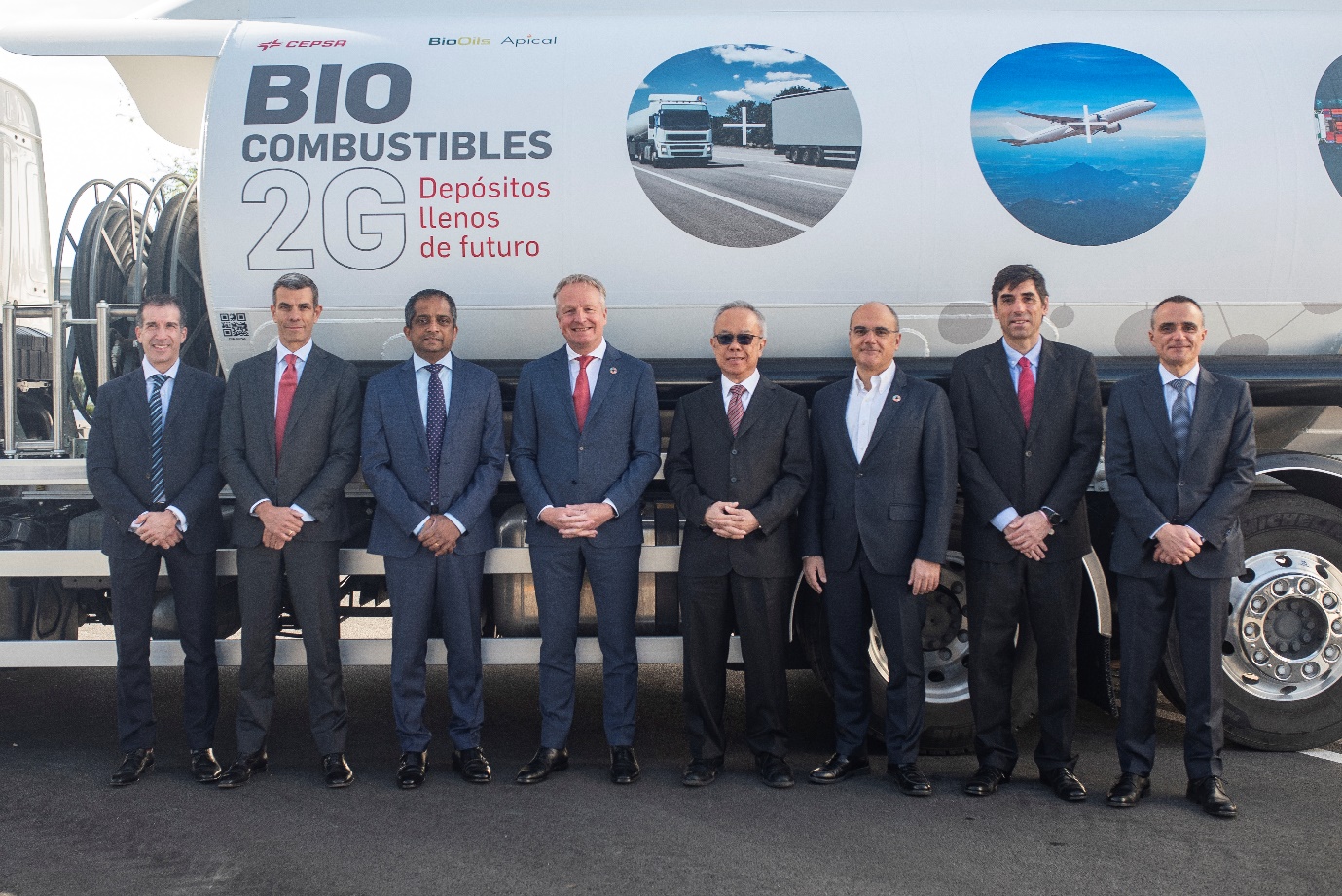
The new joint venture was announced at La Rábida Energy Park with the participation of Juan Manuel Moreno Bonilla, President of the Regional Government of Andalusia; Maarten Wetselaar, Cepsa CEO (fourth from the left); Oscar Garcia, Bio-Oils CEO (second from the right); Dato' Yeo How, President, Apical (fourth from the right); Pratheepan Karunagaran, Executive Director, Apical (third from the left); and Lamberto Gaggiotti, Head, Green Energy, Apical (first from the left).
The new plant, which is scheduled to begin operation in H1 2026, can produce up to 500,000 tons of SAF and/or renewable diesel annually, enabling the reduction of CO2 emissions by up to 90 percent, as compared to traditional fuels.
SAF is often viewed as a tool to a zero-emissions future. However, the key global challenge to the production of SAF is access to feedstock (renewable waste and residue raw materials). As a large global integrated processor of vegetable oils, Apical is able to efficiently and sustainably extract waste and residue from its supply chain and its processes in a transparent and traceable manner.
Through the joint venture, the plant will secure the majority of its feedstock supply from Apical's agricultural waste and residue through a global, long-term agreement. Cepsa will contribute its technical expertise and experience in the development of large industrial projects and fuel production; and knowledge of the European market and the decarbonisation goals of its customers in the transport sector. The facility will be located at Cepsa's La Rábida Energy Park in the Spanish province of Huelva.
Dato' Yeo How, President of Apical, said: "Apical's ample supply of high quality second generation feedstock is key to ensuring that the new joint venture delivers on our shared vision to reduce greenhouse gas emissions across air, sea and land transport. The wider use of SAF and renewable diesel provides significant benefits on a global scale, both in terms of mitigating the effects of climate change and promoting sustainable economic growth. Apical, through Bio-Oils, will ensure the supply of raw materials and contribute our own expertise in biofuels production."
The new facility will feature the latest technology for the production of second generation biofuels. Designed as a digital native plant, the new operation incorporates state-of-the-art technology including the latest industry advances in artificial intelligence, internet of things (IoT) and data analysis to maximise process efficiency, and ensure the highest standards of safety and environmental protection. By leveraging innovation, Apical is accelerating its sustainable operations in line with Apical2030's Pillar 3 (Green Innovation) of its strategic sustainability roadmap.
Pratheepan Karunagaran, Executive Director, Apical, said: "Aviation emissions account for 2-3 percent of global energy-related CO2 emissions and are expected to grow by 300-700 percent by 2050[1]. To reduce the direct carbon emissions of flying, SAF can be an immediate solution. A next-generation low-carbon fuel produced from 100% renewable waste and residue raw materials, it works seamlessly with existing aircraft engines and fuelling infrastructure. As the availability of waste and residue grows in tandem with the expansion of Apical's global footprint and capacities, we are able to create value-added partnerships for our waste stream in various parts of the world, especially in Asia."
With regard to the development of the SAF industry in Asia, Pratheepan commented: "SAF in Asia has much potential for growth and development. The good news is: as more countries begin to recognise the importance of sustainable practices and environmental responsibility, there is likely a greater focus on promoting the adoption of SAF throughout the aviation industry," he added.
Juan Manuel Moreno Bonilla, highlighted in his speech: "Cepsa has been investing in Huelva and Andalusia for almost 60 years and has been an active part and main player in the progress experienced in our land. Cepsa has made an outstanding contribution to our progress and to the creation of employment, with almost 8,000 direct and indirect jobs. Big bets like Cepsa's confirm that we are on the right track."
Maarten Wetselaar noted: "This alliance is a decisive step in our strategy to lead biofuels in Spain and Portugal and positions Andalusia as a European benchmark in sustainable energy production and circular economy. Second-generation biofuels are an immediate solution to support our customers' energy as they can be used in conventional engines, while enabling local development and increased energy autonomy in Europe."
Oscar Garcia said: "Cepsa has been Bio-Oils' largest customer for many years. We share many operational advantages, such as the proximity and interconnection of our facilities and the use of the Reina Sofía berth for the charge and discharge of our products. This new joint venture is a natural evolution of our relationship"
Hashtag: #Apical
The issuer is solely responsible for the content of this announcement.
Notes to Editors:
Apical is a leading vegetable oil processor with an expanding global footprint. Our vertically integrated mid-stream refining and value-added downstream processing makes us an integral supplier that supports the food, feed, oleochemicals and renewable fuel needs across industries. With integrated assets in strategic locations spanning Indonesia, China and Spain, Apical operates numerous refineries, oleochemical plants, renewable fuel plants and kernel crushing plants. Through joint ventures and strategic partnerships, Apical also has processing and distribution operations in Brazil, India, Pakistan, Philippines, Middle East, Africa, USA and Vietnam.
Apical's growth is built on the foundations of sustainability and transparency, and motivated by our strong belief that we can make a more meaningful impact even as we continue to grow our business and deliver innovative solutions to our customers.
***
Cepsa is a leading international company committed to sustainable mobility and energy with a solid technical experience after more than 90 years of activity. The company also has a world-leading chemicals business with increasingly sustainable operations.
In 2022, Cepsa presented its new strategic plan for 2030, Positive Motion, which projects its ambition to be a leader in sustainable mobility, biofuels, and green hydrogen in Spain and Portugal, and to become a benchmark in the energy transition. The company places customers at the heart of its business and will work with them to help them advance their decarbonization objectives.
ESG criteria inspire all of Cepsa's actions as it advances toward its net positive objective. Over the course of this decade, it will reduce its Scope 1 and 2 CO2 emissions by 55% and its carbon intensity index by 15-20%, with the goal of achieving net zero emissions by 2050.
***
Bio-Oils was founded in 2005 to develop biofuels projects, with the strategic objective to become a leading industry player in the Spanish and European biodiesel market. A member of the Singapore-based Apical group of companies, Bio-Oils´ wholly owned "La Rábida" Biodiesel Plant, located in Palos de la Frontera (Huelva), began operations in 2008 and today is one the most efficient plants in Spain, benefitting from a strategic location, with pipeline connections to vessel and tanker loading docks.
Through an ambitious R&D program, Bio-Oils has obtained wide experience in the production of high-quality biofuels from a broad variety of oils. The plant currently uses all available first-use oils, and has been adapted to process other residual raw materials. Committed to operating at the highest levels of sustainability, Bio-Oils is a member of APPA (Association of Renewable Energy Producers), FOSFA (Federation of Oils, Seeds and Fats Associations), EBB (European Biodiesel Board), EABA (European Algae Biomass Association), and AIQBE (Association of Chemical Industries, Basic and Energy of Huelva).
***
RGE, headquartered in Singapore, is a group of resource-based manufacturing companies with global operations. We produce sustainable natural fibres, edible oils, green packaging and clean natural gas used to create products that feed, clothe and energise the world. We help improve billions of peoples' lives through sustainable products they use every day. With more than US$30 billion in assets and 60,000 employees, we are creating a more recyclable, biodegradable and lower carbon future.
Committed to sustainable development, conservation and community development, we strive towards what is good for the community, good for the country, good for the climate, good for the customer, and good for the company. With current operations spanning across Indonesia, China, Brazil, Spain and Canada, we continue to expand and engage new markets.


 Daily Bulletin


