

Would you like to grow old at home? Why we’re struggling to meet demand for subsidised home care
- Written by: Michael Woods, Professor of Health Economics, University of Technology Sydney
The Royal Commission into Aged Care Quality and Safety is this week turning its focus to aged care in the home.
So far it has heard evidence of long waiting times to access home care services and a complicated system of fees. It’s only a matter of time before it questions the reasons behind those wait lists and fees.
Unlike aged care, access to many health care services is unlimited. Anyone can seek an appointment with their GP or turn up to a hospital emergency department, in most cases for free.
But the number of home care packages available to older Australians is capped, and the frail elderly are asked to foot some of the bill.
While some may argue to uncap the number of home care places, and replicate parts of the health system by providing free care for all, it’s not that simple. Governments will keep increasing the number of subsidised home care services in response to needs, but costs will also keep rising.
The challenge is to find the right funding balance between individuals and taxpayers, and for the system as a whole to remain sustainable.
Read more: Aged care failures show how little we value older people – and those who care for them
Why are many health services free?
Australia has a high standard of health care, which supports people to live to a longer, and generally healthier, old age.
Our Medicare system of funding is based on the principle of universal public health insurance which is paid for by the government (that is, the taxpayers). Public patients receive free care in public hospitals. Medical services by GPs and specialists are subsidised, as are many blood tests, X-rays and other imaging, allied health services (such as optometry), and most medicines.
In the year to September 2018, 86% of all GP attendances were “bulk billed” (provided at no cost to the patient).
These benefits, however, come at a cost. About 10% of Australia’s economic output (gross domestic product) is spent on health care and two-thirds of this is funded by governments.
And, of course, not all health services are free for most people. Visits to dentists, physiotherapists and others are regular reminders of this. A more equitable way of funding dental care is one of the emerging issues for the upcoming federal election.
Read more: Two million Aussies delay or don't go to the dentist – here's how we can fix that
What is home care?
Aged care plays a different role to health care in supporting people to stay at home. There are two forms of home care.
First, the Commonwealth Home Support Program assists with daily activities such as meals, transport and personal care (showering, dressing, and so on) and some allied health services such as physiotherapy and podiatry (foot care).
In 2016-17, around 723,000 people received one or more of these services.
Second, Home Care Packages provide expanded support, with daily activities as well as more complex health care from nurses and allied health workers.
At September 2018, there were over 90,000 people receiving one of the government’s subsidised Home Care Packages.
Why are many elderly asked to help pay for home care?
Australia’s population is ageing. In 2017 3.8 million Australians were aged 65 and over. In the next 40 years this will probably grow to 8.8 million. The costs of funding aged care will continue to increase.
In 2011, when one of us (Michael Woods) was the presiding commissioner on the Productivity Commission’s inquiry into aged care, we put forward three principles to help governments create a sustainable funding models for aged care:
accommodation and everyday living expenses should be the responsibility of individuals, with a safety net for those of limited means
health care services provided through aged care (such as nursing and allied health care) should be subject to charging arrangements consistent with those in the health care system
individuals should contribute to the cost of their personal care according to their capacity to pay, but should not be exposed to catastrophic costs of care.
The current fee arrangements broadly reflect the intent of these principles.
The government aims to keep fees for the basic Commonwealth Home Support Program at very affordable levels and has produced fee guidelines for providers. There are no formal income tests and while some providers do no more than seek a voluntary contribution for some services, others may recover around 10% of the cost of some services as direct fees or membership subscriptions.
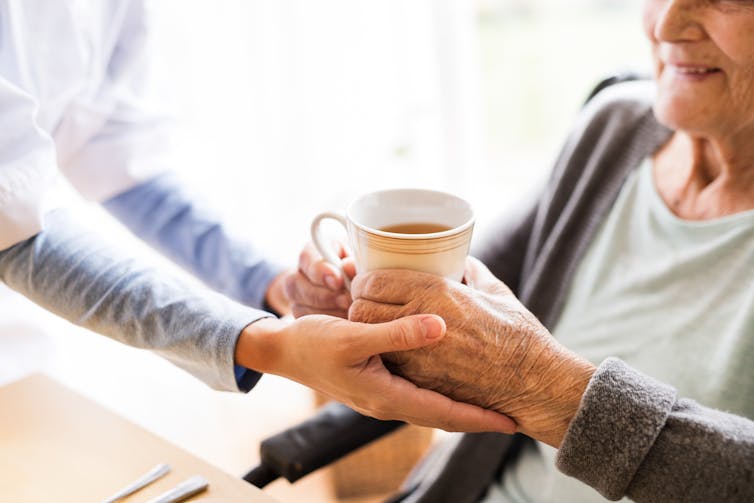 Many older people prefer to receive care at home rather than going into residential aged care.
From shutterstock.com
Many older people prefer to receive care at home rather than going into residential aged care.
From shutterstock.com
For the more complex and higher cost home care packages, providers can charge consumers a basic daily fee of 17.5% of the basic rate of the single age pension.
There is also an income-tested care fee, which recognises many older people have a greater capacity to contribute to the costs of their everyday living expenses. As a safety net for all, however, there are annual and lifetime caps on these fees.
Read more: Explainer: what is a home care package and who is eligible?
The home care system has many issues to address, but it is not in crisis
Despite the growing number of government-subsidised home care packages, the latest aged care statistics show that at December 2018 there were over 127,000 people on a national priority list for services that met their needs.
The wait time for some, sadly, is too long. However, some subsidised help is available for nearly all people on the list. Over 96% of people on the list had been offered, and were generally accepting, a lower level of subsidised support while they waited for a higher level of service.
There are also questions about how this queue is created and the assessment process itself that the royal commission may want to follow up.
For example, not all assessments and referrals to services are necessarily based on current needs. At December 2018, 96,000 people who were waiting for their approved level of home care package also had an approval for a permanent place in residential aged care. This suggests the assessment process may contain an element of anticipating future needs, rather than reflecting current needs.
Another concern with the current assessment process is a lack of focus by some assessors on helping older people to regain a level of independence through short-term “reablement” programs rather than adding them to the queue for ongoing services. As the Department of Health notes, a wellness and reablement approach in assessment and service delivery is not being consistently and effectively applied across the regions.
Read more: There is extra funding for aged care in the budget, but not enough to meet demand
For the foreseeable future we can expect the government to keep increasing the number of subsidised home care services, but it will also keep a careful eye on the balance between public and private funding, and seek to keep the overall cost to the elderly and to the budget within sustainable limits.
Authors: Michael Woods, Professor of Health Economics, University of Technology Sydney


 Daily Bulletin


