

Coral reproduction on the Great Barrier Reef falls 89% after repeated bleaching
- Written by: Morgan Pratchett, Professor, ARC Centre of Excellence for Coral Reef Studies, James Cook University
The severe and repeated bleaching of the Great Barrier Reef has not only damaged corals, it has reduced the reef’s ability to recover.
Our research, published today in Nature, found far fewer baby corals are being produced than are needed to replace the large number of adult corals that have died. The rate at which baby corals are settling on the Great Barrier Reef has fallen by nearly 90% since 2016.
While coral does not always die after bleaching, repeated bleaching has killed large numbers of coral. This new research has negative implications for the Reef’s capacity to recover from high ocean temperatures.
How coral recovers
Most corals reproduce by “spawning”: releasing thousands of tight, buoyant bundles with remarkable synchronisation. The bundles burst when they hit the ocean surface, releasing eggs and/or sperm. Fertilised eggs develop into larvae as they are moved about by ocean currents. The larvae settle in new places, forming entirely new coral colonies. This coral “recruitment” is essential to reef recovery.
Read more: Explainer: mass coral spawning, a wonder of the natural world
The research team, led by my colleague Terry Hughes from the ARC Centre of Excellence for Coral Reef Studies, measured rates of coral recruitment by attaching small clay tiles to the reef just before the predicted mass spawning each year. These settlement panels represent a standardised habitat that allows for improved detection of the coral recruits, which are just 1-2mm in size.
Almost 1,000 tiles were deployed across 17 widely separated reefs after the recent mass bleaching, in late 2016 and 2017. After eight weeks they were collected and carefully inspected under a microscope to count the number of newly settled coral recruits. Resulting estimates of coral recruitment were compared to recruitment rates recorded over two decades prior to the recent bleaching.
Australian Academy of Science.Rates of coral recruitment recorded in the aftermath of the recent coral bleaching were just 11% of levels recorded during the preceding decades. Whereas there were more than 40 coral recruits per tile before the bleaching, there was an average of just five coral recruits per tile in the past couple of years.
Read more: Tropical marine conservation needs to change as coral reefs decline
Reef resilience
The Great Barrier Reef (GBR) is the world’s largest reef system. The large overall size and high number of distinct reefs provides a buffer against most major disturbances. Even if large tracts of the GBR are disturbed, there is a good chance at least some areas will have healthy stocks of adult corals, representing a source of new larvae to enable replenishment and recovery.
Larvae produced by spawning corals on one reef may settle on other nearby reefs to effectively replace corals lost to localised disturbances.
It is reassuring there is at least some new coral recruitment in the aftermath of severe bleaching and mass mortality of adult corals on the GBR. However, the substantial and widespread reduction of regrowth indicates the magnitude of the disturbance caused by recent heatwaves.
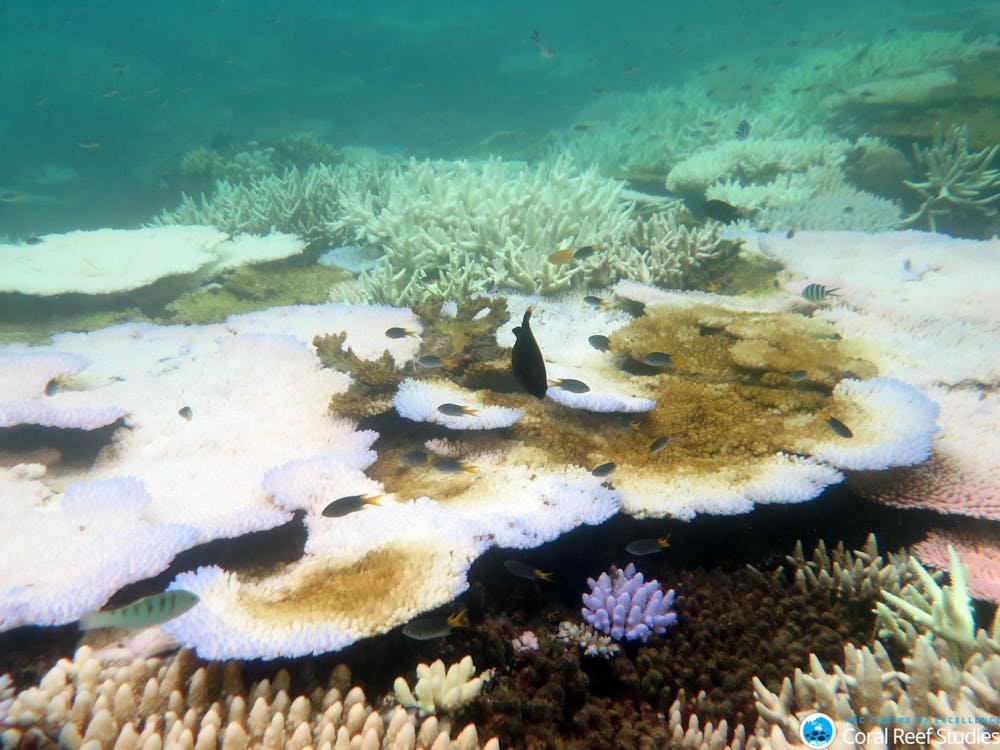 Reduction of coral regrowth shows the effects of recent heatwave disturbances.
Bette Willis
Reduction of coral regrowth shows the effects of recent heatwave disturbances.
Bette Willis
Declines in rates of coral recruitment were greatest in the northern parts of the GBR. This is where bleaching was most pronounced in 2016 and 2017, and there was the greatest loss of adult corals. There were much more moderate declines in coral recruitment in the southern GBR, reflecting generally higher abundance of adults corals in these areas. However, prevailing southerly currents (and the large distances involved) make it very unlikely coral larvae from southern parts of the Reef will drift naturally to the hardest-hit northern areas.
It is hard to say how long it will take for coral assemblages to recover from the recent mass bleaching. What is certain is low levels of coral recruitment will constrain coral recovery and greatly increase the recovery time. Any further large-scale developments with also greatly reduce coral cover and impede recovery.
Read more: The 2016 Great Barrier Reef heatwave caused widespread changes to fish populations
Reducing carbon emissions
This study further highlights the vulnerability of coral reefs to sustained and ongoing global warming. Not only do adult corals bleach and die when exposed to elevated temperatures, this prevents new coral recruitment and undermines ecosystem resilience.
The only way to effectively redress global warming is to immediately and substantially reduce global carbon emissions. This requires that all countries, including Australia, renew and strengthen their commitments to the Paris Agreement on climate change.
While further management is required to minimise more direct human pressure on coral reefs – such as sediment run-off and pollution – all these efforts will be futile if we do not address global climate change.
Authors: Morgan Pratchett, Professor, ARC Centre of Excellence for Coral Reef Studies, James Cook University


 Daily Bulletin


