

In Australia, climate policy battles are endlessly reheated
- Written by: Marc Hudson, PhD Candidate, Sustainable Consumption Institute, University of Manchester
This article is part of a series examining the Coalition government’s record on key issues while in power and what Labor is promising if it wins the 2019 federal election.
It might feel like the past decade of climate policy wars has led us into uncharted political waters. But the truth is, we’ve been sailing around in circles for much longer than that.
The situation in the late 1990s bore an uncanny resemblance to today: a Liberal-led government; a prime minister who clearly favours economic imperatives over environmental ones; emerging internal splits between hardline Liberal MPs and those keen to see stronger climate action; and a Labor party trying to figure out how ambitious it can be without being labelled as loony tree-huggers.
The striking parallels between now and two decades ago tell us something about what to expect in the months ahead.
Read more: Ten years of backflips over emissions trading leave climate policy in the lurch
After a brief flirtation with progressive climate policy in the 1990 federal election, the Liberals had, by the final years of the 20th century, become adamant opponents of climate action.
In March 1996, John Howard had come to power just as international climate negotiations were heating up. In his opinion, even signing the United Nations climate convention in Rio in 1992 had been a mistake. He expended considerable effort trying to secure a favourable deal for Australia at the crunch Kyoto negotiations in 1997.
Australia got a very generous deal indeed (and is still talking about banking the credit to count towards its Paris target), and Howard was able to keep a lid on climate concerns until 2006. But it was too little, too late, and in 2007 his party began a six-year exile from government as Rudd, then Gillard, then Rudd took the climate policy helm, with acrimonious results.
When Tony Abbott swept to power in 2013, his first act was to abolish the Labor-appointed Climate Commission, which resurrected itself as the independent Climate Council. Next, he delivered his signature election campaign promise: to axe the hated carbon tax (despite his chief of staff Peta Credlin’s later admission that the tax wasn’t, of course, actually a tax).
Read more: Obituary: Australia's carbon price
Abbott also reduced the renewable energy target, and sought (unsuccessfully) to keep climate change off the agenda at the 2014 G20 summit in Brisbane.
Abbott and his environment minister Greg Hunt did preside over some policy offerings – most notably the Direct Action platform, with the A$2.55 billion Emissions Reduction Fund at its heart, dishing out public money for carbon-reduction projects. The pair also announced an emissions reduction target of 26-28% on 2005 levels by 2030, which Australia took as its formal pledge to the crucial 2015 Paris climate talks.
But by the time nations convened in Paris, Malcolm Turnbull was in the hot seat, having toppled Abbott a few months earlier. Many observers hoped he would take strong action on climate; in 2010 he had enthused about the prospect of Australia going carbon-neutral. But the hoped-for successor to the carbon price never materialised, as Turnbull came under sustained attack from detractors within both his own party and the Nationals.
Then, in September 2016, a thunderbolt (or rather, a fateful thunderstorm). South Australia’s entire electricity grid was knocked out by freak weather, plunging the state into blackout, and the state government into a vicious tussle with Canberra. The dispute, embodied by SA Premier Jay Weatherill’s infamous altercation with the federal energy minister Josh Frydenberg, spilled over into a wider ideological conflict about renewable energy.
Read more: A year since the SA blackout, who's winning the high-wattage power play?
With tempers fraying on all sides, and still no economy-wide emissions policy in place, business began to agitate for increasingly elusive investment certainty (although they had played dead or applauded when Gillard’s carbon price was under attack).
In an era of policy on the run, things accelerated to a sprinter’s pace. Frydenberg suggested an emissions intensity scheme might be looked at. Forty-eight hours later it was dead and buried.
Turnbull commissioned Chief Scientist Alan Finkel to produce a report, which included the recommendation for a Clean Energy Target, prompting it to be vetoed in short order by the government’s backbench.
Within three months Frydenberg hurriedly put together the National Energy Guarantee (NEG), which focused on both reliability and emissions reduction in the electricity sector. The policy gained support from exhausted business and NGOs, but not from the Monash Forum of Tony Abbott and cohorts, who preferred the sound of state-funded coal instead. And then, in August 2018, the NEG was torpedoed, along with Turnbull’s premiership.
The next man to move into the Lodge, Scott Morrison, was previously best known in climate circles for waving a lump of coal (kindly provided, with lacquer to prevent smudging, by the Minerals Council of Australia) in parliament.
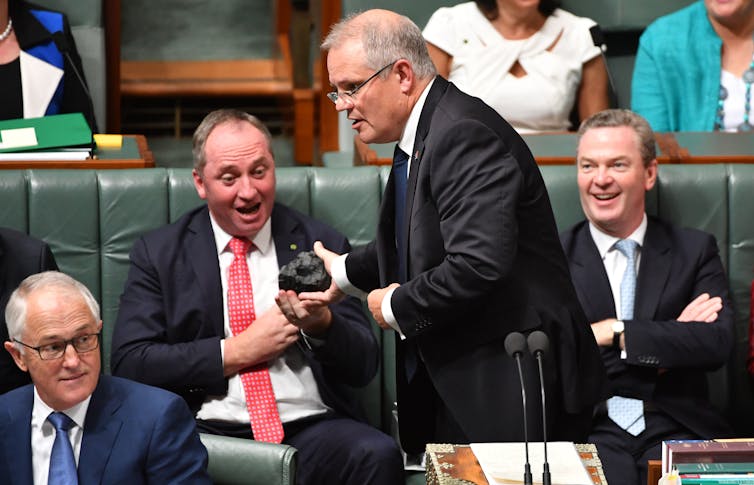 Scott Morrison’s new-found enthusiasm for Snowy 2.0 stands in contrast to his earlier excitement about coal.
AAP Image/Mick Tsikas
Scott Morrison’s new-found enthusiasm for Snowy 2.0 stands in contrast to his earlier excitement about coal.
AAP Image/Mick Tsikas
Read more: The pro-coal 'Monash Forum' may do little but blacken the name of a revered Australian
Morrison’s problems haven’t eased. His energy minister Angus Taylor and environment minister Melissa Price have each come under attack for their apparent lack of climate policy ambition, and Barnaby Joyce and a select few fellow Nationals recently endangered the fragile truce over not mentioning the coal.
Meanwhile, Labor, with one eye on the Green vote and another on Liberal voters appalled by the lack of action on climate change, are trying to slip between Scylla and Charybdis.
While Labor has decided not to make use of a Kyoto-era loophole (taking credit for reduced land-clearing), its newly released climate policy platform makes no mention of keeping fossil fuels in the ground, dodges the thorny issue of the Adani coalmine, and has almost nothing to say on how to pay the now-inevitable costs of climate adaptation.
What will the minor parties say? Labor’s policy is nowhere near enough to placate the Greens’ leadership, but then the goal for Labor is of course to peel away the Greens support – or at least reduce the haemorrhaging, while perhaps picking up the votes of disillusioned Liberals.
Overall, as Nicky Ison has already pointed out on The Conversation, Labor has missed an “opportunity to put Australians’ health and well-being at the centre of the climate crisis and redress historical injustices by actively supporting Aboriginal and other vulnerable communities like Borroloola to benefit from climate action”.
Read more: Labor's climate policy: a decent menu, but missing the main course
And so the prevailing political winds have blown us more or less back to where we were in 1997: the Liberals fighting among themselves, business despairing, and Labor being cautious.
But in another sense, of course, our situation is far worse. Not only has a culture war broken out, but the four hottest years in the world have happened in the past five, the Great Barrier Reef is suffering, and the Bureau of Meteorology’s purple will be getting more of a workout.
We’ve spent two decades digging a deeper hole for ourselves. It’s still not clear when or how we can climb out.
Authors: Marc Hudson, PhD Candidate, Sustainable Consumption Institute, University of Manchester
Read more http://theconversation.com/in-australia-climate-policy-battles-are-endlessly-reheated-114971


 Daily Bulletin


