

How to find a good restaurant? Economists can help
- Written by: Lionel Page, Professor in Economics, University of Technology Sydney
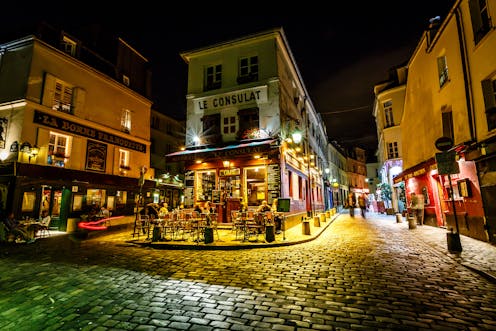
Where to eat? It’s a question you’ve probably pondered when visiting somewhere unfamiliar. Though it’s fun to explore a strange suburb, town or city, when you’re hungry you’d rather minimise the chance of paying exorbitant prices for an unpleasant experience.
Can economics help?
We’ve combined economic theory with data from online restaurant ratings to identify a few simple strategies that will help you find a decent restaurant in unfamiliar places.
Read more: Changing tastes: why foodies are the new food critics
The key? Location is almost everything – but in the opposite sense to what a real estate agent would have you think. When it comes to restaurants, quality of location is inversely correlated to quality of food and service.
Search costs
The first economic principle that’s important here are “search costs”.
If you’re from out of town, it’s likely your search strategy will involve looking for something appealing within walking distance of where you are staying. To decide if it’s appealing will involve walking past it.
Suppose you do this. Perhaps it not exactly what you wanted. Should you press on, looking for a better option?
It’s a risk. You may end up trudging around only to end back at the same spot 30 minutes later. Settling on the first restaurant you find may therefore be the best option to minimise search costs.
Economic theory provides a key insight about markets with search costs for customers. Businesses can take advantage of these costs to raise prices or lower quality. They can do this because they deal with more uninformed customers.
Consider a large city with tourist and non-tourist areas.
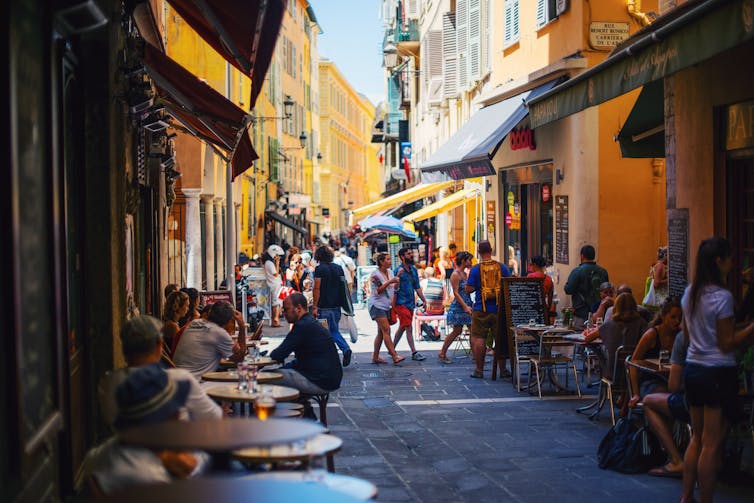 Being close to tourist hot spots increases the probability of food being lower quality and higher priced. Paul Rysz/Unsplash
In non-tourist areas, restaurants will rely on local customers. If they do not provide good food and prices, customers are likely to go elsewhere next time. A restaurant that satisfies its customers will get return business; one that doesn’t is more likely to go out of business.
In tourist areas, the situation is different. Visitors do not know the quality of each restaurant they encounter, and at best might be repeat customers for a few days. So restaurants can charge higher prices and serve lower quality food without much risk of harming long-term profits.
Big data to the rescue
To investigate how customer ignorance influences restaurants price and quality, we used data from Yelp, a major online platform where users rate restaurants.
Yelp has a global outreach that allowed us to investigate this question in cities all over the world, such as Paris, London and Sydney.
Read more: Perfect information: the customer reviews most likely to influence purchasing decisions
We mapped Yelp’s ratings onto topographical information from OpenStreetMap, an open-source repository of local information on streets and buildings.
What we found was exactly what was predicted by economic theory: restaurants in tourist areas have lower ratings than those in non-tourist areas.
Mapping Sydney
The map below presents the results for Sydney. You can see the valley of tourist points (the red dots) in the centre of the city generally align with average ratings. There are just a few cases of exceptional ratings near tourist attractions, such as around the Sydney Opera House.
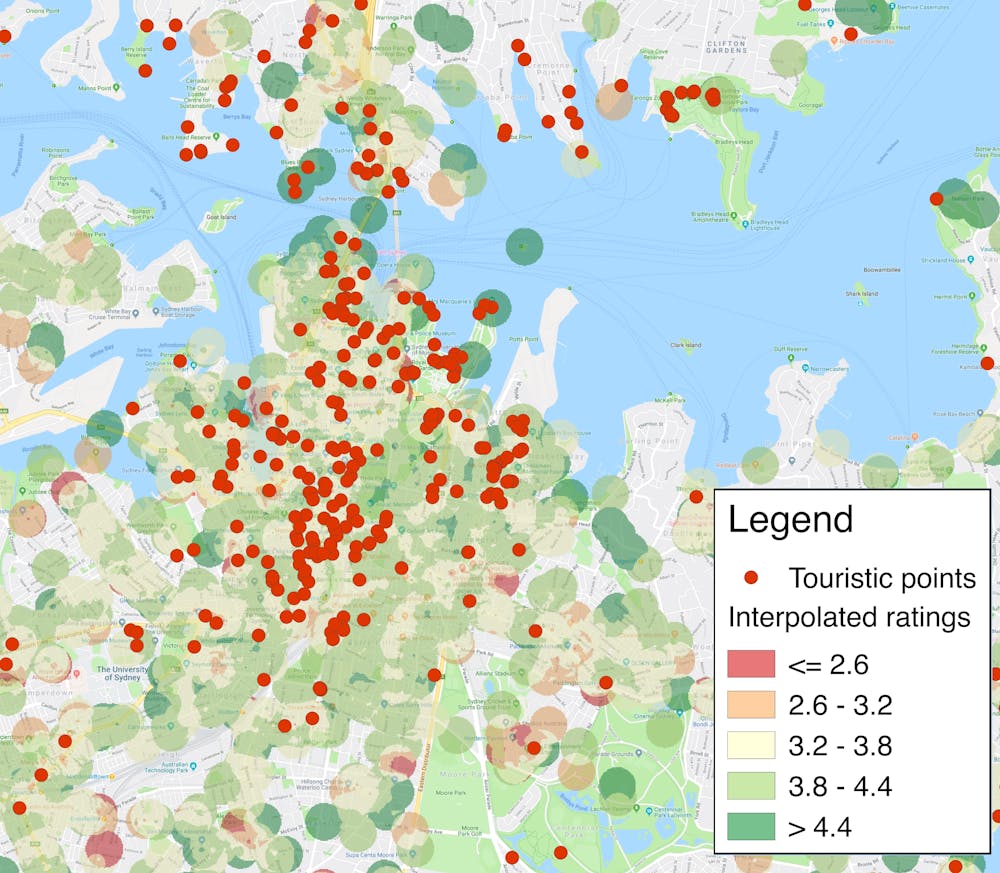 Sydney. Jeanne Dall'Orso, Romain Gauriot & Lionel Page
Mapping London
The pattern is even clearer in London, where areas with higher local ratings seem to be systematically away from touristic locations. Our map suggests that you’d be advised not to look for lunch around Victoria Station, near Buckingham Palace (in the southwest corner) or near the British Museum (northwest from the centre of the map).
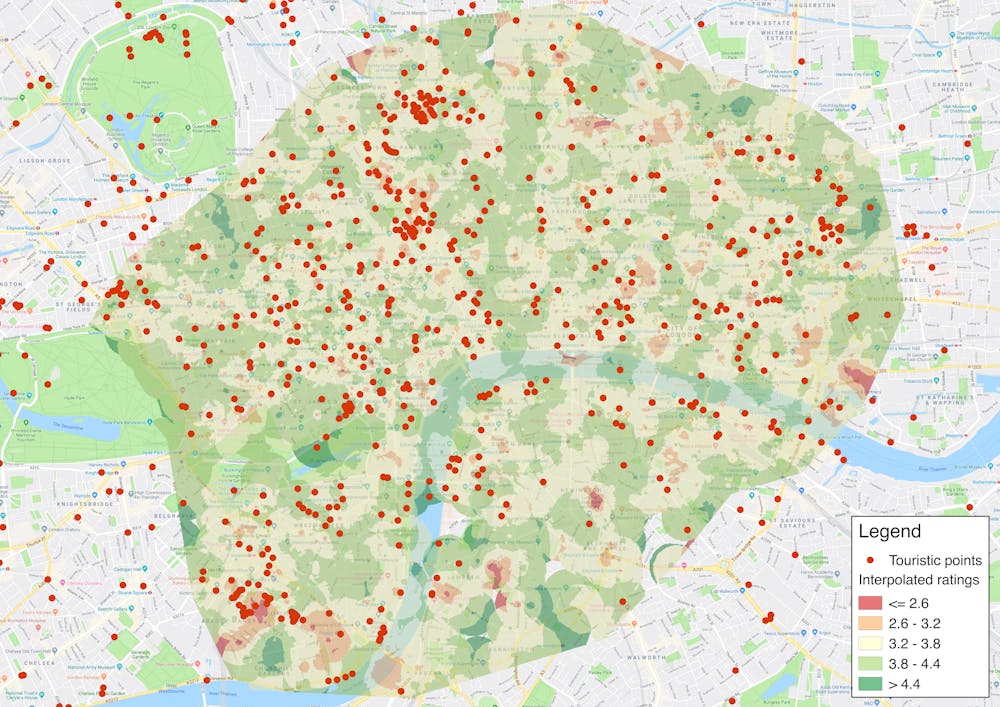 London. Jeanne Dall'Orso, Romain Gauriot & Lionel Page
Mapping Paris
Finally this Paris map suggests you are advised to venture away from all the landmarks you know – Eiffel Tower, the Sacré-Cœur Basilica, the Louvre – when looking for some good French food. Definitely steer clear of the area around the Paris-Gare de Lyon train station.
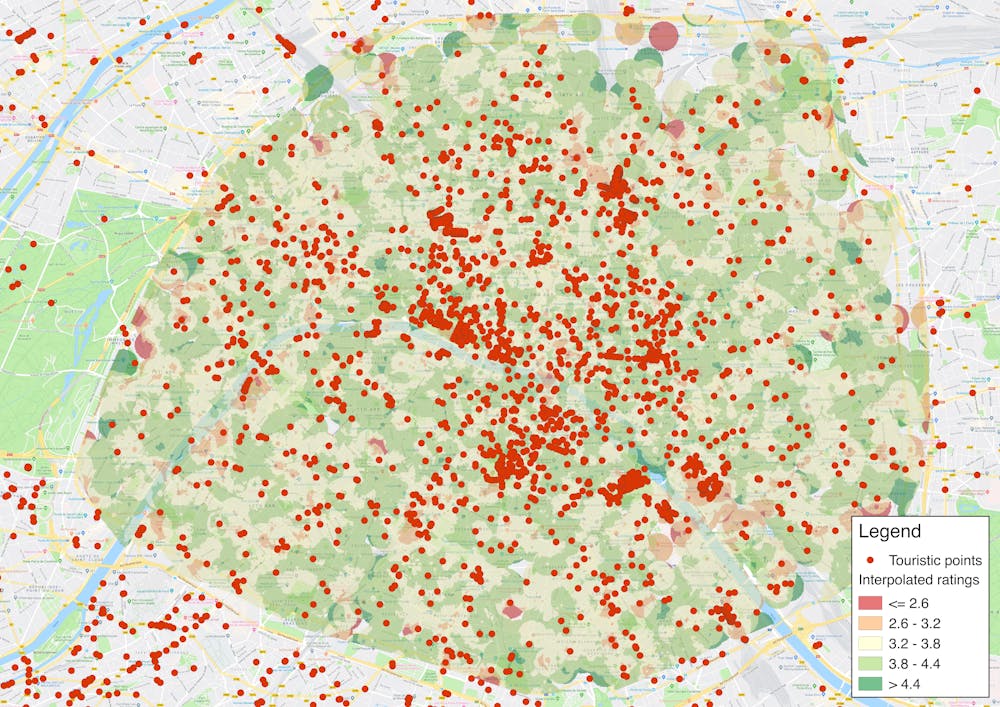 Paris. Jeanne Dall'Orso, Romain Gauriot & Lionel Page
Visibility trap
The existence of tourist traps may come as no surprise. If you’ve ever gone sight-seeing in a big city, you know there are restaurants whose business is based on attracting tourists, and that they are often pricey and ordinary.

Small restaurants, away from the tourist traps of inner city, are often the perfect places to chow down. Dominic Dreier/unsplash
This insight goes beyond just restaurants. In economic terms, any time a business deals with uninformed customers, higher prices and lower quality is more likely.
A key characteristic to attract uninformed customers is visibility. A restaurant on a main road or busy thoroughfare, for example, can be found by potential customers simply walking around.
To test whether restaurants with high visibility are indeeed more likely to offer worse deals, we looked at restaurants that were more visible but not necessarily in touristic locations.
We focused on corner restaurants – visible to pedestrians from two streets instead of just one.
Again we looked at Yelp ratings, and again the effect was there: corner restaurants had lower average ratings. The largest effect was for corner restaurants on big avenues in tourist areas, where average restaurant ratings were more than 0.2 stars (out of 5 stars) lower.
Chain reactions
Though our results show Restaurants Brisbane in tourist areas and in visible locations are generally more likely to offer worse quality and prices, there are some caveats.
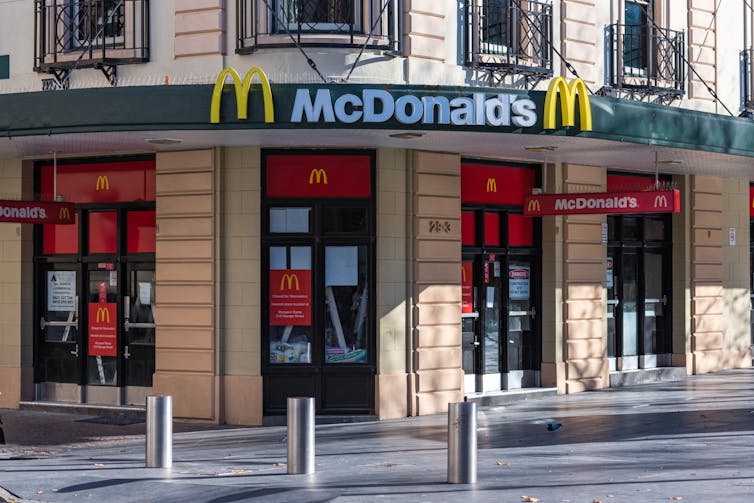 An advantage of fast-food franchises is that they tend to provide the same quality across locations. www.shutterstock.com
Economic theory suggests chain restaurants should have more incentive to keep the standard their consumers are used too, even if located in visible locations.
A customer dissatisfied by the food/service of one chain restaurant is less likely to come back to the chain elsewhere. Corporate headquarters can therefore not allow individual franchises to use a visible location to lower quality or raise prices.
This economic prediction was also confirmed in our data: restaurants that belong to a chain are not rated significantly lower in visible locations.
Find the hidden restaurants
So our advice is the following:
You maximise your chance of finding a fantastic dining experience by stepping away from the beaten tracks. Whether searching online or on foot, look for the “hidden restaurants” tucked away on side streets and the like. Avoid the establishments with huge garish signs that are clearly pitching themselves to tourists.
Your second-best option, when in doubt, is to look for a chain restaurant as a “safe haven” in a touristic location. Such establishments are unlikely to offer you a surprising experience, one way or other other. What you expect is probably what you’ll get.
But when it comes to restaurants, the better option is usually around the corner.
This article was co-authored by Jeanne Dall’Orso, who now works as a data scientist for Masae Analytics in Paris. Jeanne also co-authored the 2016 paper Disappointment looms around the corner: Visibility and local businesses’ market power with Lionel Page and Romain Gauriot.
Authors: Lionel Page, Professor in Economics, University of Technology Sydney
Read more http://theconversation.com/how-to-find-a-good-restaurant-economists-can-help-117670


 Daily Bulletin


