

Stop worrying about screen 'time'. It's your child’s screen experience that matters
- Written by: Brittany Huber, Postdoctoral researcher, Swinburne University of Technology
Most (80%) Australian parents worry children spend too much time with screens.
But what children are doing on and off screen matters more than how much time they’re exposed to screen media.
Too much time?
There was a time when society was concerned about children reading. If kids are reading, how will they complete their chores or homework?
The fear that time spent with media replaces other “acceptable” activities of childhood is often referred to as the displacement hypothesis. One such concern is that screen time occupies time spent in physical activity.
Read more: What is physical activity in early childhood, and is it really that important?
Because screen time is often sedentary, researchers have investigated whether it displaces the time children spend being physically active. But the relationship between screen time and physical activity is not straightforward.
 Spending time using a screen doesn’t automatically mean less time on physical activity.
from shutterstock.com
Spending time using a screen doesn’t automatically mean less time on physical activity.
from shutterstock.com
Low levels of screen time do not always equate to higher levels of physical activity. And when there is a relationship between more screen time and less physical activity, it’s often a result of excessive daily screen time.
The Australian guidelines on physical activity and sedentary behaviour advise children under two avoid screen time entirely. But a nationally representative poll conducted by the Royal Children’s Hospital found 63% of children aged two and under had screen exposure.
For children aged two to five, the Australian guidelines encourage parents to limit the time children spend with screens to no more than one hour a day. The child health poll found around 72% of children in this age group exceeded this recommendation.
Read more: Look up north. Here's how Aussie kids can move more at school, Nordic style
So, most Australian families are exceeding the guidelines, which are essentially built on a premise that isn’t clear-cut. Not all screen time is “bad”.
Is screen time bad?
A 2004 study from the United States explored the average time children spent watching television per day when they were aged one and three, and whether this affected their attention span in later years.
They found watching TV in the early years was associated with a higher risk of attention problems when these children were seven. But the research didn’t test the types of programs the children were watching.
In 2007, the same researchers looked at the effects of the content children watched. They found an association between watching violent or entertaining television such as Scooby Doo and Rugrats before the age of three and an increased risk of attention problems five years later. __
But there was no such association when it came to educational content such as Sesame Street.
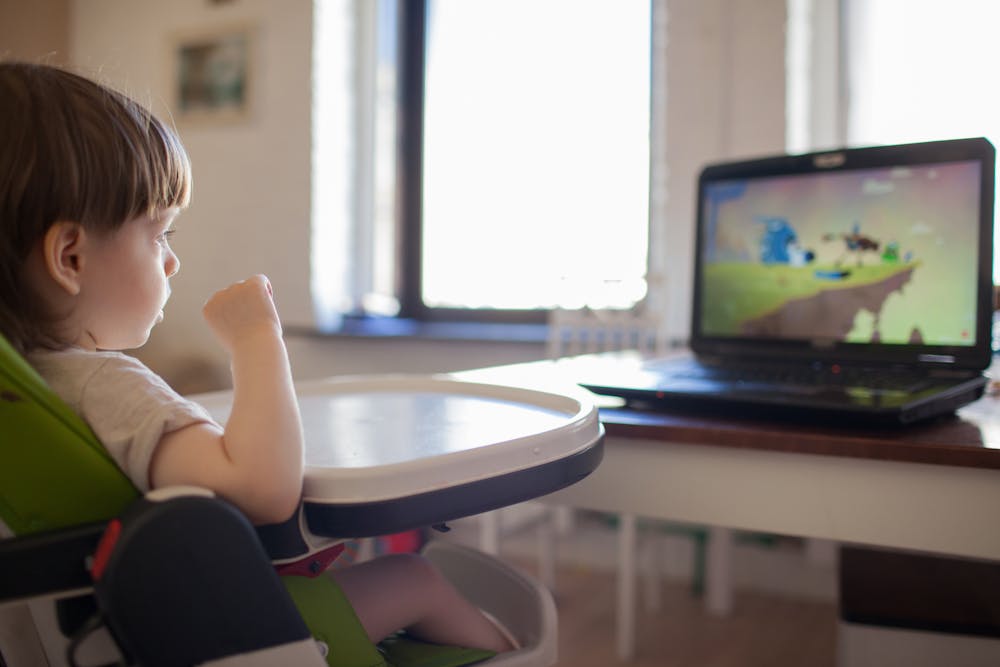 Educational content is better than entertainment.
from shutterstock.com
Educational content is better than entertainment.
from shutterstock.com
So, content plays a role, but the child’s age also matters. In this same study, the type of content viewed by four- and five-year-olds did not affect their attention five years later.
The above studies describe changes over time. But other studies looked at the immediate effects of different screen content on children’s executive functioning – the thinking required to problem solve and stay on task.
Read more: Two-hour screen limit for kids is virtually impossible to enforce
These studies found exposure to educational content didn’t hinder children’s subsequent executive functioning. But these abilities were depleted in four- and six-year-olds who had just watched fast and fantastical shows that played with the bounds of physics and reality.
What if you use screens with your children?
Decades of television research has shown children under three years old learn better from live interactions than from two-dimensional sources. So, these young children have little to gain from screens in the absence of a parent or peer.
Television meant for adult audiences, as well as television on in the background, disrupts the quality of children’s play and parent-child interactions that are critical for early language and social development.
The adverse effects of this type of screen exposure are due to limiting both the frequency and quality of interactions between child and caregiver. In the presence of background television, parents are less attentive and responsive to their child.
Read more: Let them play! Kids need freedom from play restrictions to develop
Parents’ own device use can be detrimental to the interactions they have with their children. Smartphone use can cause parents to be less attentive and responsive to their children.
All this is important to be mindful of, especially during the early years when these interactions directly contribute to language learning and social skills.
But what about if a parent uses a screen together with their child?
A 2014 study found preschoolers’ storybook comprehension and parent-child interactions did not significantly differ between a traditional book and an electronic book.
However, the quality of play and parent-child interactions are reduced with electronic toys as compared to traditional toys.
So, what screen time is OK?
To have healthy, positive, quality screen media experiences, parents could ask the following questions:
Is the screen content
optimally challenging (meaning not too difficult or too easy)?
engaging (does it have age-appropriate features that maintain attention and invite participation)?
meaningful (can children relate the content to their lives)?
interactive, in the physical or social sense. Young children can actually form relationships with screen characters, which improves their learning. Older children can engage virtually in worlds such Minecraft, then talk about it in school.
Sharing the screen experience with an adult has benefits too. These include helping children understand the content and having an adult direct learning and ask questions.
The best way to engage in screen time with your children is to talk about it, ask questions and create opportunities to take the screen into the 3D world.
And, importantly, model the media use behaviour you want your children to adopt.
By occasionally employing the “digital babysitter”, you are not dooming your children’s success. What children are doing matters just as much, if not more, than how long they’re doing it for.
Parents can find more information about creating positive screen media experiences at:
Authors: Brittany Huber, Postdoctoral researcher, Swinburne University of Technology


 Daily Bulletin


