

Crossing Several European Borders? How to Keep Your Phone Working the Whole Trip
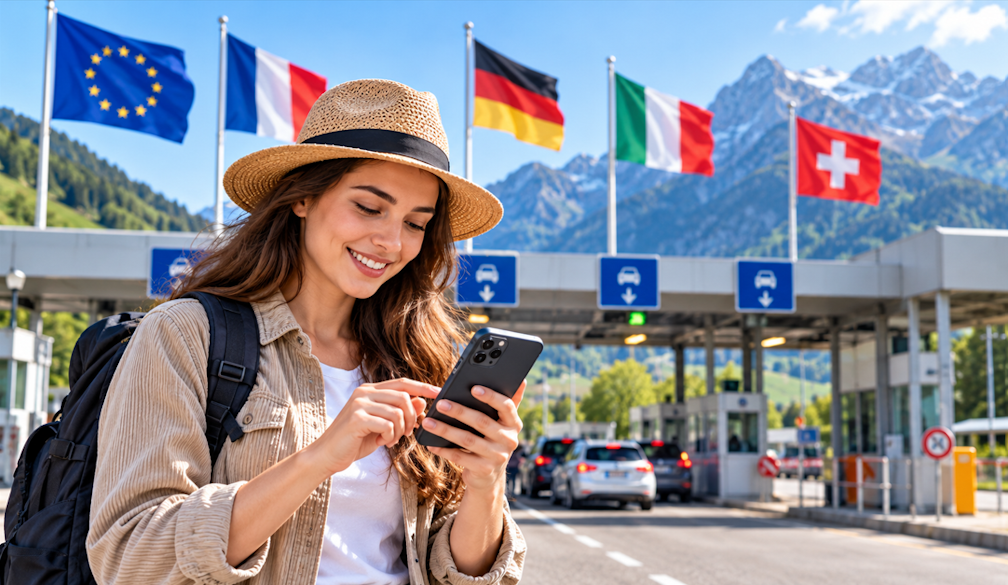
A multi-country trip through Europe can cross three borders in a day. Take the coach from Split to Dubrovnik and you pass through a short stretch of Bosnia and Herzegovina at Neum before re-entering Croatia. Drive on to Kotor and you are in Montenegro by lunch. Each crossing can mean a new mobile network, a different roaming rate and a phone that has quietly stopped loading maps.
For Australian travellers, the safest approach is to decide how you will get data before you leave and to check that your choice covers every country on the route. If your phone supports eSIM and is carrier-unlocked, a regional Europe eSIM lets you install one plan at home that covers several countries. Check the plan's country list, data allowance and validity before buying, as coverage and inclusions vary between plans.
What EU Roaming Rules Mean for Australians
You may have heard that phones work across Europe at no extra cost. That applies to people with a plan from a European operator. Under the EU's "roam like at home" rules, a subscriber based in an EU country can use their plan in other EU countries, as well as Iceland, Liechtenstein and Norway, at domestic rates, subject to fair-use limits. The EU's guide to mobile roaming costs sets out who the scheme covers and how those limits work.
An Australian SIM sits outside the scheme. When you use your Australian number in Europe, your carrier's international roaming rates apply, and they may differ from one country to the next. Read your carrier's roaming page for each country you plan to visit, including whether calls, texts and data are charged separately.
Know Which Countries Are Outside the EU
The EU and the Schengen Area are not the same map, and neither matches every itinerary. If you are already sorting travel insurance that covers every Schengen country, apply the same country-by-country check to your phone plan. Some destinations popular with Australians, such as Estonia and Bulgaria, are EU members. Others, including Montenegro, Bosnia and Herzegovina, Serbia and Albania, are not.
Switzerland, the United Kingdom and Turkey are also outside the EU. Multi-country plans and carrier roaming packs do not always treat these countries the same way as EU members, so compare your itinerary with the coverage list line by line.
Watch for Network Switching Near Borders
Phones usually connect to the strongest available signal, and near a border that can be a network in the neighbouring country. You might be standing in Croatia while your phone connects to a Bosnian network, or sitting on Lake Geneva's French shore while it picks up a Swiss tower. If your plan does not cover the neighbouring country, you could be charged at a different rate without crossing anywhere.
If you are staying close to a border, you can choose a network manually in your phone's mobile settings. Turning off automatic network selection keeps the phone on a network your plan covers.
Set Up Before You Leave Australia
Confirm that your phone supports eSIM and is not locked to your Australian carrier. Install the eSIM over home Wi-Fi and follow the activation instructions, so the plan does not start before you need it. Keep your Australian SIM in the phone if your bank sends security codes by text, but switch off data roaming on that line.
Download offline maps for each country and save accommodation addresses, car hire details and rail or coach bookings as screenshots. Rural roads in the Balkans and mountain passes in the Alps can have patchy signal, and border queues are a poor place to wait for a booking email to load.
If You Are Driving Across Borders
Check that your hire car company allows the car to cross each border on your route, and carry the paperwork it gives you. Some non-EU countries may ask for extra insurance documents at the border. Keep your hire company's roadside assistance number in your phone, along with 112, the emergency number used across EU countries.


 Daily Bulletin


