

Enrolments flatlining: Australian unis' financial strife in three charts
- Written by: Andrew Norton, Honorary fellow, University of Melbourne
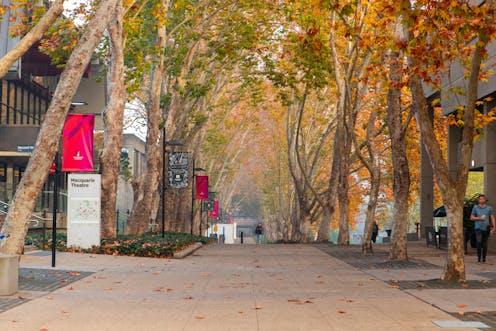
Sydney’s Macquarie University announced budget cuts in recent days, due to “zero growth” in enrolments next year.
Vice-Chancellor Bruce Dowton reportedly wrote a letter to staff announcing the cuts, which included a hiring freeze. The letter said:
Enrolment growth domestically and internationally has slowed significantly at a time when our base operating costs continue to rise […] Current projections are that there will be zero growth in load [full-time student numbers] in 2020.
This comes a few months after a report from the Centre for Independent Studies warned Australia’s universities were in for a “catastrophic” financial hit due to their over-reliance on international students from China.
Macquarie has been hit harder than most other universities, but many universities are finding it more difficult to recruit students than they did a few years ago. New domestic enrolments are in a mild recession. And although international student numbers are still growing, demand from Chinese international students has stabilised.
No increase in school leavers wanting university
In 2018, the number of students starting a bachelor degree fell for the first time since 2003. Of Australia’s 37 public universities, 23 took fewer new bachelor-degree students in 2018 than 2017.
Enrolments are expected to be down again in 2019, following a drop in applications. Commencing domestic postgraduate student numbers peaked several years ago.
In a sector used to growth a downturn causes problems.
Since a Commonwealth funding freeze announced in late 2017, universities have not had strong financial incentives to enrol additional students. But this is not the main reason for falling enrolments. The issue is weak demand more than reluctant supply.
Demand for higher education is influenced by the population of potential applicants. Recent school leavers are the biggest bachelor-degree market. The number of year 12 school students fell slightly in 2018, mostly due to a downward trend in babies born 17 years previously.
Birth and forecast population trends suggest year 12 student numbers will increase by only 1-2% in the next couple of years. So domestic demand for higher education from school leavers should stay close to current levels.
Mature-age students also affect enrolments
To date, mature-age students are the principal cause of falling commencing bachelor-degree enrolments. But the number of non-year 12 applicants new to higher education is not trending down. For the last few years their applications have fluctuated in a narrow range.
The drop in demand is driven by people who have been to university before. Possibly, more student places under demand-driven funding triggered a boom in course switching and former students returning, which has now subsided.
Former students are also affecting the domestic postgraduate market. The number of people who already have a degree, which makes them eligible for postgraduate study, is at record levels. But domestic postgraduate coursework commencements peaked in 2014 and have declined since.
This is not an isolated trend. All types of structured education for people already in the workforce are in decline. It’s likely online self-education is taking market share.
Read more: The three things universities must do to survive disruption
What about international enrolments?
The story is very different in the international-student postgraduate market, which is growing rapidly. In 2018, for the first time ever, more international students started a postgraduate than an undergraduate course in Australia.
Despite some soft international markets, the overall trend is up. The most recent data, which take us to August 2019 and cover all levels of higher education, show commencing enrolments are 7% higher than at the same time in the previous year.
Student visa applications, which go up to September this year, suggest overall demand continues to increase modestly. But we should wait until later in the year before drawing firm conclusions.
A key cause of enrolment increases is India’s rapid rise. Commencing Indian student enrolments have more than doubled since 2016. Although China remains the largest source of international students, new Chinese enrolments have stabilised this year.
International student issues could cause numbers to fall
Given enrolment and visa trends, total international student enrolments will increase in the short term. But there are many concerns about this industry, including English language standards, cheating, soft marking, Chinese political interference, university financial over-reliance on international students, labour market exploitation of students, and poor graduate outcomes.
Read more: Are international students passing university courses at the same rate as domestic students?
There are also broader issues of international students driving up migration numbers, as well as questions of whether we want a large proportion of the population living with limited political and welfare rights.
Population issues contributed to a rule change to attract international students away from congested big cities to regional and minor city locations. I expect further regulatory changes and market reactions to international education issues to eventually cause a decline in numbers.
University luck might be about to run out
For universities addicted to international student dollars any enrolment decline is bad news. But universities have a history of luck. As international student numbers dropped a decade ago, domestic enrolments boomed. And as domestic numbers flattened in recent years, the international market took off.
As the domestic demography chart above suggests, there is potential for big increases in Australian undergraduates in the mid-2020s, as the mid-2000s baby boom children reach university age.
Read more: Australian universities can't rely on India if funds from Chinese students start to fall
There is, however, a major obstacle to that scenario: with the end of demand-driven funding, there will be no money to pay for those extra students. Federal Education Minister Dan Tehan has acknowledged the problem but so far has no solution.
Without one, the future contains major risks. Universities could have falling enrolments for both domestic and international students. This will mean staff cuts and less money for research.
And the people born in the mid-2000s could be part of an unlucky generation in which population growth collides with budget constraint. Their chances of finding a university place will be lower than for people born in earlier decades.
Authors: Andrew Norton, Honorary fellow, University of Melbourne


 Daily Bulletin


