

Friday essay: seeing the news up close, one devastating post at a time
- Written by: Cherine Fahd, Director Photography, School of Design, University of Technology Sydney
We are used to being spectators of news events — viewing difficult images beamed to us from the other side of the world, the next state or the next suburb.
This spectator lens can start to feel so familiar that we become numb to what we are witnessing. News reports show us another scene of destruction, another disaster, another cry for help, another decline. We can look away from the paper, turn off the television or radio. But our social media marches on.
Instagram images of smoke, coloured orange by the bushfire sun, catch us off-guard. Social sharing of images like those of the current bushfires cuts through the resistance we’ve built up to the news cycle, chipping away at the degrees separating us from the event itself.
Bringing us closer to disaster, for better or worse.
 We are growing numb to news images of destruction in the news cycle, but the ones with a personal connection can stop us in our tracks.
AAP/Mick Tsikas
We are growing numb to news images of destruction in the news cycle, but the ones with a personal connection can stop us in our tracks.
AAP/Mick Tsikas
The frame
For the most part, news images are taken by professional photographers trained to frame a decisive moment; the picture-perfect scene that will capture an “event”. Photographers know how to manipulate light and composition to create a great image. We are accustomed to seeing catastrophes through their expert eye.
Our newspapers feature stunning photographs, such as one captured recently by Sydney Morning Herald photographer Nick Moir. In it, two firefighters hold their hands to their heads while running through an apocalyptic, dizzying shower of fire.
SMH photo editor Mags King told us “images taken by professional photojournalists … still retain their visceral impact and trigger a deeper reaction or a lasting thought on the subject”.
She notes that the fire photos taken by Moir are “highly considered”.
The impact, judging by the feedback, has been tremendous. They are nightmarish, powerful, all encompassing. I think people can see that they are not snaps. These are the type of photos that make you feel and that is the skill of a photojournalist who understands the tenets of photojournalism.
Sometimes that consideration can push an image too far. In 2015, a significant number of entries (20%) were disqualified from the World Press Photo competition for excessive manipulation and post-processing.
The 2019 World Press Photo top prize went to John Moore of Getty Images for his capture of a simple image, devastating in its natural depiction of a Honduran toddler crying as she and her mother were taken into custody by US border officials in Texas.
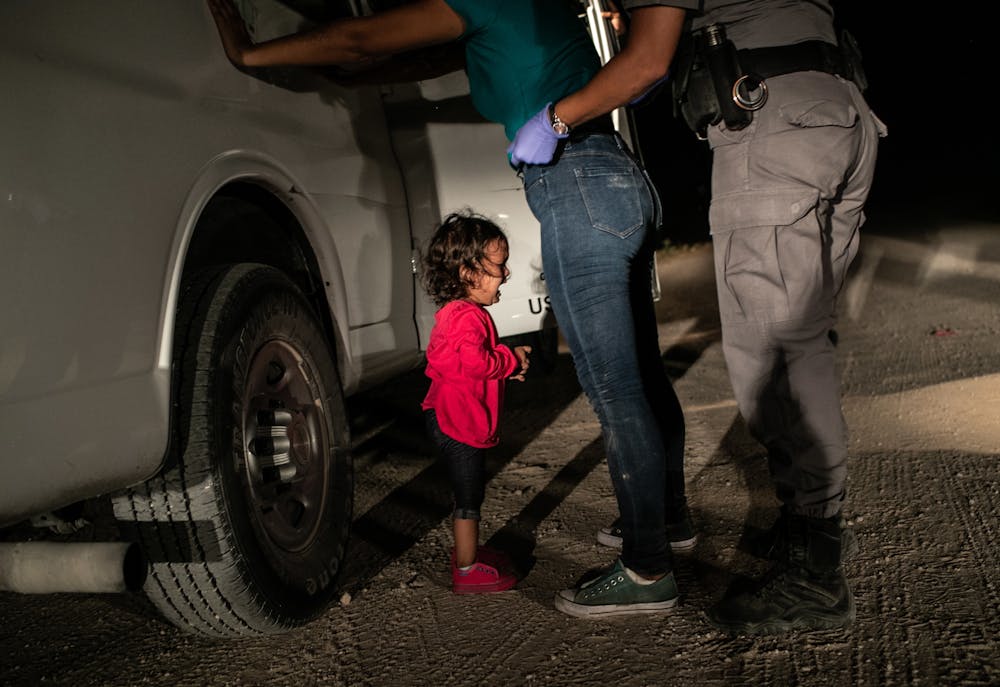 The 2019 World Press Photo of the year shows the importance of proximity.
EPA/John Moore
The 2019 World Press Photo of the year shows the importance of proximity.
EPA/John Moore
The winning photo is framed at the height of the small child, while her mother and the official’s figures are cut at waist height. We can see the child’s emotional reaction to the events unfolding at the adult level above her.
Stop, look, read
In photojournalism, the proximity of the photographer to the event is key. Robert Capa, the photojournalist who founded Magnum Photos in 1947 with Henri Cartier-Bresson, David Seymour, George Rodger and William Vandivert, famously said “if your pictures aren’t good enough, you’re not close enough”.
Capa was so close to crisis that it cost him his life in 1954 when, at age 40, he stepped on a landmine while on assignment for Life in Northern Vietnam.
The task of the professional photojournalist — to distil a crisis artfully in an image that makes us stop, look and read — has never been more difficult. Exposure to images has reached unprecedented levels, while our trust in news has declined.
The proportion of Australians avoiding news increased from 57% in 2017 to 62% in 2019, and 28% say they are worn out by the volume of news. Meanwhile, social media analysts report 9,442,000 Instagram users in Australia in 2019, accounting for 37.2% of the country’s population.
The Red Cross bushfire appeal recently encouraged people to share images of the Burnt Christmas Tree on social media.Sharing, caring
Viewing images on Instagram offers a different, though linked, perspective to the photojournalist.
As the devastating bushfires ravage parts of New South Wales and Queensland, “ordinary” people are sharing, viewing, commenting on and “liking” images of the crisis engulfing the state.
Captured on smart phones, images posted on Instagram still frame the event as spectacle but from a different point of view. Proximity is still key, but it is gained via a different path. And the path images take to reach us is also different.
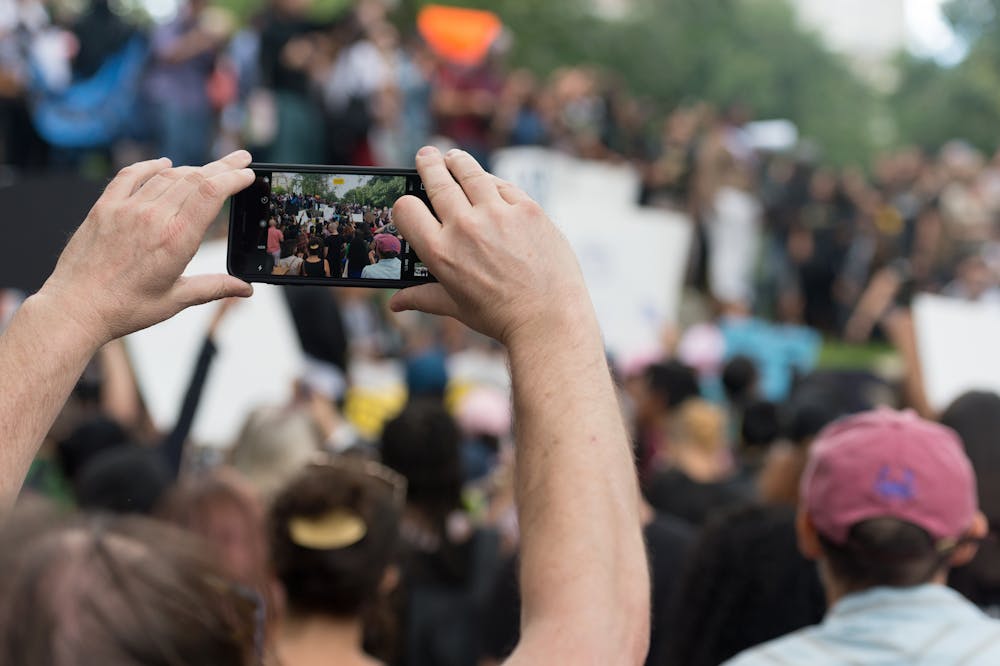 Have accusations of fake news, caused us to turn away from traditional news sources?
Shutterstock
Have accusations of fake news, caused us to turn away from traditional news sources?
Shutterstock
On Facebook and Twitter, news sharing from faceless sources is deemed responsible for the spread of fake news. Instagram (though owned by Facebook) is designed primarily so that images provide information. Caption plays a supporting role only.
The images are taken by amateurs and they are people we mostly know, or feel like we know, and follow on social media.
As Waleed Aly noted in response to photos on Facebook of the London Bridge attack in 2017, “images can be weaponised to evoke and reinforce existing narratives, confirm prejudices and galvanise a sense of shared outrage”.
A social stage
The algorithmic bubble that drives our social media feed, exposes us to images and sentiments that mirror our own. But increasingly, the public is suspicious of “spin” in news and images of crisis transmitted to us through news outlets that are owned by those with political biases, special interests and powers.
Researchers in Finland who studied issues of trustworthiness in amateur images in newspapers versus professional images, found that people tended to trust amateur ones more than the professional.
The amateur snaps were imbued with authenticity, and a lack of vested interests associated with news corporations.
That same authenticity might be available to us via Instagram, ironically the natural home of colour filters, selfies and silicon enhancements.
According to sociologist and social media theorist Nathan Jurgenson, the ontology of the “social photo” — the fundamentals of its reason for being — is sharing.
“Social photos are not primarily about making media but about sharing eyes,” he writes.
Images shared among friends and followers fuel a “social process” as catalysts for dialogue. Like the newspaper once did, Instagram offers a communal conversation.
While Instagram is a brand that carries a slick aesthetic, the feature of sharing and commenting creates a collective cultural archive. News photography can affect change but our responses to these images have reportedly dimmed as we become inured to images of children like three-year-old Alan Kurdi caught up in the refugee crisis.
Instagram has become a repository that collects and organises images through its various tools of hashtags and geolocation. More than just the playground for “influencers” and their polished images, it is the contemporary family album that also features images from connections who act as “our man on the ground” photojournalist.
Read more: Ten photos that changed how we see human rights
Closer to home
One might encounter a stream of images in seemingly random succession: a hotel room in Cologne, a family pet, children playing in the suburbs, a duck-faced selfie, a red sun, an image of smoke obscuring the Sydney Opera House, a radio announcer posing with Samuel L. Jackson, a friend’s son ice-skating somewhere, riots in Hong Kong, the army approaching protestors angrily in Beirut, fresh paint on canvas.
The images in this eclectic stream catch the viewer off-guard: images of crisis are couched within images of everyday life with kids, cats, selfies and fires.
These are not news images that comply with the tenets of photojournalism; they are taken on a smart phone and shared immediately. The snapshot taken by your friend on Instagram, as compared to the framed shot by a professional photojournalist, has a different kind of “proximity”.
In the age of Instagram, being close enough to take the good picture — in Robert Capa’s terms — means not just proximity to the scene or event, but also proximity to a social network that will receive the post in their feed (unless posts are, in turn, re-purposed by a news outlet).
So when someone you follow — who is a friend — “reports” on the fire from their backyard, it stops you in your tracks. A picture of a tree fern covered in lurid pink fire retardant shows how close the fire came.
Looking back on the same friend’s feed to see a bucolic photograph of a similar tree fern amongst daisies, only enhances the tragedy by showing what was once there and what has been destroyed in the fires.
For the viewer of the image, proximity means closeness to the person who took the photograph. It is this social connection — “kinship” in anthropological terms — to the photographer that can impact the way we respond to that image.
In the social realm, care and concern turns spectatorship into an act of obligated looking. Such an ethical response means we resist the impulse to look away.
Authors: Cherine Fahd, Director Photography, School of Design, University of Technology Sydney


 Daily Bulletin


