

Homes with higher energy ratings sell for more. Here's how Australian owners could cash in
- Written by: Daniel Daly, Research Fellow at the Sustainable Buildings Research Centre, University of Wollongong
Everybody wants an energy-efficient home. After all, an energy-efficient home is comfortable to live in, without large energy bills. These can be important factors for prospective home owners or renters. Our review of international research found energy-efficient homes typically fetch a higher price.
An energy performance rating is one way to show how “energy hungry” a home could be. In many countries, it is mandatory for the seller to obtain and disclose a home’s rating. For European Union countries, this has been the case for ten years.
But that’s not the case in most of Australia. Only one of the states and territories – the ACT – has a regulated scheme to disclose the energy-efficiency rating of housing to prospective buyers.
Read more: Australia's still building 4 in every 5 new houses to no more than the minimum energy standard
Disclosing energy ratings is standard practice in the commercial building sector in Australia. Previous research showed this increases the value of buildings with higher energy ratings (a price premium). Our recent review of international research looked to see if a similar effect exists in the residential sector.
What does the research show?
The majority (23) of the 27 relevant studies we reviewed found more energy-efficient homes fetch higher prices than less energy-efficient, but otherwise comparable, homes. So what sort of price premium do houses with a higher energy rating attract? It’s typically around 5% to 10%.
Price effects were considered in two ways. The first involved comparing rated versus unrated residences. The second compared higher-rated residences with lower-rated ones. In both cases, a price premium was found to exist.
The reported price premium varied substantially by study, country and real estate market. One study, in Belfast, found a 27% price premium for higher-rated buildings. Another in the Netherlands found a price premium of 2.7% for similarly higher-rated dwellings.
Only one study looked at Australia (the ACT scheme, which has operated since 2003). It found a 2.4% price premium for a six-star house and a 9.4% premium for a seven-star house compared to a 3 star home. For Australia, with a median house price of $773,635 in late 2019, the ACT results equate to potential price premiums of $18,500 and $72,721.
Obviously, it isn’t just the energy rating of a house that affects its price. Location, size, age and other relevant features of a property influence the final price. Researchers use a statistical method, called hedonic regression, to estimate the effects of all these factors. A home energy rating was included as one of these factors.
The studies we reviewed were published between 2011 and 2019, covering 14 countries and ten energy performance rating schemes. Most of the studies (18) considered the European Union’s Energy Performance Certificate (EPC). Although there are differences in how each EU country defines and manages these certificates, they are broadly comparable, in that they use a standard A (high) to G (low) grade.
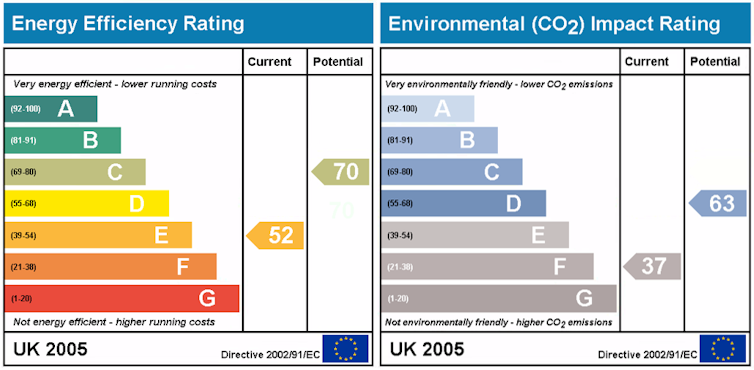 Example of a displayed Energy Performance Certificate from the UK, with an A to G rating. The certificate include details on how to improve the rating and indicates the potential rating if all upgrades were completed.
How would this system benefit Australia?
This system would obviously be good for people trying to sell (or wanting to buy) energy-efficient homes, but it’s also good for our society. It has been estimated almost half the homes that will be in use in 2050 have already been built. If we are to meaningfully reduce carbon emissions from our cities and built environment, we need to tackle our existing building stock.
Read more: Making every building count in meeting Australia's emission targets
A scheme that allows owners to capitalise on the energy efficiency of their home would change the economics of retrofitting existing homes. Owners would have a clear incentive to improve energy performance without the need for large government subsidies.
Unfortunately, there is no agreed method to measure energy-efficiency for the majority of existing Australian homes (i.e. those outside the ACT). This means there is no simple way for prospective owners or renters to make an informed decision about the likely comfort and future energy bills for a home.
Other countries have already shown the path forward. Key steps include:
define a nationally consistent rating tool for existing homes. The Victorian government has developed the Victorian Residential Efficiency Scorecard. This voluntary tool provides owners with a star rating for the overall energy performance of their home. It also provides specific information on its performance during hot weather, as well as recommendations on how to improve that performance
provide a framework for owners to voluntarily disclose the certified energy performance of their home at the point of sale or lease. Only owners of higher-rating homes will be likely to do this voluntarily
legislate for mandatory disclosure of a home’s energy rating when it’s being sold or leased
introduce minimum standards of energy performance for rental properties. Once a property’s energy performance is rated and disclosed, the government has a powerful policy lever to drive improvement of the energy efficiency of the existing building stock. For instance, in the UK, owners are obligated to improve the energy performance of any property they wish to offer for rent to at least grade E (on an A-to-G scale).
Our review of international academic literature suggests home buyers typically value a more energy-efficient home. When presented with easily accessible information in the form of an energy performance rating, they are willing to pay more.
Hence, energy rating disclosure policies can help consumers make informed decisions that will result in lower energy bills and more comfortable homes. At the same time, by allowing sellers to capitalise on energy-efficiency improvements through a certified rating, government can support reducing carbon emissions from our existing building stock.
To ensure we realise these societal and environmental benefits, all levels of government should co-ordinate to enact appropriate nationally consistent legislation.
Read more: Low-energy homes don't just save money, they improve lives
The author would like to acknowledge Michelle Zwagerman for her contribution to this article.
Authors: Daniel Daly, Research Fellow at the Sustainable Buildings Research Centre, University of Wollongong


 Daily Bulletin


