

Coronavirus weekly: racism, COVID-19, and the inequality that fuels these parallel pandemics
- Written by: Liam Petterson, Assistant Editor, Health + Medicine, The Conversation Australia
The protests against systemic racism and police violence sweeping the globe highlight the intersection between two pandemics: COVID-19 and racism. Researchers are pointing out that structural inequalities mean people of colour are hit harder by the coronavirus.
Politicians are also concerned the protests may trigger an increase in the spread of COVID-19, so public health experts are providing tips on how to protest safely.
And while many countries grapple with increasing rates of COVID-19, New Zealand has declared it has eliminated the virus, and is now aiming to keep it that way.
In this week’s roundup of coronavirus stories from scholars across the globe, we explore the disproportionate impact of COVID-19, New Zealand’s success, and the latest on drug trials.
 This is our weekly roundup of expert info about the coronavirus.
The Conversation, a not-for-profit group, works with a wide range of academics across its global network. Together we produce evidence-based analysis and insights. The articles are free to read – there is no paywall – and to republish. Keep up to date with the latest research by reading our free newsletter.
Pandemics expose inequality
Past pandemics have exposed existing inequalities, and this one is no different. Our experts explain why COVID-19 is having a greater impact on people of colour and other marginalised groups.
Disproportionate impact. Black Americans have been dying from the coronavirus at nearly three times the rate of white Americans, while black people in the United Kingdom are four times more likely to die from COVID-19 than their white compatriots. Medical historian Mark Honigsbaum writes about the relationship between pandemics and inequality.
Social justice is crucial to healthcare. Systemic racism means marginalised groups have limited access to resources that impact health, according to an interdisciplinary team of US health researchers. Doctors need to be trained to understand the social determinants of health to deal with problems like COVID-19, argue researchers from Rwanda’s University of Global Health Equity.
Safely protesting. Public health experts are concerned the protests will increase the spread of COVID-19. An infection prevention researcher at Monash University gives some tips on how to minimise the risk of transmission when taking to the streets.
“Fear of what others might think when they see a Black man in a mask.”. Despite masks providing increased safety during the pandemic, black and other minority groups are often subjected to racist abuse or discrimination when wearing them. Jasmin Zine of Wilfrid Laurier University explores the racial politics of mask wearing.
A lack of clean water. Clean water is crucial for hygiene and hand washing, key elements of infection control. But many people do not have access to good quality water, especially in slums and refugee camps, according to researchers from the National University of Singapore and the University of Glasgow.
This is our weekly roundup of expert info about the coronavirus.
The Conversation, a not-for-profit group, works with a wide range of academics across its global network. Together we produce evidence-based analysis and insights. The articles are free to read – there is no paywall – and to republish. Keep up to date with the latest research by reading our free newsletter.
Pandemics expose inequality
Past pandemics have exposed existing inequalities, and this one is no different. Our experts explain why COVID-19 is having a greater impact on people of colour and other marginalised groups.
Disproportionate impact. Black Americans have been dying from the coronavirus at nearly three times the rate of white Americans, while black people in the United Kingdom are four times more likely to die from COVID-19 than their white compatriots. Medical historian Mark Honigsbaum writes about the relationship between pandemics and inequality.
Social justice is crucial to healthcare. Systemic racism means marginalised groups have limited access to resources that impact health, according to an interdisciplinary team of US health researchers. Doctors need to be trained to understand the social determinants of health to deal with problems like COVID-19, argue researchers from Rwanda’s University of Global Health Equity.
Safely protesting. Public health experts are concerned the protests will increase the spread of COVID-19. An infection prevention researcher at Monash University gives some tips on how to minimise the risk of transmission when taking to the streets.
“Fear of what others might think when they see a Black man in a mask.”. Despite masks providing increased safety during the pandemic, black and other minority groups are often subjected to racist abuse or discrimination when wearing them. Jasmin Zine of Wilfrid Laurier University explores the racial politics of mask wearing.
A lack of clean water. Clean water is crucial for hygiene and hand washing, key elements of infection control. But many people do not have access to good quality water, especially in slums and refugee camps, according to researchers from the National University of Singapore and the University of Glasgow.
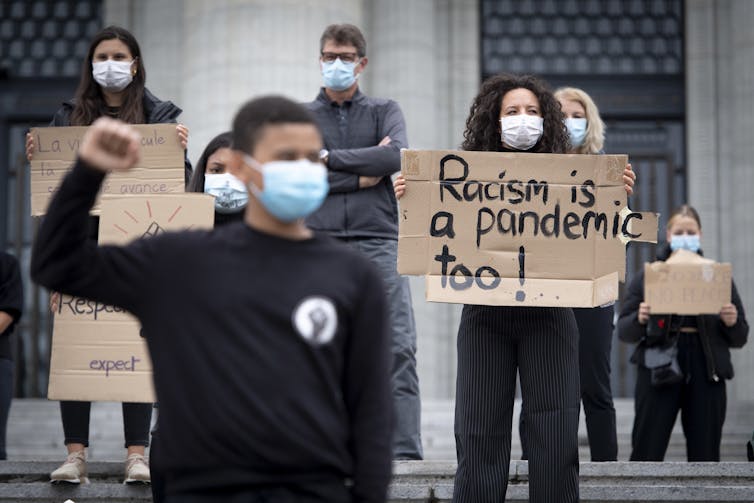 Many protestors are seeing the links between centuries of entrenched racism and the racial inequalities exposed by COVID-19.
Laurent Gillieron/EPA
New Zealand eliminates the virus
New Zealand has hit the historic milestone of zero active cases, and lifted almost all its coronavirus restrictions. Two of the leading public health experts behind the successful elimination now explain the challenge of maintaining it. Meanwhile, across the Tasman Sea, experts chart Australia’s journey in controlling the virus.
Cautious celebration. New Zealand has successfully eliminated COVID-19, but elimination is not one point in time: it requires ongoing work. Two public health professors from the University of Otago describe five ways the country can protect itself in the long term.
Asymptomatic cases. Removing coronavirus restrictions in New Zealand increases the chance of a new outbreak to 8%, according to modelling from an interdisciplinary research team. This is because there may be hidden asymptomatic cases that haven’t been uncovered by testing.
Australia’s success. On the other side of the Tasman, Australia’s response has also been one of the most successful in the world. Yet small outbreaks continue to crop up. Steven Duckett and Anika Stobart from the Grattan Institute explain four factors behind the success, and four ways Australia’s response could have been even better.
Testing is key. The success of both New Zealand and Australia is supported by a high number of tests per thousand people, according to a researcher from the University of Sydney, who poured over the worldwide data. Bahrain, Qatar, Lithuania and Denmark are also among the countries with the highest rates of testing per thousand people.
Many protestors are seeing the links between centuries of entrenched racism and the racial inequalities exposed by COVID-19.
Laurent Gillieron/EPA
New Zealand eliminates the virus
New Zealand has hit the historic milestone of zero active cases, and lifted almost all its coronavirus restrictions. Two of the leading public health experts behind the successful elimination now explain the challenge of maintaining it. Meanwhile, across the Tasman Sea, experts chart Australia’s journey in controlling the virus.
Cautious celebration. New Zealand has successfully eliminated COVID-19, but elimination is not one point in time: it requires ongoing work. Two public health professors from the University of Otago describe five ways the country can protect itself in the long term.
Asymptomatic cases. Removing coronavirus restrictions in New Zealand increases the chance of a new outbreak to 8%, according to modelling from an interdisciplinary research team. This is because there may be hidden asymptomatic cases that haven’t been uncovered by testing.
Australia’s success. On the other side of the Tasman, Australia’s response has also been one of the most successful in the world. Yet small outbreaks continue to crop up. Steven Duckett and Anika Stobart from the Grattan Institute explain four factors behind the success, and four ways Australia’s response could have been even better.
Testing is key. The success of both New Zealand and Australia is supported by a high number of tests per thousand people, according to a researcher from the University of Sydney, who poured over the worldwide data. Bahrain, Qatar, Lithuania and Denmark are also among the countries with the highest rates of testing per thousand people.
 Prime Minister Jacinda Ardern lifts nearly all coronavirus restrictions as New Zealand declares the virus ‘eliminated’.
Daniel Hicks/AAP
The latest on drug trials, spread, contact tracing
As the world awaits a vaccine that might not arrive, intensive research continues into possible drugs to treat COVID-19. Trials of hydroxychloroquine, the anti-malaria drug spruiked by US President Donald Trump, continue in the face of ongoing controversy.
Study retracted. One study had previously made global headlines after concluding hydroxychloroquine and the related drug chloroquine were associated with an increased risk of death. But the study has been retracted by prestigious medical journal The Lancet because of concerns over the data. Some clinical trials have been paused, while others continue.
The history of clinical trials. The concept of clinical trials might be new to many of us, but they have an ancient history. One of the earliest experiments happened almost 1,000 years ago in China, writes Adrian Esterman from the University of South Australia.
Will it burn out?. The original SARS virus disappeared in 2004. But Connor Bamford, a virologist from Queen’s University Belfast, says COVID-19 is unlikely to do the same because it spreads more easily than SARS. Instead, SARS-CoV-2, the virus that causes COVID-19, might become an endemic virus that settles into the human population.
Contact tracing isn’t new. Contact tracing has been an important tool in controlling COVID-19 in many countries. Two researchers from the University of Glasgow examine the history behind the idea, and how it was used to tackle the bubonic plague 500 years ago.
Development risks. Pregnant women have experienced greater anxiety and depressive symptoms since the start of the pandemic. This could affect the development of foetuses, writes Berthelot Nicolas from the University of Quebec (in French).
Prime Minister Jacinda Ardern lifts nearly all coronavirus restrictions as New Zealand declares the virus ‘eliminated’.
Daniel Hicks/AAP
The latest on drug trials, spread, contact tracing
As the world awaits a vaccine that might not arrive, intensive research continues into possible drugs to treat COVID-19. Trials of hydroxychloroquine, the anti-malaria drug spruiked by US President Donald Trump, continue in the face of ongoing controversy.
Study retracted. One study had previously made global headlines after concluding hydroxychloroquine and the related drug chloroquine were associated with an increased risk of death. But the study has been retracted by prestigious medical journal The Lancet because of concerns over the data. Some clinical trials have been paused, while others continue.
The history of clinical trials. The concept of clinical trials might be new to many of us, but they have an ancient history. One of the earliest experiments happened almost 1,000 years ago in China, writes Adrian Esterman from the University of South Australia.
Will it burn out?. The original SARS virus disappeared in 2004. But Connor Bamford, a virologist from Queen’s University Belfast, says COVID-19 is unlikely to do the same because it spreads more easily than SARS. Instead, SARS-CoV-2, the virus that causes COVID-19, might become an endemic virus that settles into the human population.
Contact tracing isn’t new. Contact tracing has been an important tool in controlling COVID-19 in many countries. Two researchers from the University of Glasgow examine the history behind the idea, and how it was used to tackle the bubonic plague 500 years ago.
Development risks. Pregnant women have experienced greater anxiety and depressive symptoms since the start of the pandemic. This could affect the development of foetuses, writes Berthelot Nicolas from the University of Quebec (in French).
 The ongoing saga surrounding hydroxychloroquine takes another twist as The Lancet retracts a study claiming the anti-malarial drug increased the risk of death.
Shutterstock
The ongoing saga surrounding hydroxychloroquine takes another twist as The Lancet retracts a study claiming the anti-malarial drug increased the risk of death.
Shutterstock
 Get the latest news and advice on COVID-19, direct from the experts in your inbox. Join hundreds of thousands who trust experts by subscribing to our newsletter.
This article is supported by the Judith Neilson Institute for Journalism and Ideas.
Get the latest news and advice on COVID-19, direct from the experts in your inbox. Join hundreds of thousands who trust experts by subscribing to our newsletter.
This article is supported by the Judith Neilson Institute for Journalism and Ideas.
Authors: Liam Petterson, Assistant Editor, Health + Medicine, The Conversation Australia


 Daily Bulletin


