

Employers, schools, take note. Coronavirus 'clearance certificates' are a waste of everybody's time
- Written by: Lauren Ball, Associate Professor/ Principal Research Fellow, Griffith University
Last week, my two-year-old niece was sent home from daycare for having a runny nose – a sin that would otherwise be commonplace on a windy winter’s day.
The daycare centre instructed my sister she would need to produce a medical certificate “clearing” my niece of COVID-19 before she would be allowed to return to daycare.
My sister stopped her work to collect my niece before going to the local medical centre and waiting for an appointment with a general practitioner. The GP did not recommend a COVID-19 test and wrote a letter encouraging the daycare centre to allow my niece to return.
This is not an isolated case. Reports in the media, as well as accounts on parenting forums and social media, suggest Australians are being asked to present “clearance certificates” before returning to childcare, school or work after illness.
But there are several problems with this. Chiefly, it places an unnecessary strain on resources when it’s not technically possible for a doctor to “clear” a patient of COVID-19.
Read more: Why do some people with coronavirus get symptoms while others don't?
Everyone is trying to do the right thing
Schools, workplaces and businesses have appropriately declared ensuring people’s safety is the number-one priority as Australia works to recover from the pandemic.
Businesses have enacted social distancing policies that are now a non-negotiable part of their workplaces.
Similarly, health authorities have advised schools and early childhood centres to be proactive in sending home children who become unwell during the day.
These measures are logical and understandable. After all, no business wants to be at the centre of an outbreak of COVID-19.
 Childcare centres have reportedly been asking for COVID-19 clearance certificates.
Shutterstock
Childcare centres have reportedly been asking for COVID-19 clearance certificates.
Shutterstock
An unnecessary strain on resources
The added volume of patients coming in for so-called clearance certificates places additional strain on GPs and their clinic staff.
Each time an otherwise healthy worker or child visits a GP for a medical clearance certificate, they may delay other patients in genuine need of medical attention.
It also fills waiting rooms, which are now more limited in their capacity so as to allow for social distancing.
Read more: How can I treat myself if I've got – or think I've got – coronavirus?
Further, this trend increases costs to the government, which funds Medicare – and to patients themselves if there’s an out-of-pocket fee.
Strictly speaking, it’s not appropriate to be using Medicare funds for these consultations as they’re not medically warranted.
You can’t ‘clear’ a person of COVID-19
GPs cannot give a conclusive, written guarantee that the patient sitting in their office is free from COVID-19. That’s simply not how the science of COVID-19 detection works.
Rather, GPs can report on the results of a COVID-19 test. However, a negative test result doesn’t rule out the possibility of a person having COVID-19. An infection may still be developing at an as yet undetectable level.
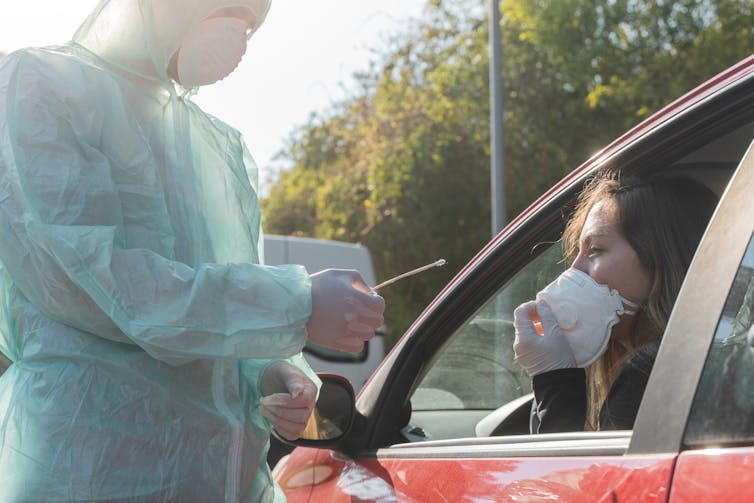 It’s important to get tested if you’re experiencing any coronavirus symptoms. But a negative test doesn’t mean you can be ‘cleared’.
Shutterstock
It’s important to get tested if you’re experiencing any coronavirus symptoms. But a negative test doesn’t mean you can be ‘cleared’.
Shutterstock
The Royal Australian College of General Practitioners (RACGP) has voiced its frustration that employers, schools and daycare centres are continuing to request these certificates.
The RACGP says the notion of clearing someone of COVID-19 is nonsensical and could give false assurance to both the individual and workplace or school that the person is free of COVID-19.
It also notes this practice may mean COVID-19 testing kits are being used unnecessarily. Tests should be reserved for people with symptoms specifically associated with COVID-19, health-care workers, or people who have had close contact with a case.
Read more: How long are you infectious when you have coronavirus?
It’s not a legal requirement
Your employer cannot force you to provide a COVID-19 clearance, chiefly because there is no law mandating it.
As an alternative, the RACGP has developed a letter template that GPs can sign and give to their patients to provide to their employer, school principal or daycare manager.
It suggests employers and schools can help support safe workplaces by allowing flexible workplace arrangements, providing access to sick leave without requiring medical review, ensuring adequate hand washing facilities and upholding social distancing recommendations.
Read more: Immunity passports could help end lockdown, but risk class divides and intentional infections
Of course, if you’re sick and have COVID-19 symptoms such as cough or fever, it’s important you seek a test straight away, and self-isolate if you return a positive test.
But in the absence of COVID-19 symptoms, parents and employees should be trusted to determine when they are well and can safely return to childcare, school or work.
Authors: Lauren Ball, Associate Professor/ Principal Research Fellow, Griffith University


 Daily Bulletin


