

Eradication, elimination, suppression: let's understand what they mean before debating Australia's course
- Written by: Anita Heywood, Associate Professor, UNSW
The current surge in community transmission of COVID-19 in Victoria has brought renewed discussion of whether Australia should maintain its current “suppression” strategy, or pursue an “elimination” strategy instead.
But what do these terms actually mean, and what are the differences between the two?
Read more: As restrictions ease, here are 5 crucial ways for Australia to stay safely on top of COVID-19
In theory
Disease eradication means a global absence of the pathogen (except in laboratories). We achieved this for smallpox in 1980. Diseases suitable for eradication are usually those where humans are the only host, and where there’s an effective vaccine or other prevention strategy.
Disease elimination relates to a country or a region, and is usually defined as the absence of ongoing community (endemic) transmission.
Elimination generally sits in the context of a global eradication goal. The World Health Organisation sets a goal for eradication, and countries play their part by first achieving country-wide elimination.
Cases and small outbreaks may still occur once a disease is eliminated — imported through travel — but these don’t lead to sustained community transmission.
Finally, disease control refers to deliberate efforts to reduce the number of cases to a locally acceptable level, but community transmission may still occur. Australia’s current suppression strategy, though seeking to quash community transmission, can be classified as disease control.
 There are subtle differences between disease control, elimination, and suppression.
Bianca De Marchi/AAP
There are subtle differences between disease control, elimination, and suppression.
Bianca De Marchi/AAP
In practice
Elimination and suppression strategies employ the same control measures. For COVID-19, these include:
rapid identification and isolation of cases
timely and comprehensive contact tracing
testing and quarantining of contacts
varying degrees of social distancing (lockdown, banning mass gatherings, keeping 1.5m distance from others)
border controls: restricting entry through travel bans, and quarantine of returning international travellers
face masks to reduce transmission.
Read more: Grattan on Friday: Does Victoria's second wave suggest we should debate an elimination strategy?
The differences between a suppression strategy and an elimination strategy are the strictness, timing, and duration with which these measures are applied, especially travel restrictions.
For example, under a suppression strategy, physical distancing requirements might be lifted while there’s still a low level of community transmission. But under an elimination strategy, these measures would remain in place until there’s no detectable community transmission.
What’s realistic for COVID-19?
First, the prospect of eradicating COVID-19 is likely no longer feasible, even with a vaccine.
People without symptoms may be able to spread COVID-19, which makes it difficult to identify every infectious case (SARS, for example, was only spread by people with symptoms). And if the virus has an animal host, animal reservoirs would also need to be eradicated.
So what about elimination?
For measles, elimination is defined as the absence of endemic measles transmission for more than 12 months. Countries must demonstrate low incidence, high quality surveillance and high population immunity.
Imported cases in unvaccinated returning travellers and occasional small outbreaks continue to occur, but a country will lose its elimination status if community spread lasts longer than one year.
The majority of the Australian population are immune to measles, which lowers the probability of sustained outbreaks. But most Australians remain susceptible to COVID-19.
So future sustained outbreaks, like the current Victorian outbreak, will remain possible until we can vaccinate the population — even under an elimination strategy.
Read more: Lockdown, relax, repeat: how cities across the globe are going back to coronavirus restrictions
Like we have with measles, for COVID-19, we need a definition of elimination with specific criteria that can be measured.
Declaring COVID-19 “eliminated” after the absence of community transmission for a few weeks means little during a pandemic, and may lead to complacency in the community. This period should be more like a few months.
Effective suppression can lead to elimination
While the federal government continues to advocate for its suppression strategy, some states have demonstrated absence of community transmission.
International arrivals to these states (and to New Zealand) are comparatively small, and the virus was always going to be more difficult to contain in cities with substantial international arrivals and high population densities, such as Sydney and Melbourne.
To achieve and sustain national elimination of any infectious disease during a pandemic is ambitious. It requires an epidemiologic definition with measurable criteria, significant resources and almost complete closure of international borders.
But maintaining the right for Australian citizens and residents to return to Australia means the borders are never fully closed, whether under a suppression strategy or elimination strategy.
So ultimately, both strategies are susceptible to outbreaks of COVID-19 in the community as long as the pandemic endures.
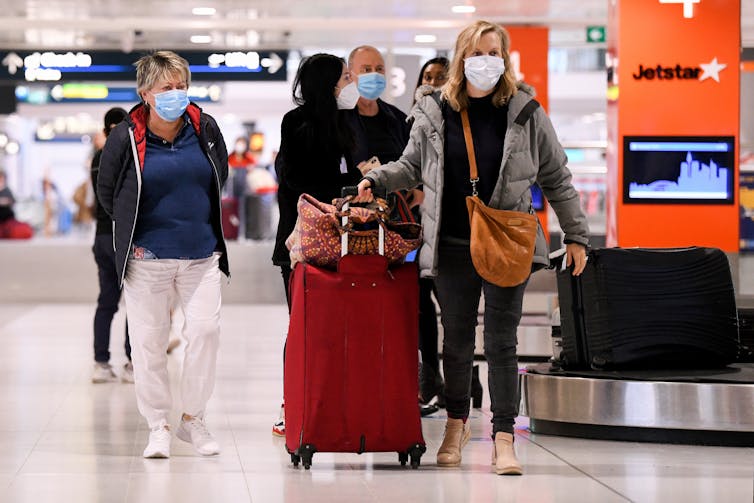 Returned travellers can threaten elimination.
Bianca De Marchi/AAP
Returned travellers can threaten elimination.
Bianca De Marchi/AAP
It will always ebb and flow
An elimination strategy would not necessarily have prevented the current outbreak in Victoria, particularly if social distancing restrictions had already been lifted.
Whether Australia continues with its suppression strategy or opts to switch to a defined elimination strategy, either approach will require continued vigilance. This could include intermittent reinstating of restrictions or targeted containment around hotspots as transmission ebbs and flows.
And whatever name we give to Australia’s approach, neither Victoria or New South Wales have accepted any level of community transmission. Both have gone hard to stop community outbreaks that have arisen, and that’s a good thing.
But long-term maintenance of periods of elimination are unlikely to be possible until we have a vaccine.
Read more: Which face mask should I wear?
Authors: Anita Heywood, Associate Professor, UNSW


 Daily Bulletin


