

Immunity to COVID-19 may not last. This threatens a vaccine and herd immunity
- Written by: Nigel McMillan, Program Director, Infectious Diseases and Immunology, Menzies Health Institute, Griffith University
How is the world going to go back to the days when we could grab a coffee, see a movie, or attend a concert or footy game with anyone?
Opinion suggests there are two options: an effective vaccine, or herd immunity via at least 60-80% of people becoming infected. Either one of these options requires that people become immune to SARS-CoV-2, the coronavirus that causes COVID-19.
An important new study released online this week could have a large bearing on how our future looks in 2021 and beyond.
It suggests our immunity to SARS-CoV-2 does not last very long at all — as little as two months for some people. If this is the case, it means a potential vaccine might require regular boosters, and herd immunity might not be viable at all.
Read more: Lockdown, relax, repeat: how cities across the globe are going back to coronavirus restrictions
Immunity dwindles quickly
Antibodies are an important part of our immune system that mainly work by physically binding to virus particles and stopping them infecting cells. They can attach to infected cells to induce cell death in some cases.
We also have T cells, another part of the immune system that is much better at recognising and killing virus-infected cells. But for COVID-19, antibodies are important in the lungs because T cells aren’t good at getting to airways where the virus first invades.
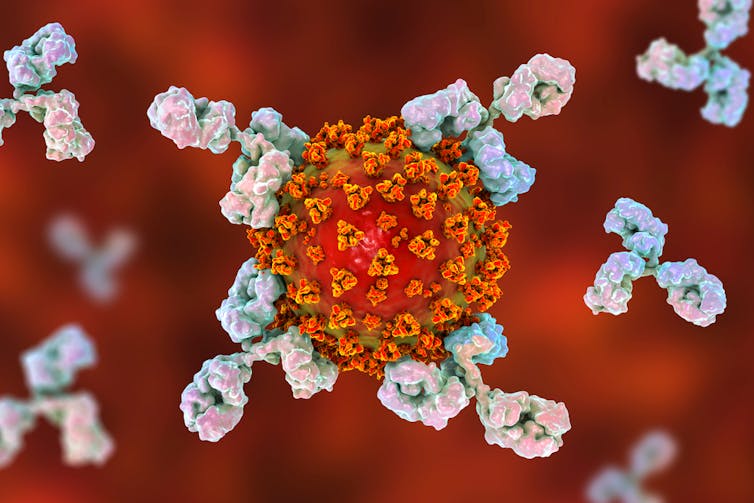 Antibodies attach on to viruses and prevent them from infecting our cells.
Shutterstock
Antibodies attach on to viruses and prevent them from infecting our cells.
Shutterstock
The newly released research, from Katie Doores and her team at Kings College London, looked at how long the antibody response lasted in people who had COVID-19. It has been submitted to a journal but hasn’t been peer-reviewed, so it must be treated with some caution.
Of the 65 patients studied, 63 produced antibody responses. The important measurements in the study relate to how good the response is. This is measured in the lab by putting patients’ blood serum together with infectious SARS-CoV-2 virus and seeing whether the virus can infect cells in a lab dish. This is called a “neutralisation assay”, and here the results were good.
Around 60% of people produced a very potent neutralisation response that stopped virus growing in the lab cells.
Finally, the researchers measured how long the antibody response lasted. This is the most important data. Unfortunately, antibodies levels began falling after day 20 and only 17% of patients retained a potent level at day 57. Some patients completely lost their antibodies after two months.
This suggests our immune response to SARS-CoV-2 may be lost much faster than we might have hoped, and people might thereafter be susceptible to reinfection with the virus.
One vaccine might not be enough
It therefore follows that COVID-19 vaccines may not be as effective as we hope. The fact antibody levels reduce over time is normal, but this typically happens much more slowly. Antibody responses against the mumps, measles and chickenpox viruses last for more than 50 years. A tetanus vaccination wanes more quickly but still lasts 5-10 years before a booster is needed.
So why is this happening? It comes down to the nature of the SARS-CoV-2 coronavirus itself. The four normal strains of coronaviruses that cause common colds in humans also fail to prompt a long-lasting immune response, with most people losing antibodies completely after 6-12 months. Coronaviruses in general seems to be particularly good at not being well recognised by our immune system. Indeed, a feature of common cold coronaviruses is that people get reinfected by them all the time.
SARS, another coronavirus which caused a pandemic in 2003, seems to produce a slightly longer antibody response, lasting up to three years. It’s still a long way short of a lifetime, but it perhaps helps explain why the virus disappeared in 2003.
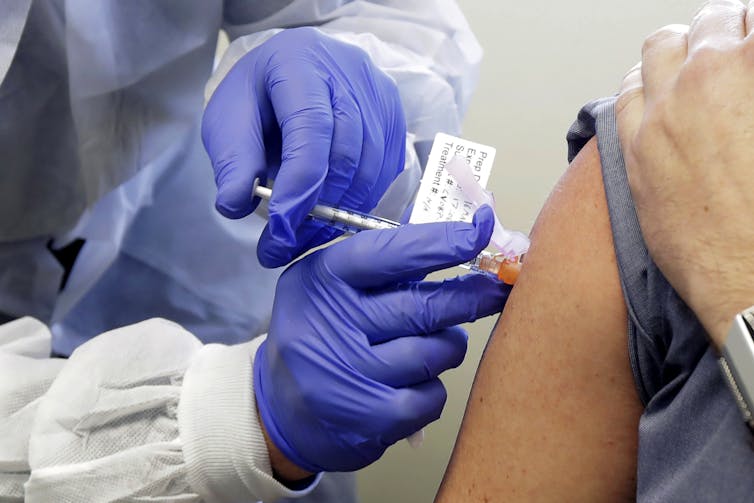 There are many vaccine candidates currently being trialled, and researchers are hoping they can generate long-lasting immunity. But new evidence suggests immunity wanes quickly, meaning we may need regular booster vaccines.
Ted S. Warren/AP/AAP
There are many vaccine candidates currently being trialled, and researchers are hoping they can generate long-lasting immunity. But new evidence suggests immunity wanes quickly, meaning we may need regular booster vaccines.
Ted S. Warren/AP/AAP
Herd immunity might be in trouble
So herd immunity may not be the solution some think. This is because if immunity is short-lived, we will be in an ongoing cycle of endless reinfection. For herd immunity to be effective we need a high percentage (perhaps more than 60%) of people to be immune at any one time to disrupt chains of transmission. This can’t happen if a lot of reinfection is occurring.
The hope is vaccines will give much stronger and longer lasting immune responses to the virus than getting and recovering from COVID-19 itself. Indeed, the first vaccine candidates from Pfizer and Moderna, reported in early July, show very strong immune responses.
However, these studies only reported out to 14 and 57 days, respectively, after vaccinations were completed. They don’t tell us whether there is a long-lived response that we would need for a vaccine to be truly protective. Phase 3 trials designed to measure this are due to report in December 2020, so watch this space.
While we wait, we should reflect on the fact that although the results of the Kings College study are in one sense disappointing news, this knowledge adds to the truly remarkable scientific progress we have made in understanding a virus that only emerged in December 2019.
This article is supported by the Judith Neilson Institute for Journalism and Ideas.
Authors: Nigel McMillan, Program Director, Infectious Diseases and Immunology, Menzies Health Institute, Griffith University


 Daily Bulletin


