

State of disaster called as Melbourne moves to nightly curfew and stage 4 restrictions
- Written by: Adrian Esterman, Professor of Biostatistics, University of South Australia
Victorian Premier Daniel Andrews has announced that metropolitan Melbourne will move to “stage 4” restrictions from 6pm Sunday, as new cases of COVID-19 continue to rise. The state recorded another 671 cases and 7 deaths on Sunday.
Andrews has declared a state of disaster from 6pm on Sunday, imposing a nightly curfew on Melbourne and giving the government and police extra powers to enforce the new restrictions.
Meanwhile, regional Victoria (outside of Melbourne) will move to stage 3 restrictions from midnight on Wednesday. Mitchell Shire will remain at stage 3.
What are the new restrictions?
Under the new stage 4 restrictions, only one person in each household can do shopping once a day. Exercise can be undertaken once a day for one hour, and no more than two people can exercise together. Residents can’t travel more than five kilometres from their home for shopping or exercise.
During the curfew, the only permitted reasons for being outside will be to receive or give care, or to go to or from work. A fine of A$1,652 will apply for anyone breaching these restrictions, and police will have the power to arrest those breaking the curfew without good reason.
Andrews said there are “common sense” exemptions. People can travel more than 5km to see their intimate partner and for care giving.
All schools across the state will move to remote learning from Wednesday, with some exceptions, such as students with special needs and children of essential workers.
On Monday, Andrews will outline further restrictions on workplaces. He flagged three categories: workplaces such as supermarkets, grocers and bakeries will remain open; some workplaces will stay open but with restrictions; and others will shut down or work exclusively from home if possible.
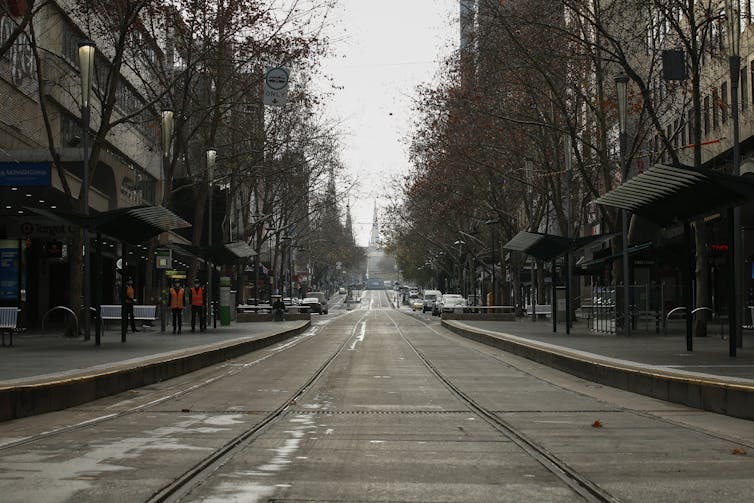 Shopping in Melbourne will be limited to essential items, once per day by one member of each household, within 5km of home.
Daniel Pockett/AAP Image
Shopping in Melbourne will be limited to essential items, once per day by one member of each household, within 5km of home.
Daniel Pockett/AAP Image
How did we get here?
Andrews said the current restrictions were “not working fast enough”, and that continuing with the current settings would mean it takes until the end of the year to drive daily numbers down to a point at which restrictions could be eased.
This comes as no surprise to those of us working in public health. Several epidemiologists have argued that stage 3 restrictions were not severe enough. For example, it seemed crazy when stage 3 restrictions were imposed in early July that people were told they could travel for work or study if unable to do it from home. This left the door open for too many people to travel while potentially infected.
Andrews said that there are currently 760 “mystery” cases – that is, cases of community transmission for which the source of infection is unknown. This is tantamount to saying the disease is out of control.
A range of exacerbating factors have brought us to this point. They include:
Aged-care homes
Much of the current outbreak is occurring in aged-care homes across Victoria. The handling of the situation in aged-care homes has been abysmal. The deployment of AUSMAT teams to aged-care homes is very welcome, but has come far too late. Aged-care residents with any symptoms should be immediately transferred to a hospital or clinic, although admittedly this is is not easy for some patients.
The current bickering between the Victorian and federal governments about who is to blame for the high number of infections and deaths in aged-care homes is counterproductive. The damage has been done — let’s fix it.
Failures to self-isolate
One of the main reasons why the current restrictions have not worked is that many people who have tested positive have not followed quarantine instructions and were not home when they should have been. Some of these might have been absent for a genuine reason, but many were likely low-paid casual workers who either couldn’t afford not to work, people who did not understand what they were supposed to do, or those who simply did not care. On top of this, there has been confusion in the Victorian government messaging about what to do while waiting for test results.
Read more: 'Far too many' Victorians are going to work while sick. Far too many have no choice
Is the virus more contagious?
The current strain of SARS-CoV-2 circulating around the world is more contagious than the original form. But that in itself cannot explain why only Victoria is grappling with disaster, and not the whole of Australia. However, the fact the virus is more contagious does mean it can take better advantage of the lapses in Victoria.
Will stage 4 restrictions work?
They should do — they include many of the rules we have been calling for, such as a stricter definition of essential workers and workplaces. But there are yet more potentially useful measures, which are not necessarily very expensive.
In a previous article I said that if necessary, Australian Defence Force (ADF) personnel could be used to deliver food and essential supplies to those at high risk, and help with logistics. They are trained in disaster relief, supply chain management and logistics. ADF staff are currently door-knocking people who have tested positive to check they are self-isolating. While there, why can’t they deliver 14 days’ supply of food and essential items to help people stay at home? They could also deliver supplies to vulnerable people stuck at home.
The ADF could also work with the major supermarket chains to ensure that they are well-stocked, and therefore help reduce the panic buying currently happening in Melbourne.
Finally, better messaging is required. The Victorian government is not getting through to enough people about why the restrictions are essential. For example, compared with other state health departments, Victoria’s COVID-19 page is very clinically oriented, and not particularly user-friendly.
How will we know the new restrictions are working?
There are several indicators that help us assess what is happening. The effective reproduction number, or Reff, is the average number of people each infected person themselves infect. It needs to be below one for the outbreak to die out.
However, at this stage of the outbreak, it can only be estimated by modelling, and is more of a long-term indicator. An alternative is the “growth factor”. This is simply the number of cases today, divided by the number yesterday. We would like to see the growth factor less than one, and unlike Reff, it is a short-term indicator.
Because daily cases can fluctuate for many reasons, we prefer to look at a moving average that smoothes out daily numbers and helps spot trends. With a 5-day median incubation period, a 5-day moving average should show up whether or not the new restrictions have worked.
Finally, we must see community transmission of unknown origin go down.
This article is supported by the Judith Neilson Institute for Journalism and Ideas.
Authors: Adrian Esterman, Professor of Biostatistics, University of South Australia


 Daily Bulletin


