

Can Victorians stick to the stage 4 rules? Our perception of what others are doing might be the key
- Written by: Liam Smith, Director, BehaviourWorks, Monash Sustainable Development Institute, Monash University
With new rules restricting Victorians’ activities and movements to try and stem the second wave of coronavirus cases comes the question of whether people will actually stick to them.
There are at least two ways to answer this question, from a compliance perspective and a behavioural science perspective. Both lead to a similar answer: yes. But there are caveats when it comes to people’s behaviour, and it’s important we know them to keep compliance high.
There are various compliance models that predict whether people will follow the rules.
These models describe compliance as a complex formula of different motives (for example, economic or social factors), capabilities (having the knowledge or resources available to comply with the rules), a respect for the law, and the risk of detection and punishment (including severity) if caught.
Read more: What to do with anti-maskers? Punishment has its place, but can also entrench resistance
Looking at the current situation in Victoria, it appears many of these predictive boxes are ticked, meaning compliance should be high.
For example, the new rules have been shared widely in traditional and social media, so most people should be aware of them. Daily messaging about the number of people dying from COVID-19 and the strain on ICUs provides a strong moral platform to motivate people to behave correctly.
And widespread communication about the enforcment of the rules should cause people to feel they’re likely to be caught if they break them.
Required behaviours are also highly visible — wearing face masks, being in groups of no more than two people, staying indoors after 8pm — which makes the certainty of detection higher for those who flout the rules.
And if people are caught breaking them, the punishments are severe, as evidenced by the on-the-spot fines of nearly $5,000 for people who fail to self-isolate.
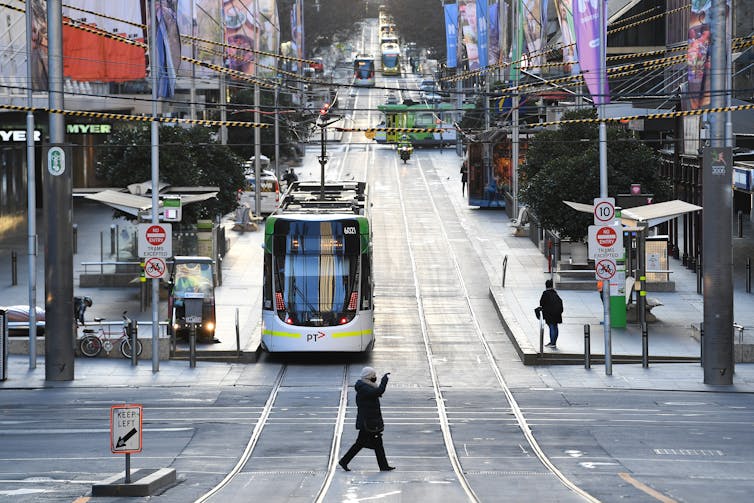 Melbourne’s streets are noticeably quiet since the new restrictions went into place.
James Ross/AAP
Melbourne’s streets are noticeably quiet since the new restrictions went into place.
James Ross/AAP
Other factors that make compliance uncertain
Yet it isn’t that simple. New research from the US adds other factors that are important, such as the many opportunities for people to break the rules, impulsiveness (vs self-control) and the perceptions of what others are doing.
These factors — along with knowledge of the rules, the practical capacity of people to follow them and the threat of COVID-19 itself — were what influenced compliance rates in the US study. The possibility of being caught and the severity of punishment, however, were less relevant.
Read more: Psychology can explain why coronavirus drives us to panic buy. It also provides tips on how to stop
These latest models suggest compliance may not be so easy. There are plenty of opportunities for people to break rules, for instance, and impulsiveness is hard to control.
There is also much sharing (and shaming) of rule breakers on social media, as well as details on the number of fines being issued, which may lead to a perception that compliance rates are lower than they are.
Perceptions of others can influence our own behaviour
There is a long history of evidence that shows how our behaviour is influenced by what others are doing around us (regardless of whether these norms are real or perceived). Importantly, this can work in both positive and negative ways.
If we believe most people (or a growing number of people) are following the rules, we are all more apt to behave properly. And highlighting this positive behaviour to others can be a powerful tool. A good example of this is Victoria Premier Dan Andrews tweeting the empty streets of Melbourne this week.
However, the influence of others can backfire when there is a perception a lot of people are breaking the rules.
This perception can be fuelled by the media regularly seeking out and sharing examples of rule breakers. If we believe there is widespread non-compliance, it often leads to further non-compliance.
It takes time to form new habits, but then they become easy
Another uncertainty is how long it takes people to grow accustomed to new rules and form new behaviours.
Some research suggests an average of 66 daily repetitions, but this is highly dependent on the specific behaviour and audience.
It stands to reason the more we become accustomed to always wearing a mask when we leave the home, the more likely this behaviour will become habituated. This makes it easier to do over time, as it requires less thinking. The behaviour simply becomes automatic.
And if behaviours become habituated, there should be fewer concerns over so-called “response fatigue”, which occurs when we become tired of having to be constantly vigilant about our behaviour — particularly when we are unsure if it’s making a difference.
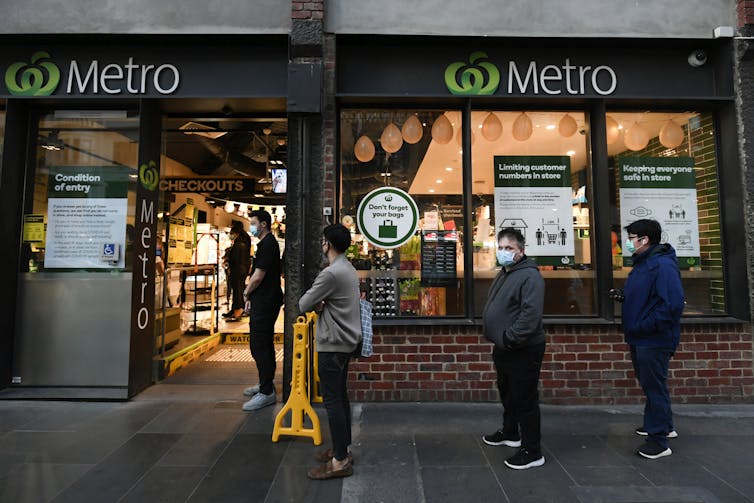 Social distancing has become the norm in Australia since early in the pandemic.
Erik Anderson/AAP
Social distancing has become the norm in Australia since early in the pandemic.
Erik Anderson/AAP
We need to be specific about behaviour
Lastly, people are much more apt to follow rules when the authorities are clear in their directions of what is and isn’t allowed. It’s necessary to tell people what you want them to do, why, when, where and for how long.
Such clarity can provide us with much-needed direction, motivation and persistence in times of uncertainty, even in the face of challenging tasks and difficulties tempering our lack of impulse control.
Read more: Coronavirus spike: why getting people to follow restrictions is harder the second time around
The COVID-19 world presents a unique type of compliance and behaviour change challenge. It requires high levels of compliance — all the time and over a prolonged period of time.
We can’t tolerate or ignore a small minority of people doing the wrong thing, as this will have implications for all of us.
While compliance and behavioural science research would suggest most of the right things are in place in Victoria to foster compliance, we still remain vulnerable to our own biases, desires and previous habits.
But through the sharing of collective and clear goals, a close examination of the factors that influence us (including the perception of rule breakers we see in the media) and the formation of new habits, it is possible to get everyone to fall in line and do the right thing.
Authors: Liam Smith, Director, BehaviourWorks, Monash Sustainable Development Institute, Monash University


 Daily Bulletin


