

How to keep your contact lenses clean (and what can go wrong if you don't)
- Written by: Nicole Carnt, Scientia Senior Lecturer, School of Optometry and Vision Science, UNSW, Sydney, UNSW
You’re rushing and accidentally drop a contact lens on the bathroom floor. Should you:
a) run it under the tap and pop it in?
b) spit on it and do the same?
c) use the cleaning solution your optometrist insists you use?
d) replace it with a new lens?
e) do any of the above. It doesn’t really matter.
Don’t do what champion boxer and rugby league legend Anthony Mundine did in 2007 and go for (b) spit on your lens. He ended up in hospital with a severe eye infection.
If you chose c), it’s true that rubbing your lens with the cleaning solution for 20 seconds will remove some microbes. But you would need to soak the lenses in the solution for a minimum four to six hours to disinfect the lens effectively.
The best answer is d) replace with a new lens.
Running the lens under the tap, option a), risks your lens and eye becoming infected with a microorganism found in tapwater that could lead you to losing your sight.
Read more: Curious Kids: will I go blind if I shut my eyes and face the Sun?
Not all eye infections are harmless
Aren’t all eye infections conjunctivitis? Like the kids get, bit of redness, icky discharge, drops from chemist, all good after a week?
No. If your contact lens mixes with water, you could get a rare but severe infection called acanthamoeba keratitis.
Of the 680,000 contact lens wearers in Australia, we estimate 10-20 a year are affected by the condition.
Of these, we estimate about two to four people a year will need a transplant at the front of their eye to regain vision; about two to five people will need treatment for more than a year.
The condition mostly affects people who wear soft contact lenses, the main type worn in Australia.
Here’s how the condition affects people and their partners (NIHR Moorfields BRC).We found about one-third of bathroom sinks in greater Sydney contain acanthamoeba. We assume it’s present in other parts of the country but no-one else has studied it so don’t know how common it is elsewhere in Australia.
Acanthamoeba are free-living protozoa (single-celled microorganisms) that feed on bacteria and cells at the front of the eye, the cornea. This leads to inflammation, disorganisation and destruction of the cornea, blocking vision.
The vast majority of acanthamoeba keratitis occurs in contact lens wearers.
But you can minimise your chance of getting it. Avoid exposing your lenses to water, including running them under the tap, in the shower or while swimming.
In fact, many new packs of contact lenses now carry “no water” warning stickers like the one below.
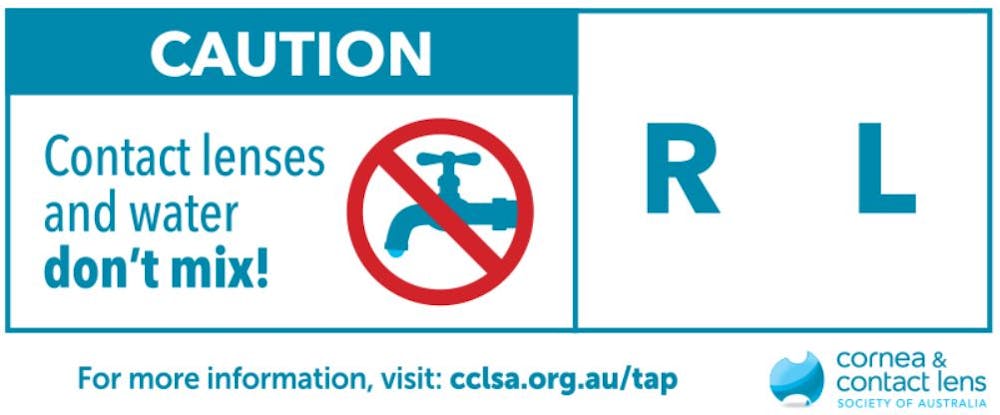 Contact lens packs are now clearly marked reminding users of the dangers of exposing lenses to water.
Cornea and Contact Lens Society of Australia
Contact lens packs are now clearly marked reminding users of the dangers of exposing lenses to water.
Cornea and Contact Lens Society of Australia
Another of our studies shows this particular warning sticker can change behaviour. Contact lens wearers who see this sticker are more likely to avoid water. Their contact lens storage cases were also less likely to be contaminated with bacteria, meaning less chance of bacterial infection and less food for acanthamoeba.
You can catch other eye infections too
While acanthamoeba infections are rare, bacterial eye infections are much more common, estimated to affect around four per 10,000 contact lens wearers a year.
About 13% of people whose eyes or contact lenses are infected with bacteria lose substantial vision. That’s equivalent to two lines or more on the vision chart optometrists use.
Read more: Explainer: what is conjunctivitis and how did I get it?
Most people’s infections improve in two to four weeks by using antibiotic drops.
However, bacterial infections can be severe and fast-acting. The main bacterium responsible for contact lens related infections is pseudomonas, another water-loving microorganism. It can sometimes burrow through the eye surface in hours.
There is no evidence to suggest wearing contact lenses increases your risk of being infected with the virus that causes COVID-19.
So how do I avoid all this?
These evidence-based tips for healthy contact lens wear will help you avoid infections:
wash and dry your hands before handling lenses or touching your eyes
rub, rinse and store contact lenses in fresh disinfecting solution. Topping up old solution with new is an infection risk
clean your storage case with the disinfecting solution and leave to air dry upside down between uses
don’t use water with lenses or cases
avoid wearing your lenses overnight.
How do I know if I have a problem?
If your eyes sting, are red and watery, blurry or are otherwise uncomfortable while wearing your lenses, remove them.
If your symptoms get worse, visit an optometrist. GPs do not usually have equipment with enough magnification to diagnose potentially serious eye infections.
Pseudomonas is resistant to the strongest over-the-counter drops, chloramphenicol. But most optometrists can treat eye infections by prescribing eye drops and can refer you to an ophthalmologist (a specialist eye doctor) if needed.
Authors: Nicole Carnt, Scientia Senior Lecturer, School of Optometry and Vision Science, UNSW, Sydney, UNSW
&media=https://www.dailybulletin.com.au/https://images.theconversation.com/files/350534/original/file-20200731-35-1fi1f6t.JPG?ixlib=rb-1.1.0&q=45&auto=format&w=754&fit=clip&description=How%20to%20keep%20your%20contact%20lenses%20clean%20(and%20what%20can%20go%20wrong%20if%20you%20don't) "Pin It")

 Daily Bulletin


