

Kids spend nearly three-quarters of their school day sitting. Here's how to get them moving — during lessons
- Written by: Natalie Lander, Senior Research Fellow, Deakin University
Regular physical activity is linked to improvements in physical and mental health including anxiety and depression. It can also improve cognitive functioning such as attention and memory, and academic achievement in children.
But only 14% of Australian children get the recommended 60 minutes of physical activity per day and they spend 70% of the school day sitting. Primary school students spend over half of the school week in English and maths lessons, and the majority of these lessons are traditionally sedentary — up to 76% of their time is spent sitting during maths.
Australian students’ are scoring lower in international tests than before while sedentary behaviour and mental-health issues are on the rise. One way to improve academic outcomes and health is to add more movement to classes.
Mixing learning with movement
Theories of cognition — the mental processes in acquiring knowledge — hold that we learn through physical actions in our environment, as well as through physical senses and perceptions. So, engaging in physical activity can help students better understand concepts and retain the experience in a meaningful way.
But for this to occur, the students’ actions must directly correspond to the learning concept. For example, in maths, kids can stretch their arms diagonally to represent the function y=x, “crocodile” arms can show acute angles, and crossing forearms can create perpendicular lines.
 Students can cross their forearms to create perpendicular lines.
Shutterstock
Students can cross their forearms to create perpendicular lines.
Shutterstock
In groups, they can link arms to form a triangle, and stretch and shrink without changing the angle measurements.
Recent research suggests integrating physical activity in maths lessons enhances student enjoyment, engagement and attitude, and improves maths performance.
In English lessons, research shows physical activity can improve students’ engagement with, and enjoyment of, tasks and lead to better spelling and reading.
Learning and movement doesn’t only have to happen in school. At home, parents can encourage children to move and learn at the same time.
This might involve talking about the numbers on letterboxes while walking to school, as a way to learn about odd and even numbers, or skip counting. When playing soccer in the park, parents can make scoring more challenging with each goal being a fraction (¼) or decimal (1.5) .
Read more: Move it, move it: how physical activity at school helps the mind (as well as the body)
At various times during reading, you could ask your child to stand up and act out a scene to represent what they have just read.
What teachers can do to help kids move more
We have developed an evidence-based program called Transform-Us!. This provides primary school teachers with professional learning and resources to help them adopt teaching strategies that get students moving more and sitting less across the school day.
We also conducted a randomised controlled trial to test the program among seven–to–nine-year-old children in 20 Victorian primary schools. Results showed significant increases in physical activity, time spent on tasks and enjoyment of lessons.
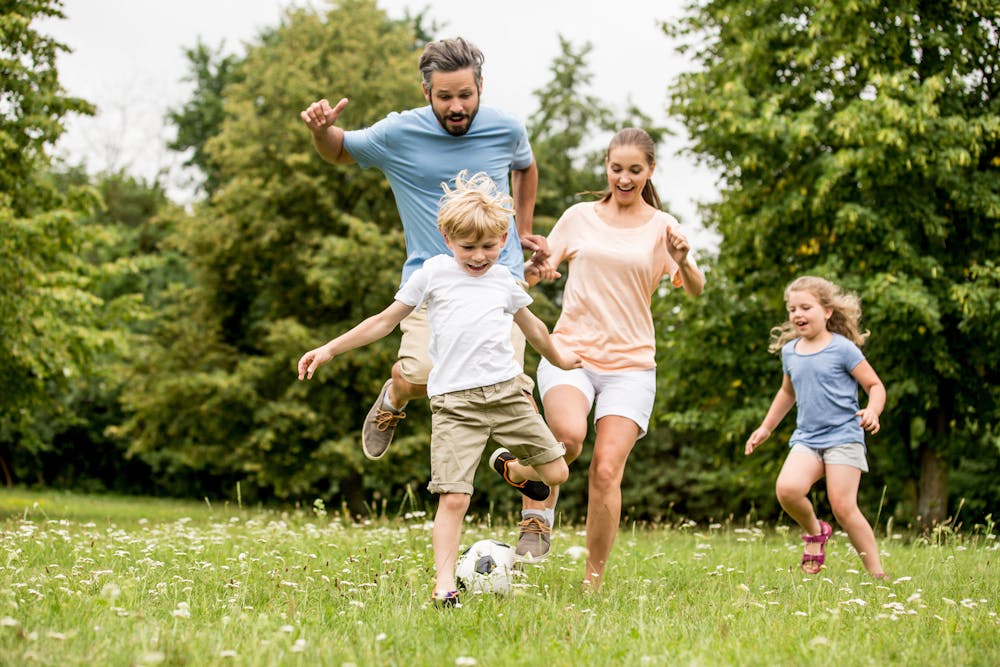 One goal could be 1.5 instead of 1, to teach kids maths.
Shutterstock
One goal could be 1.5 instead of 1, to teach kids maths.
Shutterstock
All teachers can use some of the below strategies to engage students in moving as they learn, which is particularly important in the online learning environment.
Get kids to move during a lesson to help them learn concepts
This could include using arms or bodies to create shapes, or using arms to learn time on a clock. When learning online, a teacher could ask students to
stand up and move safely away from the computer. Get ready for an active lesson to energise your body and activate your brain.
Get students to take two minute active breaks for every 20 minutes of sitting
During these breaks, students engage in short bouts of activity such as a maths activity called “Friends of 10” where one student stands up and faces a partner and puts up a hand with a certain number of fingers (say seven). The other student responds with the number that would take it to ten (three).
In online learning, a teacher could instruct students to stand up and clap or stomp patterns in time together before returning to their work.
Create a classroom environment that supports movement
This could include having standing desks, roving group work or pushing desks to the side to leave open space in the middle of the class for movement. Teachers could also use the playgrounds, outdoor spaces or ground-line markings as learning spaces.
Read more: Let them play! Kids need freedom from play restrictions to develop
Remotely, this can happen by setting children tasks that require them to work away from the screen. A shape treasure hunt is one example. Here, students walk around their house or backyard looking for specific shapes found on a worksheet, and then draw a map indicating where each shape was.
Engage families through physically active homework
This could include asking children to explore the backyard or home and select ten items, predict their measurement and record predictions, measure the items and record measurements, and record accuracy of predictions.
And of course, encourage students to move at recess and lunchtime.
While most of the research on movement during lessons has been done in primary schools (which is where our resources are for), we have started research to see how such strategies would work in secondary schools.
Ideally, all children in the future will have the opportunity to move while they learn through their school years.
Authors: Natalie Lander, Senior Research Fellow, Deakin University


 Daily Bulletin


