

6 months after New Zealand's first COVID-19 case, it's time for a more strategic approach
- Written by: Michael Baker, Professor of Public Health, University of Otago
This week marks six months since New Zealand’s first COVID-19 case was identified on February 26.
So far New Zealand has been largely in reactive mode, initially during the first elimination stage which finished in early June and now in response to the ongoing Auckland outbreak.
Given the vigorous response to controlling this current cluster, we have a good chance of eliminating community transmission again.
But to maximise our protection against future border control failures and outbreaks, we argue it is time to take a far more strategic approach to this pandemic — and we suggest five key steps New Zealand should take.
Strengths and weaknesses of New Zealand’s response
An effective ongoing response to COVID-19 is an all-of-government challenge. It requires seamless coordination of scientific input, policy design and implementation.
An early shift from a mitigation to an elimination strategy was a major strength of New Zealand’s response.
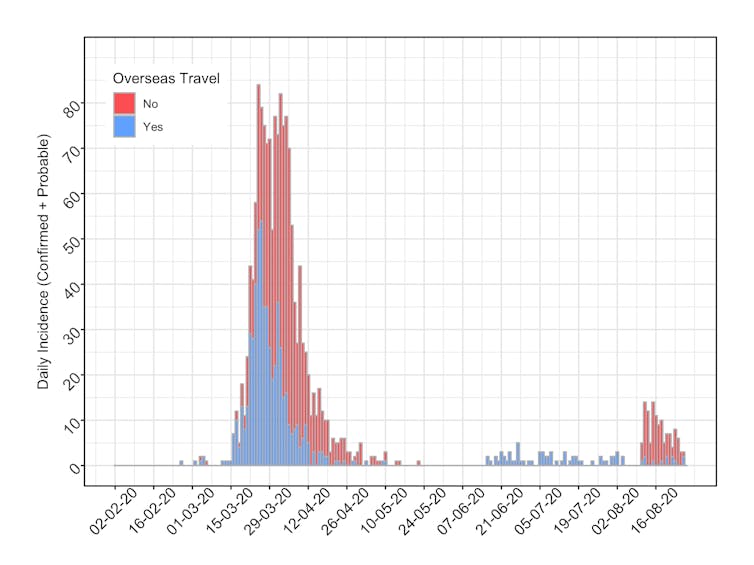
The combination of border controls with a stringent lockdown, supported by considerable science input, including from the government’s chief scientists, was effective in eliminating community transmission after the first outbreak.
 Author provided, CC BY-SA
As a result, New Zealand now has the lowest COVID-19 death rate in the OECD and relatively low economic damage compared with other high-income countries.
But there are serious weaknesses, including multiple failures at our managed isolation and quarantine facilities and slow adoption of digital technologies for contact tracing and mass masking.
Read more:
Masking the outbreak: despite New Zealand's growing COVID-19 cases, there are more ways to get back to elimination faster
Challenges ahead
The most pressing challenge is to bring the current outbreak (New Zealand’s largest cluster, with 108 cases) under control. We also need to learn from this new more targeted resurgence response so we can improve our ability to detect and control any future outbreaks.
Genome sequencing and COVID-19 testing of wastewater are promising new surveillance approaches. But we will also need to upgrade the alert level system to integrate the use of face masks and address high-risk transmission venues such as bars and nightclubs and incorporate new knowledge about controlling transmission.
Contact tracing should also be improved through digital technologies, including the CovidCard.
Read more:
Genome sequencing tells us the Auckland outbreak is a single cluster — except for one case
A second key challenge is to improve the management of our external borders to minimise the risk of introducing the virus. The border is New Zealand’s greatest vulnerability and we need an urgent review of the entire process from pre-travel to post-quarantine.
Last week, the government and the main opposition party both announced new border control policies that include the adoption of digital contact tracing technologies.
Modelling by ourselves and colleagues has been useful for assessing various border control interventions. Options include the use of digital technologies for tracking arriving passengers and staff and monitoring contact patterns.
Author provided, CC BY-SA
As a result, New Zealand now has the lowest COVID-19 death rate in the OECD and relatively low economic damage compared with other high-income countries.
But there are serious weaknesses, including multiple failures at our managed isolation and quarantine facilities and slow adoption of digital technologies for contact tracing and mass masking.
Read more:
Masking the outbreak: despite New Zealand's growing COVID-19 cases, there are more ways to get back to elimination faster
Challenges ahead
The most pressing challenge is to bring the current outbreak (New Zealand’s largest cluster, with 108 cases) under control. We also need to learn from this new more targeted resurgence response so we can improve our ability to detect and control any future outbreaks.
Genome sequencing and COVID-19 testing of wastewater are promising new surveillance approaches. But we will also need to upgrade the alert level system to integrate the use of face masks and address high-risk transmission venues such as bars and nightclubs and incorporate new knowledge about controlling transmission.
Contact tracing should also be improved through digital technologies, including the CovidCard.
Read more:
Genome sequencing tells us the Auckland outbreak is a single cluster — except for one case
A second key challenge is to improve the management of our external borders to minimise the risk of introducing the virus. The border is New Zealand’s greatest vulnerability and we need an urgent review of the entire process from pre-travel to post-quarantine.
Last week, the government and the main opposition party both announced new border control policies that include the adoption of digital contact tracing technologies.
Modelling by ourselves and colleagues has been useful for assessing various border control interventions. Options include the use of digital technologies for tracking arriving passengers and staff and monitoring contact patterns.
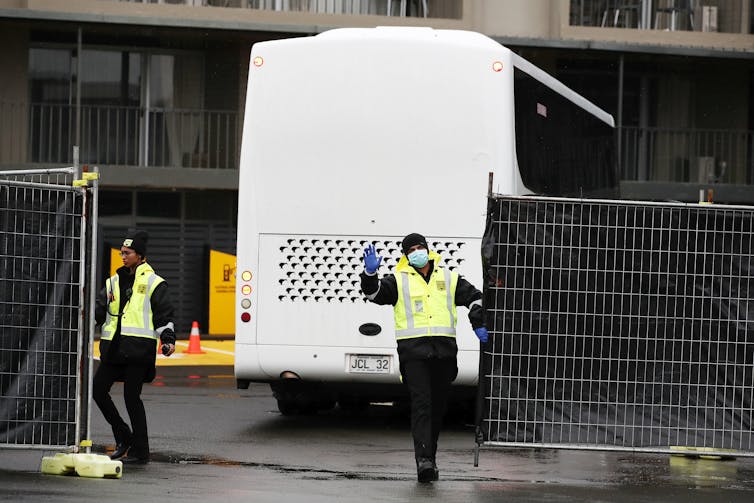 A bus unloads passengers at a managed isolation facility for returning New Zealanders,
Fiona Goodall/Getty Images
There are also important questions about how to improve quarantine, the benefits of purpose-built facilities (with proper ventilation and no shared spaces), and shifting isolation and quarantine facilities out of major cities (for example, to an air force base).
A further challenge is planning for the introduction of a vaccine. There is a long list of uncertainties to work through with any COVID-19 immunisation strategy, including the extent and duration of immunity and who should be targeted for immunisation (assuming limited initial supplies). New Zealand should begin planning now to improve the national immunisation register to support vaccine delivery.
Countries pursuing elimination have different science challenges compared with those where transmission is more widespread. They need to shift their focus to include ‘low-probability high-consequence scenarios’, such as the potential role of imported chilled food as a vehicle for the reintroduction of COVID-19 in the recent outbreak (albeit still much less likely than a border control failure).
Five key ways to be more strategic
We propose five key ways New Zealand could be more strategic in maintaining its elimination goal:
Establish a high-level COVID-19 science council. This council would provide evidence-based strategic advice across the entire response sector, help develop a COVID-19 research and development strategy, and assist with coordinating the efforts of research groups across New Zealand. In this role it might represent a logical development from the current Technical Advisory Group that advises the Ministry of Health.
Develop a well-resourced research and development strategy. This strategy would identify high-priority evidence needed to protect New Zealand from the pandemic while also achieving equitable outcomes and improving the efficiency of the response. A single day at the current alert level (level 3 for Auckland and level 2 for the rest of the country) is estimated to cost the economy NZ$63 million. It would make economic sense to invest at least this amount into research and development to identify ways of minimising the need for such lockdowns as well as addressing other major COVID-19 science questions.
Enhance the quality and transparency of science information. High-quality surveillance data are essential to guide and evaluate the COVID-19 pandemic response. These data and response documents need to be readily available for scrutiny by scientists, journalists and the public to help guide systematic improvements. Much of the critical data have never been available in this way, notably data on the pandemic itself and key components of the response, such as testing data and updates on the performance of the contact tracing system.
Evaluate the response through an official inquiry immediately after the October election. This inquiry would be useful to identify weak areas of the response that require urgent system improvements and help shape the proposed national public health agency.
Establish a national public health agency to deliver the COVID-19 response. Recent public health disasters such as the Havelock North waterborne disease outbreak and last year’s measles epidemic have already highlighted the need for such an agency. Taiwan is the country that has responded most effectively to the COVID-19 pandemic and its dedicated agencies have been a major part of its success.
Taking a highly strategic, science based approach to COVID-19 gives New Zealand the best possible opportunity to sustain its elimination approach. Focusing on principles of equity, transparency and innovation could help develop the organisations, infrastructure and workforce that provide lasting public health benefits beyond the current crisis.
A bus unloads passengers at a managed isolation facility for returning New Zealanders,
Fiona Goodall/Getty Images
There are also important questions about how to improve quarantine, the benefits of purpose-built facilities (with proper ventilation and no shared spaces), and shifting isolation and quarantine facilities out of major cities (for example, to an air force base).
A further challenge is planning for the introduction of a vaccine. There is a long list of uncertainties to work through with any COVID-19 immunisation strategy, including the extent and duration of immunity and who should be targeted for immunisation (assuming limited initial supplies). New Zealand should begin planning now to improve the national immunisation register to support vaccine delivery.
Countries pursuing elimination have different science challenges compared with those where transmission is more widespread. They need to shift their focus to include ‘low-probability high-consequence scenarios’, such as the potential role of imported chilled food as a vehicle for the reintroduction of COVID-19 in the recent outbreak (albeit still much less likely than a border control failure).
Five key ways to be more strategic
We propose five key ways New Zealand could be more strategic in maintaining its elimination goal:
Establish a high-level COVID-19 science council. This council would provide evidence-based strategic advice across the entire response sector, help develop a COVID-19 research and development strategy, and assist with coordinating the efforts of research groups across New Zealand. In this role it might represent a logical development from the current Technical Advisory Group that advises the Ministry of Health.
Develop a well-resourced research and development strategy. This strategy would identify high-priority evidence needed to protect New Zealand from the pandemic while also achieving equitable outcomes and improving the efficiency of the response. A single day at the current alert level (level 3 for Auckland and level 2 for the rest of the country) is estimated to cost the economy NZ$63 million. It would make economic sense to invest at least this amount into research and development to identify ways of minimising the need for such lockdowns as well as addressing other major COVID-19 science questions.
Enhance the quality and transparency of science information. High-quality surveillance data are essential to guide and evaluate the COVID-19 pandemic response. These data and response documents need to be readily available for scrutiny by scientists, journalists and the public to help guide systematic improvements. Much of the critical data have never been available in this way, notably data on the pandemic itself and key components of the response, such as testing data and updates on the performance of the contact tracing system.
Evaluate the response through an official inquiry immediately after the October election. This inquiry would be useful to identify weak areas of the response that require urgent system improvements and help shape the proposed national public health agency.
Establish a national public health agency to deliver the COVID-19 response. Recent public health disasters such as the Havelock North waterborne disease outbreak and last year’s measles epidemic have already highlighted the need for such an agency. Taiwan is the country that has responded most effectively to the COVID-19 pandemic and its dedicated agencies have been a major part of its success.
Taking a highly strategic, science based approach to COVID-19 gives New Zealand the best possible opportunity to sustain its elimination approach. Focusing on principles of equity, transparency and innovation could help develop the organisations, infrastructure and workforce that provide lasting public health benefits beyond the current crisis.
Authors: Michael Baker, Professor of Public Health, University of Otago


 Daily Bulletin


