

Stardust and substance: New Zealand's election becomes a 'third referendum' on Jacinda Ardern's leadership
- Written by: Stephen Levine, Professor, Political Science and International Relations, Te Herenga Waka — Victoria University of Wellington
The delay to the New Zealand election date — to which not every country’s citizenry would have adjusted with such alacrity — was only the latest event in a year when the unexpected and the extraordinary have become constant features of a fragile “new normal”.
What was expected to be a prime ministerial contest between Jacinda Ardern and Simon Bridges led, briefly, to one with Todd Muller before settling on a choice between the prime minister and Judith Collins.
Labour might have set the precedent with its desperate leadership change just weeks out from the 2017 election, but it’s unlikely this was what the National Party had in mind when it first contemplated the dismal opinion poll figures.
For a country whose politics have sometimes been considered boringly predictable, the prelude to the October 17 election has been anything but.
So it is virtually impossible to judge the Labour/New Zealand First/Green coalition’s performance by conventional measures.
The government’s original programme — as articulated in the November 2017 speech from the throne — reflected the three parties’ policy preferences, modified by post-election negotiations and agreements. But that bears little resemblance to the events that have subsequently shaped the reputation of the government and the prime minister.
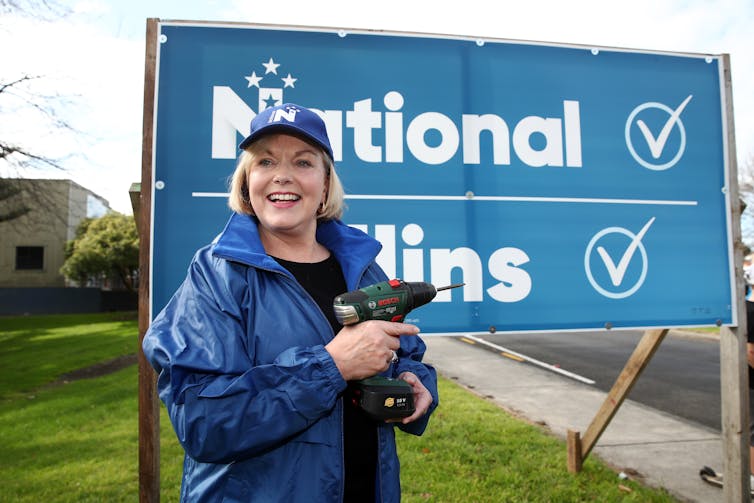 New Zealand National Party leader Judith Collins puts up an election hoarding and hits the campaign trail.
Getty Images
New Zealand National Party leader Judith Collins puts up an election hoarding and hits the campaign trail.
Getty Images
The pandemic election
Nothing in the Labour Party’s 2017 campaign could have prepared the party, its leadership or the electorate for a succession of life-and-death crises: the attack on the Christchurch mosques, the disaster of the Whakaari/White Island eruption and finally the COVID-19 pandemic, with its lockdowns, border closures and economic consequences.
The crises have arisen with almost Shakespearean qualities, prophesied in Hamlet: “When sorrows come, they come not single spies, but in battalions.”
New Zealand responded well in each case, displaying unity, resolve and concern. That speaks volumes for the government and its leadership, but also for the country and its people in general. A leadership that calls on a nation to unite can only succeed when the public complies.
At the same time, public compliance is likely when there is respect for the country’s leadership. Respect is an impermanent reputational asset, of course, won or lost as a result of decisions made and communicated.
The New Zealand Labour Party’s first television campaign advertisement, fronted by leader Jacinda Ardern.The prospect of single-party government
Amid these unpredictable and disruptive events, then, New Zealand’s electoral system (though still relatively new) now represents a kind of certainty and stability.
The 2020 parliamentary elections are the ninth to be held under the mixed member proportional (MMP) system. Having been approved, established and reconfirmed by referendums in 1992, 1993 and 2011, the system is no longer particularly controversial.
However, MMP’s success in delivering greater parliamentary diversity has also accustomed New Zealanders to coalition governments. Might this change in 2020? If the leaders’ debates and other campaign events don’t significantly affect voter preferences and current polling, an outright Labour majority is possible.
Read more: Lowering New Zealand's voting age to 16 would be good for young people – and good for democracy
That would be the first such election result since the introduction of MMP in 1996. But, as with other voting systems, MMP does not guarantee a particular outcome. The country may yet see a return to single-party government.
A third referendum
So, this election is not a normal contest in which political parties parade their programmes and ideological predilections before intermittently interested electors.
Instead, voters emerging from semi-traumatic circumstances — from confinement, new social habits and financial stress — will be asked to reflect on the performance of leaders whose decisions have had literally life-or-death consequences.
Read more: Rogue poll or not, all the signs point to a tectonic shift in New Zealand politics
New Zealand elections have traditionally been about the economy. Voters make choices along semi-tribal lines, reflecting traditional party alignments. Those features will be present in 2020 as well, but they are likely to be influenced by other considerations.
New Zealanders are being called on, first and foremost, to reflect on the performance of the prime minister, whose image dominates every Labour billboard and advertisement.
Alongside the referendums on legalising recreational cannabis use and the End of Life Choice Act, the election itself has become, in effect, a third referendum on the prime minister’s instincts, judgment and determination.
When we published our analysis of the 2017 election we titled the book “Stardust and Substance” — a reference to her then-opponent Bill English’s description of Jacinda Ardern’s supposedly ephemeral “stardust” quality.
This time around, while the stardust is still there, what most voters will be contemplating is the substance of the prime minister’s achievements, and whether other leaders and parties could have done as well, or better, faced with the same constellation of challenges.
The author is organising the traditional post-election conference (involving party leaders, journalists and academics) at Parliament on December 9 (registration here).
Authors: Stephen Levine, Professor, Political Science and International Relations, Te Herenga Waka — Victoria University of Wellington


 Daily Bulletin


