

NZ election 2020: survey shows voters are divided on climate policy and urgency of action
- Written by: Robert McLachlan, Professor in Applied Mathematics, Massey University
New Zealanders are polarised on climate change policy, according to a recent Stuff/Massey University survey of 55,000 readers. This puts the two major political parties in a difficult position as they seek options that are credible yet appealing to voters.
Just 30% of Labour voters and 22% of National voters think the country is “more or less on the right path” on climate action.
The majority of voters on one side of the political spectrum wants to see “urgent action and radical change”, while at the other end most recommend caution and scepticism.
The survey helps explain the deep distrust climate advocates have for the National Party, and their demands for bolder choices from Labour.
Where the parties stand
Labour is running heavily on its record, including the passing of the Zero Carbon Act and the introduction of a falling cap on emissions permits issued under the Emissions Trading Scheme.
Although the government’s COVID-19 recovery spending has been criticised for not being green enough, Labour seems aligned with a “just transition” approach championed by the International Labour Organisation.
Labour’s climate headline policy is for 100% renewable electricity by 2030, five years earlier than planned, and to spend NZ$100 million developing a pumped hydro scheme.
Labour is also sticking with a plan for a nationwide fuel efficiency standard, which would begin to turn around New Zealand’s growing transport emissions.
The party has dropped the electric car rebate, which the National Party has attacked on the grounds it could increase the price of popular vehicles. A similar approach worked for the Australian Liberal Party in 2019.
The Green Party would go further. While also promising 100% renewable electricity by 2030, the party promotes home solar and insulation and community clean energy. More boldly, it would immediately ban new fossil-fuelled industrial boilers and end industrial coal use by 2030 and gas by 2035. It would prioritise free public transport for under-18s, ban petrol car imports from 2030 and create a NZ$1.5 billion cycleway fund.
The National Party has released its electric vehicle policy, with a target of 80,000 electric vehicles on the road by 2023 (up from 16,000 now). It would exempt these vehicles from fringe benefit tax until 2025 and from road user charges until at least 2023 to encourage uptake by commercial fleets.
It would also target a third of government vehicles to be electric by 2023 and allow electric vehicles to use bus and carpool lanes. The last point has been criticised for impeding the flow of buses.
On the other hand, National’s climate spokesperson, Scott Simpson, has called the party a “broad church” and pledged to amend the Zero Carbon Act to emphasise that food production should not be sacrificed for climate goals.
The ACT Party, which on current polling would increase from one to ten MPs, was the only party to oppose the Zero Carbon Act. It now proposes repealing the act and tying the price of carbon to that of New Zealand’s five top trading partners.
What a difference three years make
At the time of New Zealand’s last general election in September 2017, Extinction Rebellion and the School Strike 4 Climate movements did not yet exist. Greta Thunberg was unknown to the world.
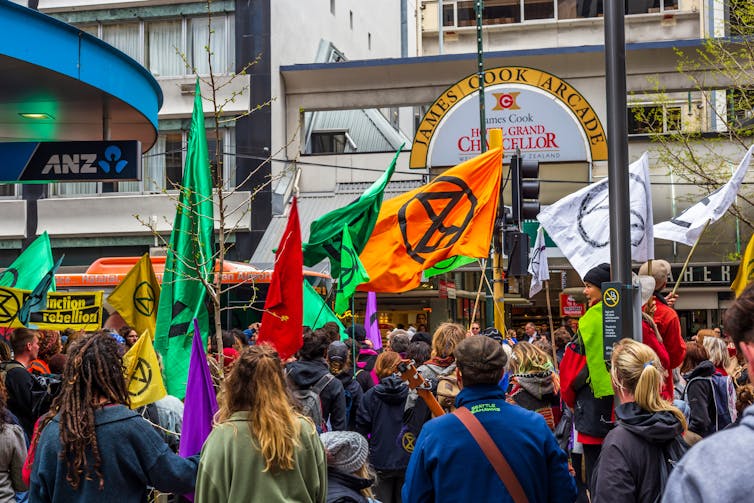 Climate protesters demonstrating in Wellington.
Shutterstock/ Natalia Ramirez Roman
Climate protesters demonstrating in Wellington.
Shutterstock/ Natalia Ramirez Roman
Now climate activism has increased globally. Climate-change impacts, including temperature records of 38℃ in northern Siberia to 54℃ in Death Valley, have attracted widespread attention. Orange skies in San Francisco are a reminder of apocalyptic Australian bushfires less than a year ago.
There are also signs of bolder climate action that may fulfil the declarations of the Paris Agreement. In the European Union, negotiations are under way to cut 2030 emissions to 40-45% of 1990 levels. This target would require halving emissions in the next decade.
In the US, the Democratic presidential candidate, Joe Biden, has a US$2 trillion proposal for rapid decarbonisation. Ireland’s new government has agreed to emission cuts of 7% per year. China has pledged to be carbon-neutral before 2060.
In New Zealand, both Auckland and Wellington councils have released highly ambitious climate plans that will require sweeping changes to housing and transport.
But this year’s New Zealand general election won’t be about climate change. The COVID-19 crisis and the high level of uncertainty about economic recovery and employment have made issues of leadership, trust and party branding more important than ever.
In this context, Labour’s nod to the Lake Onslow pumped hydro project could be a winner. Its storage potential is enormous – more than all of New Zealand’s present hydro lakes combined and 15 times the size of Australia’s Snowy 2.0 project.
It could decarbonise not just all electricity generation, but a lot of industrial process heat and transport as well. It would address the seasonal imbalance between lake inflows and electricity demand, and protect against dry years. But it’s also a traditional civil engineering project far in the future and doesn’t threaten anybody’s lifestyle today.
In New Zealand, as elsewhere, climate politics means finding support for actions now whose benefits extend far into the future.
Authors: Robert McLachlan, Professor in Applied Mathematics, Massey University


 Daily Bulletin


