

Some private schools need to change their models — they were losing students even before COVID
- Written by: Paul Kidson, Lecturer in Educational Leadership, University of Wollongong
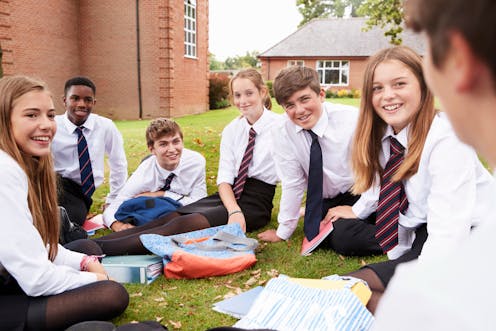
Some Australian private schools have reported lower interest from prospective parents due to the financial pressures of COVID-19.
A number of Victorian school principals have also called on the state government to re-open borders to international students. They say there’s a possibility schools may be forced to close, due to severe financial distress from the non-return of students.
But the cause of the problem may lie not so much in COVID border closures but in fragile business and financial models adopted by some schools.
It was getting worse before COVID
Some schools with large boarding communities, including The King’s School and St Joseph’s College in Sydney, have accessed JobKeeper payments as their income met the 30% downturn threshold, while their total income is fewer than A$1 billion. These schools enrol large numbers of regional and rural students, as well as international students.
The last few years have also seen a steady increase in weekly boarders — who come from families for whom juggling work and study is facilitated by boarding, even when they live in relative proximity to the school.
The costs associated with running these residential facilities is significant, so it’s unsurprising the loss of boarding income for these schools is acute.
The loss of international student enrolments for most schools, though, is unlikely to cause many of these schools to reach the 30% downturn threshold. The Australian Boarding Schools’ Association notes only 10% of its 21,000 residential students are from overseas. With these smaller numbers, some principals now find themselves with an increasingly stressed financial situation and little direct support.
This is not new, as the history of the global financial crisis shows. In the five years between 2008 to 2013, international student enrolments in Australian schools fell from 28,291 to 17,739. The number of new enrolments also fell from 14,281 to 8,753. Both represent nearly 40% declines — far in excess of the 18% decline of international school enrolments reported by Austrade in July 2020.
And international school enrolments flatlined over the period 2016-2019, even as the higher education and vocational education sectors increased by more than 30% across the same period.
Read more: Five charts on Catholic school enrolments: they're trending down while Australia's population booms
Independent Schools Australia, the peak advocacy body for schools where most international students enrol, also notes while overall international education enrolments increased by 9.7% in 2019 from the year before, international student enrolments in non-government schools declined by 4.7% in the same period.
The case for government intervention due to COVID weakens somewhat in light of these data.
Some private schools need to rethink their models
Parental choice — often the preferred ground of legitimacy for non-government schools — may also require some principals to rethink the sustainability of their models. International enrolments are not subsidised by the Australian government and their fees can be very high compared to domestic students. For example, Wesley College in Melbourne charges A$42,850 for international students in Years 9 to 12 (not including the additional $27,000 for boarding), while domestic students in Year 10 to 12 are charged $34,610.
A reduction of this income can have a significant and material impact on school operations. When parents cannot afford the fees, they will shift their child’s enrolment to a school with more sustainable fee levels.
When school enrolments deteriorate, there is significant human cost to teachers, administration and support staff. That loss, while painful for those directly impacted, could be a gain for other schools in both government and non-government sectors.
Read more: The UK Labour Party wants to abolish private schools – could we do that in Australia?
As enrolments drift elsewhere, so too does the need to increase staffing in those schools to accommodate additional enrolments. The data above suggest solutions will need to emerge from within the schools themselves as they did post-GFC, rather than from government.
The non-government school sector has long benefited from the marketisation of education in Australia. The challenge now is how some schools will reconfigure their operations in light of these changing circumstances. If they do not, or cannot, the future looks quite dire.
In response to COVID-related financial pressures, some private schools have reportedly offered fee cuts and deferrals, and asked alumni to help pay the fees of students at risk of quitting due to economic pressures in the family.
The rapid growth of UK independent school partnerships in China is also providing an increasing range of options for parents seeking international education experience.
Some private schools will likely need to adjust their staffing levels as their enrolments change; if they can do so successfully, their future may be more secure, if not quite the future those school communities and principals may have envisaged.
Such is the logic of market-driven policy.
Authors: Paul Kidson, Lecturer in Educational Leadership, University of Wollongong


 Daily Bulletin


