

Another building-site death adds to demands for industrial manslaughter laws
- Written by: Bobbie Oliver, Honorary Research Fellow, Humanities, University of Western Australia
The death of 23-year-old apprentice Jonnie Hartshorn on a Perth university building site is the 23rd workplace fatality among construction workers in Australia in 2020.
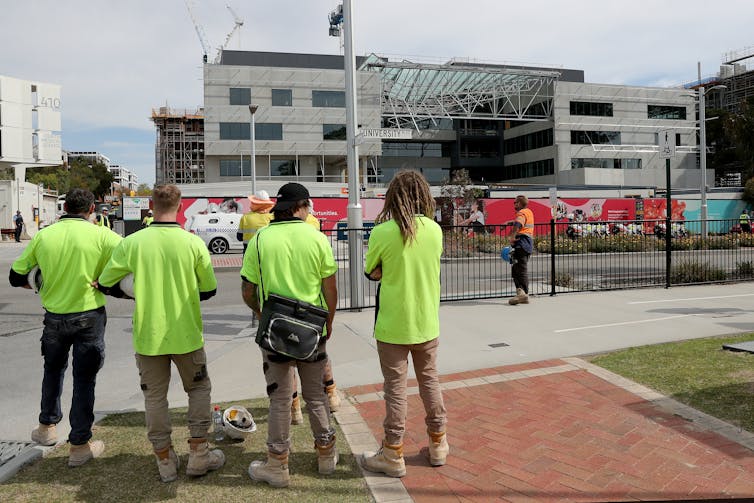
Hartshorn was killed on October 13 after falling 20 metres when the glass canopy of the building he was working on at Curtin University collapsed. Two co-workers were seriously injured.
The causes of the collapse, and any legal liability, are yet to be determined. But Hartshorn’s death highlights a tragic record of construction fatalities.
Today several hundred workers rallied at Western Australia’s Parliament House to demand new laws to make workplace manslaughter a criminal offence, as Labor governments have done in Queensland, Victoria and the Australian Capital Territory.
Western Australia’s Labor government has already introduced such legislation into parliament. But it has stalled in the upper house, where Labor members hold only 14 of the 36 seats. With the Liberal and National parties opposed to higher penalties, passage depends on four Greens, two One Nation members, one Liberal Democrat and one Shooters, Fishers and Farmers representative.
Criminal penalties may well help. But my research into the history of deaths on West Australian construction sites (for a paper to be published in the journal Labour History next month), highlights a range of issues contributing to past workplace deaths.
These include unskilled workers in insecure jobs, insufficient training, and the marginalisation of unions. These systemic problems also need to be addressed.
Read more: Killed in the line of work duties: we need to fix dangerous loopholes in health and safety laws
Workplace fatalities in Australia
The 23 deaths on building sites account for about 19% of the 122 workplace deaths in Australia so far this year. Just two industry sectors have had more deaths – transport, postal & warehousing (38 deaths) and agriculture, forestry & fishing (25 deaths) – with vehicle accidents being the main cause.
The most recent statistics from Safework Australia (the federal agency that develops national work health and safety policy) show the highest fatality rate is among machinery operators and drivers (6.2 deaths per 100,000 workers). This is followed by labourers (2.9 per 100,000) and technicians and trades workers (1.5). By comparison, the rate for clerical and sales workers is 0.1 per 100,000.
Work health and safety laws are the responsibility of state and territory governments. They mandate employer’s duties to provide a safe work environment, with penalties for non-compliance. The Australian Capital Territory was the first jurisdiction to introduce industrial manslaughter laws, in 2004. Queensland did so in 2017, and Victoria earlier this year. Elsewhere employers found culpable for worker deaths face only fines.
Read more: How and why do construction plant-related fatalities occur?
Would higher penalties prevent deaths?
Under existing West Australian laws, body corporates can be fined up to A$3.5 million for negligence causing a worker’s death. Between 1999 and 2019, though, the highest fine imposed was A$160,000, on trucking company Axedale Holdings in 2018 over the deaths of two construction workers, Joseph McDermott, 24, and Gerard Bradley, 27, who were crushed by concrete panels being unloaded from a trailer in November 2015.
Whether higher penalties create safer work places is a matter of debate.
Unions and others have campaigned for criminal penalties, believing the prospect of a prison sentence for employers might serve as an incentive to improve safety.
But international research shows the success rate of corporate manslaughter prosecutions against corporations and individual officers has been poor, because attributing physical fault is difficult.
Lines of non-responsibility
One of the problems on construction sites is the prevalence of sub-contractors and workers hired through labour-hire companies. This muddies clear lines of accountability. According to safety inspectors, labour-hire firms, sub-contractors and even construction companies are often ignorant of their duty of care to employees.
Some building companies are notorious for employing unskilled, poorly trained foreign nationals on casual contracts. Workers in precarious employment fear to speak out about safety breaches. Steve McCartney, the West Australian state secretary of the Australian Manufacturing Workers’ Union, which represents maintenance workers on building sites, told me of cases of workers being sacked for speaking out about safety issues.
Read more: Killed in the line of work duties: we need to fix dangerous loopholes in health and safety laws
In these circumstances, responsibility for safety is often left to the individual worker, rather than the employer as work safety laws mandate
 At the scene of the collapsed building at Curtin University on October 13, 2020.
Richard Wainwright/AAP
At the scene of the collapsed building at Curtin University on October 13, 2020.
Richard Wainwright/AAP
Pushing out unions
The casualisation of labour and emphasis on individual responsibility for safety is concurrent with the marginalisation of unions. Since July 2019, for example, changes to the federal Fair Work Act pushed through by the Morrison government require union officials to give 24 hours’ notice in writing before entering a work site.
The federal government has argued such amendments are necessary to curb unlawful union behaviour, particularly by the Construction, Forestry, Maritime, Mining and Energy Union.
Its war against the union has included a establishing a royal commission into the building industry in 2014, reinstating the Australian Building and Construction Commission in 2016 (first established by the Howard government in 2005), and several attempts to pass its Ensuring Integrity Bill, concentrated on reducing union power.
Read more: 'Louts, thugs, bullies': the myth that's driving Morrison's anti-union push
Whatever the merits of addressing “rogue unionists”, a wide-ranging body of research indicates work sites with an active union presence are safer than non-union sites. For example, a 2015 Canadian study analysing data from more than 40,000 construction firms concluded unionised workers were “almost 30% less likely to suffer critical injuries”.
 Members of the Construction, Forestry, Maritime, Mining and Energy Union and other workers rally in Adelaide in October 2019 to demand the introduction of industrial manslaughter laws.
Kelly Barnes/AAP
Members of the Construction, Forestry, Maritime, Mining and Energy Union and other workers rally in Adelaide in October 2019 to demand the introduction of industrial manslaughter laws.
Kelly Barnes/AAP
Workers must, of course, take responsibility for their own safety, but this can only be effective in an environment where reporting safety breaches is encouraged and rewarded.
Employees are empowered when they have a voice through safety committees and union representatives. Secure work and adequate training are also empowering. Too many workers have neither.
Authors: Bobbie Oliver, Honorary Research Fellow, Humanities, University of Western Australia


 Daily Bulletin


