

News of the collapse of the Grocon empire is greatly exaggerated
- Written by: Geoff Hanmer, Adjunct Professor of Architecture, University of Adelaide
Grocon, the Australian construction empire that grew from the family concreting business started by Luigi Grollo in Melbourne in 1948, is on its last legs.
But Grocon, the privately held property development empire headed by Luigi’s grandson Daniel Grollo, will continue to operate.
Media outlets have breathlessly reported Grollo’s announcement that Grocon’s construction business is insolvent, meaning it is no longer able to pay its debts, and that external administrators have been called in (as the law requires) to sort out if the business can be sold or its assets liquidated to pay off at least some of what is owed.
The Grocon group, though, is more than a construction business, having found better money-making opportunites in property development and being a landlord. It is a web of many legal entities and holding companies.
Exactly how much of the web is being put into administration is not yet clear – as a private company, disclosure requirements are fewer than those for public companies (listed on a stock exchange).
But based on Grocon’s track record – and common practice in the Australian building industry – the most likely upshot is that Grocon will cut its losses on ailing entities without affecting the profitable parts of the greater empire.
One thing seems sure, though. Daniel Grollo and other executives will not be at risk of losing their homes and livelihoods. The real losses will be felt by others.
Development beats construction
Luigi Grollo’s construction business began with pouring concrete on small projects. As time went by its projects got bigger. In the 1970s it moved beyond building for other entities into property development on its own account – acquiring land, gaining development approval, building and then selling or leasing the finished product.
Development, which requires a certain amount of vision, access to capital and solid political connections, is the route to making serious money.
Read more: Federal parliament just weakened political donations laws while you weren't watching
Construction, by comparison, provides limited opportunities for a big payday and plenty of opportunities to make a hash of it.
The landscape for Australia’s “Tier 1” builders – the contractors able to take on the largest projects – has been poor for several years.
Lendlease, for example, announced in December 2019 it was selling its engineering construction business to Spanish infrastructure conglomerate Acciona. The sale followed huge losses on projects such as the Melbourne Metro underground rail project and Sydney’s NorthConnex motorway tunnel project.
John Holland, the builder of Melbourne’s West Gate Tunnel and the Sydney Metro light-rail project, lost A$60 million in 2019. CIMIC Group (previously known as Leighton) made a net loss of A$1 billion.
Grocon’s Barangaroo stoush
The stated catalyst for Grocon’s announcement about its construction business is a legal dispute with Infrastructure New South Wales, the state authority overseeing the development of Sydney’s Barangaroo precinct. Different companies are developing and building different parts of the project.
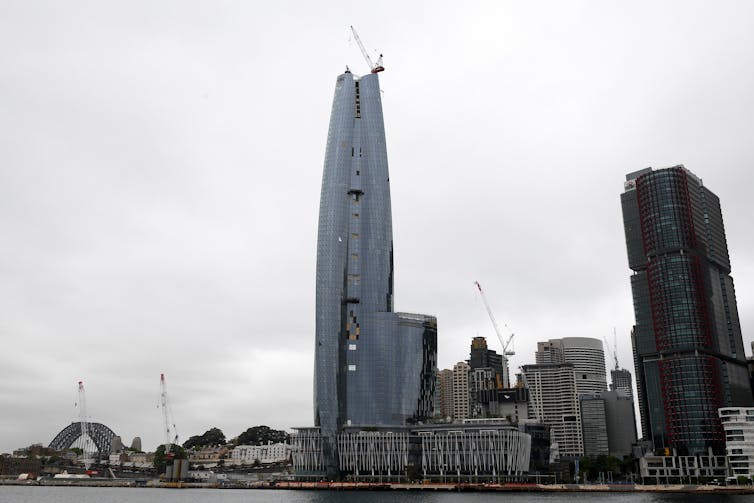 Grocon blames losses from Sydney’s Barangaroo development for forcing its hand.
Dan Himbrechts/AAP
Grocon blames losses from Sydney’s Barangaroo development for forcing its hand.
Dan Himbrechts/AAP
In 2018 Crown Resorts and developer Lendlease fought and won a legal case against Infrastructure NSW over fears buildings being built by a Grocon-led consortium as part of the “Central Barangaroo” precinct would block harbour views from Crown’s casino hotel and Lendlease’s high-rise apartments in the “Barangaroo South” precinct.
Grocon subsequently pulled out (selling its interests to Chinese partner Aqualand). It is suing Infrastruture NSW for A$270 million in compensation for not informing Grocon it needed to factor in sight lines from the Crown Resorts and Lendlease buildings.
Grollo blamed Infrastructure NSW for “forcing our hand to place the construction business into administration”:
While I have spoken before about moving Grocon away from the construction business model to new initiatives such as build to rent, I did not want to call in administrators.
But Grollo has said such things before.
In October last year Grocon put two subsidiaries into insolvency over a dispute with commercial landlord Dexus involving A$28 million in unpaid rent for space leased in Brisbane’s 480 Queen Street building.
Grollo also declared he was doing this reluctantly but had been forced into it.
Australian Securities and Investments Commission records indicate 27 Grocon entities have been deregistered or cancelled since about 2006. That leaves, by my count, 31 registered companies. How many of these will now be placed in administration is unclear.
Read more: These private companies pay less tax than we do – but reasons remain unclear
A notorious industry practice
The construction industry is notorious for the use of insolvency and administration mechanisms, dominating the statistics out of all proportion to its share of the economy.
Many in the industry see it as a normal business practice.
It’s a cost-effective solution, but it leaves subcontractors and other suppliers owed money in the lurch. It creates waves of bankruptcies among smaller businesses – electricians, plumbers, plasterers and so on – who have often secured business loans with their homes. Many are left destitute. It helps explain the industry’s high suicide rate.
Read more: Is illegal phoenix activity rife among construction companies?
Privatising profits, socialising losses
Is it right for a big operator with substantial resources to slice and dice its operating companies to ensure it continues to prosper while its subcontractor and consultant creditors are ruined?
The construction union – with which Grocon has long battled – has called for a national scheme to compensate subcontractors when a head contractor goes bust.
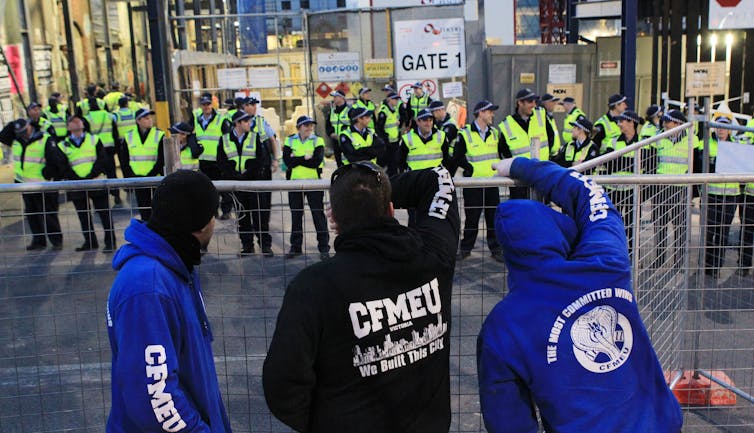 Construction workers picket Grocon’s Myer Emporium building site in Melbourne in September 2012. The CFMEU-organised blockade was later ruled illegal and the construction union agreed in 2015 to pay Grocon A$3.55 million in damages.
Julian Smith
Construction workers picket Grocon’s Myer Emporium building site in Melbourne in September 2012. The CFMEU-organised blockade was later ruled illegal and the construction union agreed in 2015 to pay Grocon A$3.55 million in damages.
Julian Smith
But this is an invitation to continue to privatise profits and socialise losses.
The first step governments could take is to adopt procurement policies using value-based assessments rather than just choosing tenders based substantially on price.
They should also not try to transfer unmanageable risks to constructors and consultants, including setting unachievable budgets and programs.
This would encourage contractors to submit honest tenders and deliver quality projects without exploiting the smaller players they rely on.
Effective monitoring of downstream activities, including payments to subcontractors, is also vital.
If we are going to have a construction industry that does not rely on the public purse to pick up the pieces, we don’t need another inquiry or royal commission. We do need a co-ordinated effort to fix the obvious problems, including effective laws to stop insolvency and administration being standard business practice.
Administrators and liquidators should have readier access to the assets of other companies in a group and also the assets of directors.
Authors: Geoff Hanmer, Adjunct Professor of Architecture, University of Adelaide
Read more https://theconversation.com/news-of-the-collapse-of-the-grocon-empire-is-greatly-exaggerated-150546


 Daily Bulletin


