

The K'gari-Fraser Island bushfire is causing catastrophic damage. What can we expect when it's all over?
- Written by: Gabriel Conroy, Environmental Management Program Coordinator, University of the Sunshine Coast
K’gari (Fraser Island) has been burning for more than seven weeks and, so far, the fires have razed half of the World Heritage-listed island off the coast of Queensland. The devastation will become more pronounced in coming weeks, despite overnight rain.
Much of the commentary on these fires has focused on how these landscapes are “meant to burn”, and that (luckily) there have been no major fires in the fire-sensitive, rainforest-style ecosystems in the island’s centre.
However, the fact remains that a fire of this magnitude will alter the ecological balance on the island. Let’s explore why.
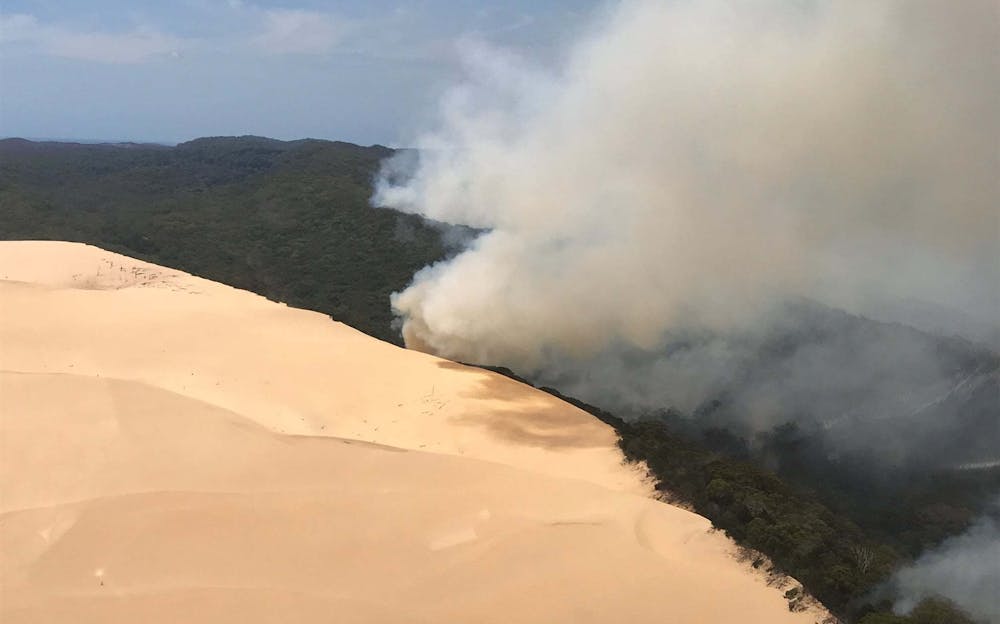 K'gari is the largest sand island in the world.
AAP Image/QFES
K'gari is the largest sand island in the world.
AAP Image/QFES
An uphill battle
K'gari is an incredibly biodiverse place, with more than 30 mammal species, 354 types of birds, 60 reptiles and 17 types of frogs.
For thousands of years, the Butchulla traditional owners maintained the island’s ecosystems with patch mosaic burning. The general principle behind patch mosaic burning is that by burning regularly and strategically, you create habitat niches that cater for a wide variety of generalist and specialist species, which favours biodiversity.
Read more: Australia, you have unfinished business. It's time to let our 'fire people' care for this land
With an absence of this mode of burning during 130 years of logging on the island (ending in 1991), today’s environmental managers have faced an uphill battle to claw back the balance.
This — alongside tinder-dry conditions and large swathes of relatively inaccessible wilderness in the north — is why we unfortunately find ourselves in the situation where an incredibly widespread, intense fire has occurred.
These types of fires can irrevocably alter the nature of even fire-adapted ecosystems (like in the northern half of K'gari) and are likely to become more commonplace in our changing climate.
Let’s take two of K'gari’s rare plant species — the tiny wattle (Acacia baueri) and the much-loved Christmas bells (Blandfordia grandiflora) — as examples of why the Australian landscape’s need for fire isn’t straightforward, and requires patch burning.
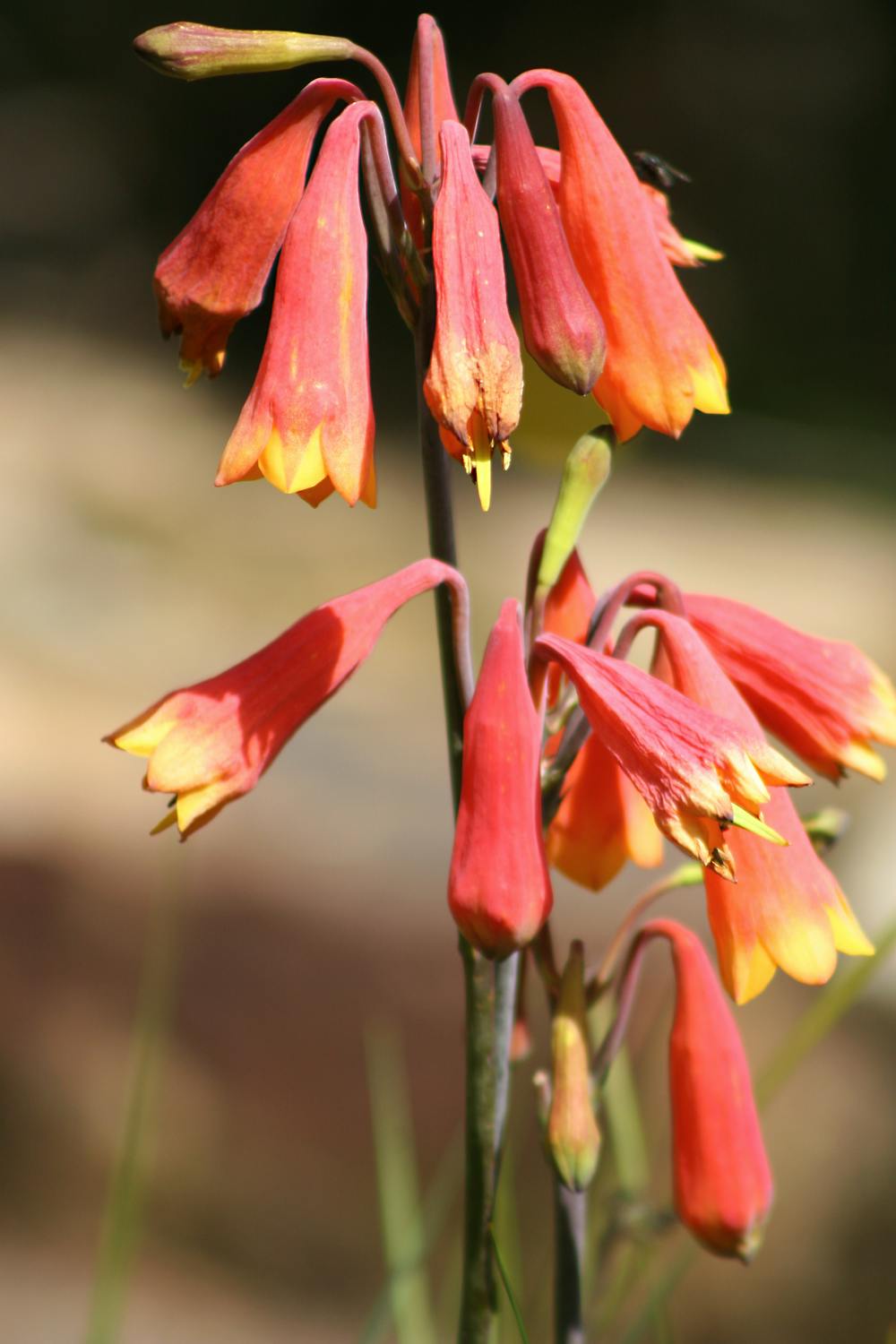 Christmas bells flower for one to three years after a fire, and then disappear underground.
Shutterstock
Christmas bells flower for one to three years after a fire, and then disappear underground.
Shutterstock
These species rely on low intensity fire occurring every three to five years to regenerate and avoid local extinction.
However, other fire-adapted species that grow alongside them, such as Banksia robur, would struggle to withstand burning this frequently. Some may not even be able to reach reproductive maturity during that kind of time span.
Invertebrates: the island’s unheralded heroes
K'gari is famous for its wild population of dingoes, which undoubtedly will have suffered in these fires. We won’t know the full impact for these and many other species until the dust has settled.
Read more: Dingoes and humans were once friends. Separating them could be why they attack
But one of my greatest concerns is for the largely forgotten species propping up ecosystems: invertebrates. In normal circumstances, the island is teeming with highly abundant and diverse invertebrate life if you bother to look for it — and will undoubtedly bite you or keep you awake at night even if you don’t.
Herbivorous species, including insects, are the unheralded heroes that transfer a lot of the the energy generated by plants up through the food chain, for example, by providing food for predators like dingoes.
With 50% (and counting) of the island’s ecosystems already burnt in this fire, the amount of food available for herbivores has reduced. This means significantly less energy can be fed back up the food chain, affecting the entire ecosystem.
 Wild dingoes are an important feature of the World Heritage-listed island.
Shutterstock
Wild dingoes are an important feature of the World Heritage-listed island.
Shutterstock
When there’s nowhere to escape
On mainland Australia, birds, bugs and fast-moving animals like dingoes and wallabies often flee to safe habitats when fires occur, and then later recolonise fire-affected regions.
Although relatively close to the mainland, K'gari is a very long and narrow island, and because the entire northern end of the island has burnt, most terrestrial species have only a narrow interface through the central part of the island to try to escape. These lack of escape routes will likely exacerbate death rates of native fauna.
To make matters worse, the ecosystems to the north are markedly different to those in the centre of the island. So while we wait to see how the northern regions regenerate, the species that depend on them may have moved further south to find equivalent ecosystems.
Effectively, only 50% of the island now provides habitat and food sources for the entire island’s wildlife, and the remaining habitat is not always a like-for-like replacement.
How will it look when it ‘bounces back’?
When the fires have extinguished and plants begin to regenerate, a sea of green may convince people the ecosystems have bounced back marvellously from the fires. But in actual fact, they may have been irrevocably changed.
Certain species will flourish in the post-fire environment, but because of the fire’s widespread nature, it’s possible the composition of the vegetation will change.
Read more: Yes, native plants can flourish after bushfire. But there’s only so much hardship they can take
Weeds, for example, love bare ground, and even native species can become “weedy” in nature and can dominate in disturbed areas. In ongoing research, our team has observed this in areas of the island impacted by sand mining in the 1970s, where there’s an overabundance of immature Acacia and Casuarina species.
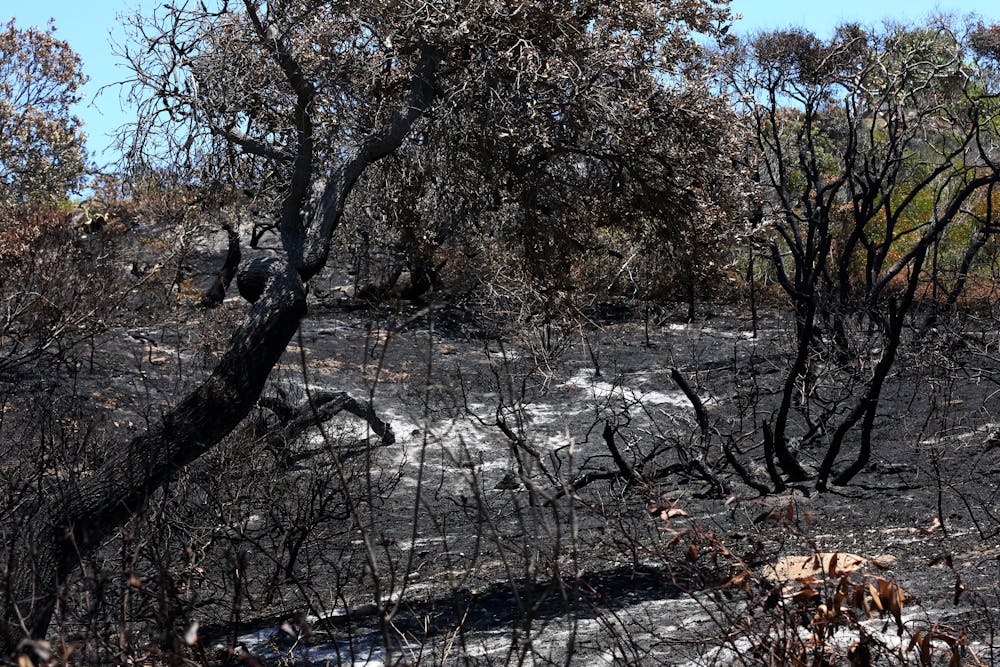 K'gari is a long, narrow island, which offers wildlife few escape routes.
AAP Image/Danny Casey
K'gari is a long, narrow island, which offers wildlife few escape routes.
AAP Image/Danny Casey
My greatest hope is that the future of K'gari includes patch mosaic burning (and cultural burns) at a landscape scale.
If we want to ensure K'gari bounces back as much as possible, then we need to use these devastating bushfires as an opportunity to work collaboratively towards a common conservation goal.
The intent from key stakeholders is evident, with productive conversations already occurring between our team at the University of the Sunshine Coast, Queensland Parks and Wildlife Service and the Butchulla Aboriginal Corporation. For this to come to fruition, on-ground efforts will need to be well-resourced and supported by ongoing monitoring and research.
Authors: Gabriel Conroy, Environmental Management Program Coordinator, University of the Sunshine Coast


 Daily Bulletin


