

Global emissions are down by an unprecedented 7% — but don’t start celebrating just yet
- Written by: Pep Canadell, Chief research scientist, Climate Science Centre, CSIRO Oceans and Atmosphere; and Executive Director, Global Carbon Project, CSIRO
Global emissions are expected to decline by about 7% in 2020 (or 2.4 billion tonnes of carbon dioxide) compared to 2019 — an unprecedented drop due to the slowdown in economic activity associated with the COVID-19 pandemic.
To put this into perspective, the Global Financial Crisis in 2008 saw a 1.5% drop in global emissions compared to 2007. This year’s emissions decline is more than four times larger.
These are the findings we show in the 15th global carbon budget, an annual report card of the Global Carbon Project on the sources and removals of carbon dioxide, the primary driver of human caused climate change.
It may sound like welcome news, but we can’t celebrate yet. A rapid bounce back of emissions to pre-COVID levels is likely, possibly by as soon as next year. A recent study found emissions in China snapped back to above last year’s levels during late spring when economic activity began to return to normal.
These findings come ahead of the Climate Ambition Summit on Saturday, where global leaders will demonstrate their commitments to climate action five years since the Paris Agreement. This huge drop in emissions should be taken as a unique opportunity to divert the historical course of emissions growth for good.
Emissions in the pandemic year
The total global fossil carbon dioxide emissions for 2020 are estimated to be 34 billion tonnes of carbon dioxide.
Estimated emissions at the beginning of December are lower than their levels in December last year, at least in the transport sectors. However, emissions have been edging back up since the peak global daily decline of 17% in early April.
Read more: The world endured 2 extra heatwave days per decade since 1950 – but the worst is yet to come
The decline in emissions in 2020 was particularly steep in the United States (12%) and European Union (11%), where emissions were already declining before the pandemic, mainly from reductions in coal use.
Emissions from India dropped by 9%, while emissions from China, which have returned to close or above 2019 values, saw an estimated drop of only about 1.7%.
Australian greenhouse gas emissions during the peak of the pandemic lockdown (the quarter of March to June 2020) were lower by 6.2% compared to the previous quarter. The largest declines were seen in transport and fugitive emissions (emissions released during the extraction, processing and transport of fossil fuels).
 The 2020 emission decline was particularly steep in the United States and European Union. While China’s emissions also dropped steeply, they snapped back later in the year.
Pep Canadell, Author provided
The 2020 emission decline was particularly steep in the United States and European Union. While China’s emissions also dropped steeply, they snapped back later in the year.
Pep Canadell, Author provided
Globally, the transport sector also contributed the most to the 2020 emissions drop, particularly “surface transport” (cars, vans and trucks). At the peak of the pandemic lockdowns, the usual levels of transport emissions were halved in many countries, such as in the US and Europe.
While aviation activity collapsed by 75%, its contribution to the total decline was relatively small given the sector only accounts for about 2.8% of the total emissions on an average year. The number of global flights was still down 45% as of the first week of December.
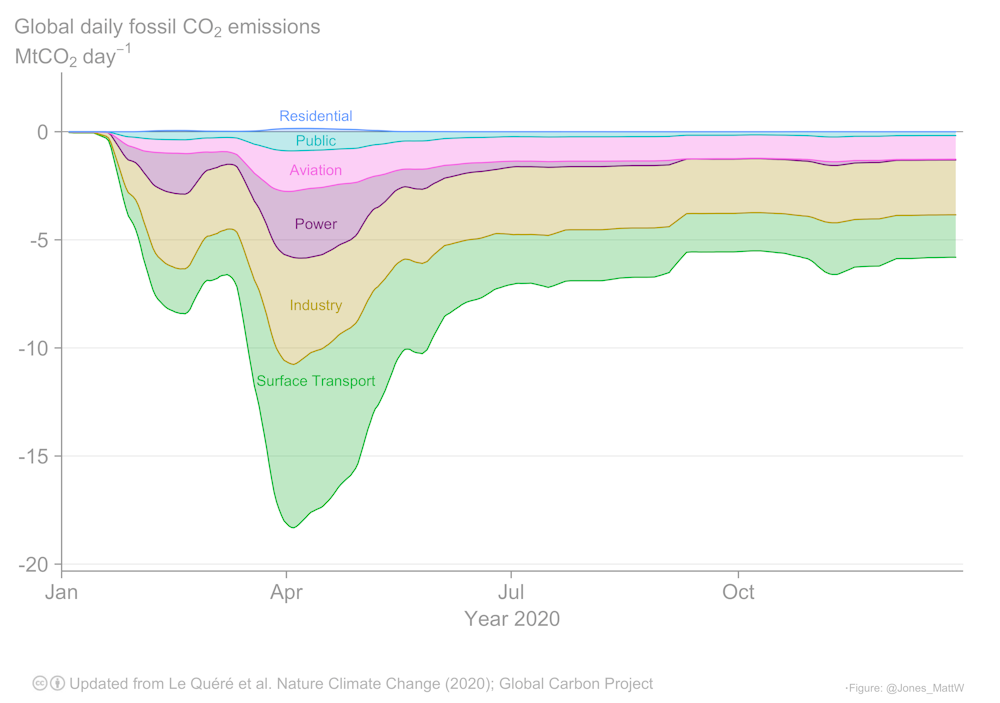 The industry sector, specifically metals production, chemicals and manufacturing, was the second largest contributor in emissions declines.
Pep Canadell, Author provided
The industry sector, specifically metals production, chemicals and manufacturing, was the second largest contributor in emissions declines.
Pep Canadell, Author provided
Global emissions were already slowing down pre-COVID
Overall, global emissions have increased by 61% since 1990. But the pace of this growth has varied.
In the early 1990s, the growth in emissions slowed down due to the collapse of the former Soviet Union, but then increased very quickly during the 2000s, by 3% per year on average. This was, in part, due to the rise of China as an economic power.
Read more: South Korea's Green New Deal shows the world what a smart economic recovery looks like
Over the last decade, however, the pace of emissions began to slow again, with an increase just below 1% per year. And emissions in 2019 didn’t grow much, if at all, when compared to 2018.
Behind the global slowing trend, there are 24 countries that had carbon dioxide fossil emissions declining for at least one decade while their economy continued to grow. They include many European countries such as the Denmark, the UK and Spain, and the USA, Mexico and Japan. For the rest of the world, emissions continued to grow until 2019.
 This chart shows how global fossil carbon dioxide emissions have increased since the 1990s. Note the drops in the early 1990s, in 2008, and the huge drop in 2020.
Pep Canadell, Author provided
This chart shows how global fossil carbon dioxide emissions have increased since the 1990s. Note the drops in the early 1990s, in 2008, and the huge drop in 2020.
Pep Canadell, Author provided
An opportunity to boost ambition
The pandemic, along with other recent trends such as the shift towards clean energy, have placed us at a crossroad: the choices we make today can change the course of global emissions.
In addition to the slow down in global emissions in recent years, and this year’s drop, there are now dozens of countries that have pledged to reach net zero emissions by mid century or soon after.
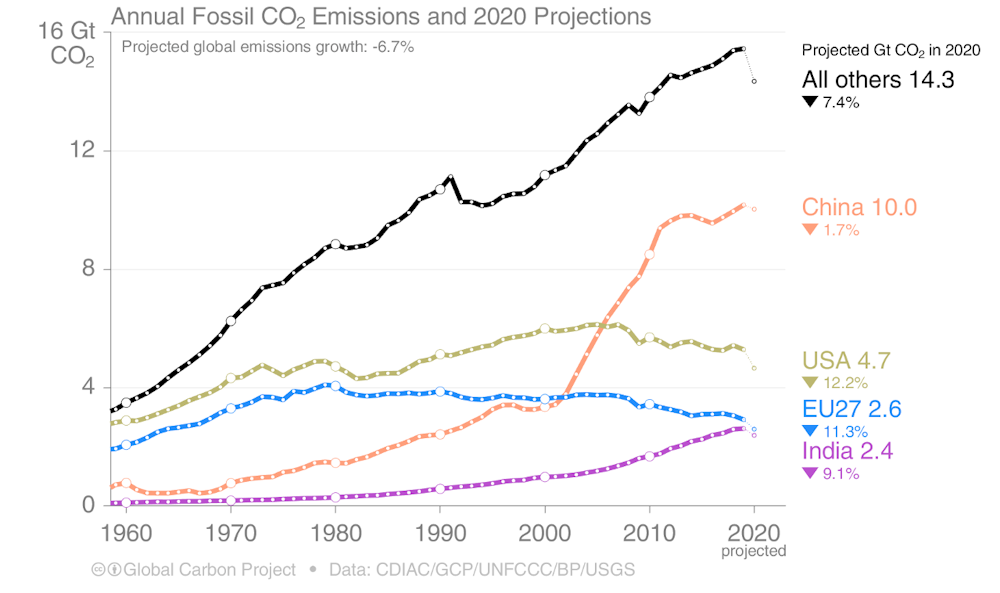 How the emissions of different countries have changed over time.
Importantly, the first (China), second (USA), third (European Union), sixth (Japan) and ninth (South Korea) top emitters — together responsible for over 60% of the global fossil carbon dioxide emissions — have either legally binding pledges or serious ambitions to reach net zero emissions by 2050 or soon after.
Coal production, the largest fossil fuel source of carbon dioxide emissions, peaked in 2013. Its decline continues to this date; however, increasing natural gas and oil negate much of this decline in emissions.
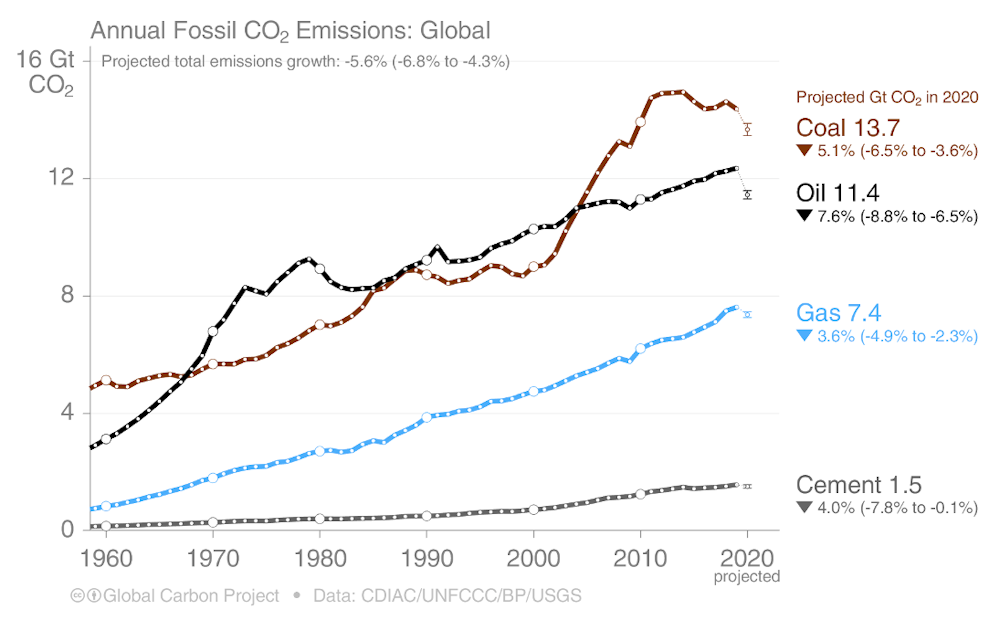 How the emissions from coal, oil, gas, and cement sectors changed over time.
Pep Canadell, Author provided
How the emissions from coal, oil, gas, and cement sectors changed over time.
Pep Canadell, Author provided
We are in the midst of extraordinary levels of economic investment in response to the pandemic. If economic investment is appropriately directed, it could enable the rapid expansion of technologies and services to put us on track towards net zero emissions.
Many countries have already committed to green recovery plans, such as South Korea and the EU, although investments continue to be dominated by the support of fossil-based infrastructure.
As global leaders prepare for tomorrow’s summit, they have an opportunity like never before. The choices we make now can have a disproportionate impact on the future trajectory of emissions, and keep temperature rise well and truly below 2℃.
Read more: Coronavirus is a 'sliding doors' moment. What we do now could change Earth's trajectory
Authors: Pep Canadell, Chief research scientist, Climate Science Centre, CSIRO Oceans and Atmosphere; and Executive Director, Global Carbon Project, CSIRO


 Daily Bulletin


