

Nature detectives in the backyard: 3 science activities for curious kids this summer
- Written by: Caitlyn Forster, PhD Candidate, School of Life and Environmental Sciences, University of Sydney
During lockdowns, millions of homes were transformed into mini schools as parents and teachers joined forces to facilitate remote learning. The experience proved education doesn’t only happen in classrooms.
The green spaces around our homes can be stimulating learning environments. Backyard activities get kids outdoors, benefiting both their health and well-being and their education.
Instead of experiencing learning loss over summer, curious kids can discover wildlife right on their doorstep. That’s good for people and the planet as a new appreciation of urban nature can ultimately inspire global conservation.
Here are three things kids can do in the backyard over the summer that are fun and educational, too.
1. Grow your own slime moulds
The weirdest organisms living in our green spaces can appear more alien than animal. Despite their name, slime “moulds” are completely different from the nasty fungal moulds that invade our homes.
In fact they’re not fungi; though they’re not animals or plants either. Slime moulds are protists, a diverse group of organisms including algae and amoebae. They are found in leaf litter and help decompose organic matter.
Read more: Nature's traffic engineers have come up with many simple but effective solutions
One of the most notable species is Fuligo septica, commonly known as “dog vomit slime mould”. It is a large, yellow and scrambled-egg like and sometimes spontaneously appears on front lawns after a lot of rain.
When they are feeding, slime moulds move like an animal and can even solve mazes for food. But when it comes time to reproduce, they produce spores that are held in structures called fruiting bodies which look like tiny mushrooms. Often they are brightly coloured or even iridescent.
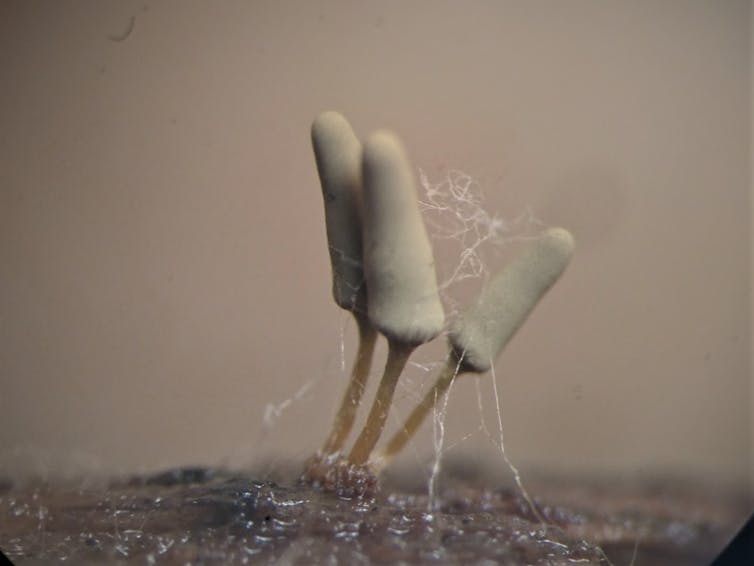 Fruiting body of Arcyria cinerea.
Arisa Hosokawa
Fruiting body of Arcyria cinerea.
Arisa Hosokawa
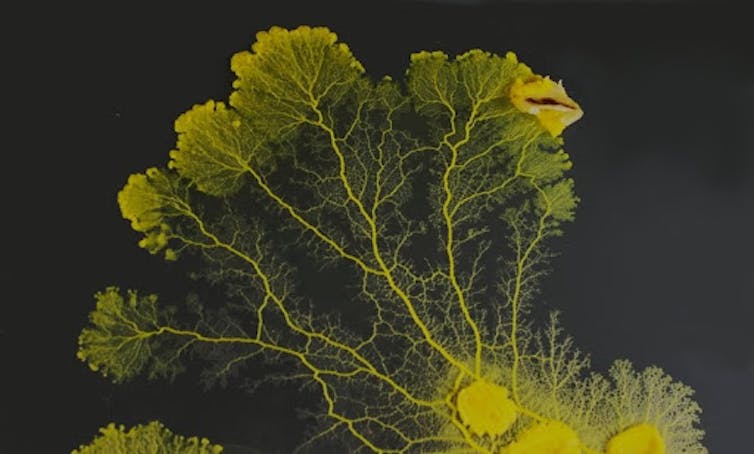 Physarium polycephalum plasmodia.
Arisa Hosokawa
Physarium polycephalum plasmodia.
Arisa Hosokawa
They’ve got to be seen to be believed … so how do we find them?
Slime-mould spores are found on leaf litter and they need a moist and dark environment to hatch. You can grow your own by making a “slime-arium”, which is a moist chamber that creates a perfect environment for slime moulds to start feeding. This activity should be done wearing gloves and under adult supervision.
Place dried leaves, twigs and bark in a plastic container with a layer of paper towel on the bottom
fill the container completely with water and let it sit for 24 hours
after 24 hours, pour all the water out and place a lid on the container and store in a dark area
every few days, spray the contents with water to keep the environment moist.
After two weeks you can start finding some slime moulds.
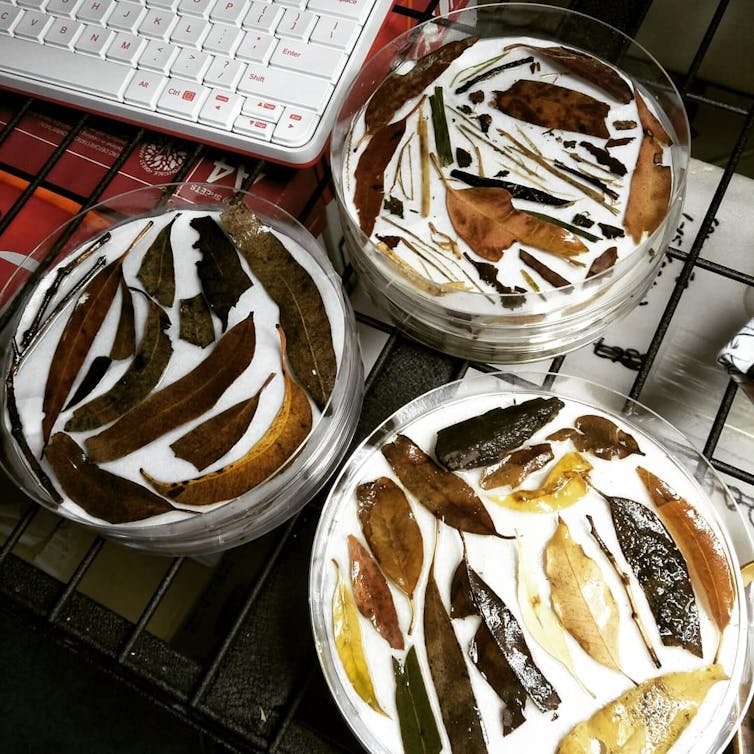 These slime-ariums are in petri dishes, but most containers will be fine.
Eliza Middleton @smiley_lize
These slime-ariums are in petri dishes, but most containers will be fine.
Eliza Middleton @smiley_lize
The feeding slime moulds are slimy and spread their tendrils slowly around the container. They can be white, brown, yellow or even bright red. If you have a magnifying glass, look for tiny fruiting bodies on the leaves and twigs.
The diverse ecosystem in the leaf litter is responsible for decomposing around 90 gigatons of organic matter such as fallen leaves and branches globally each year. Unlike most other organisms in the leaf litter, slime moulds are large enough to be seen without special equipment.
Watching slime moulds growing and exploring in your slime-arium is a great way for kids to learn about nutrient cycling and see decomposition in action.
2. Use fake caterpillars to find your garden’s animal visitors
We don’t always notice the animals visiting or living in our backyards. Some are small, nocturnal or shy. They need some detective work to find them.
Caterpillars are food for many animals, from insects to birds and reptiles.
Plasticine caterpillars offer an excellent way of luring critters out of hiding and recording their presence for us to see.
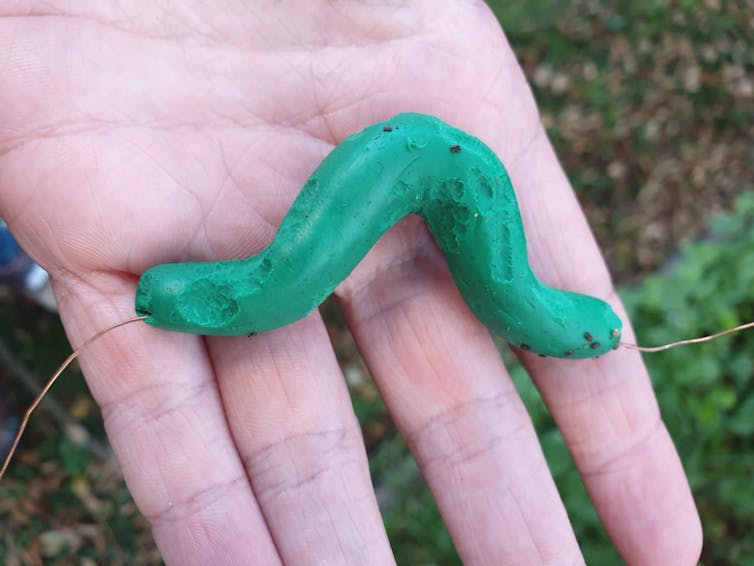 Plasticine caterpillar with damage from a snail.
Caitlyn Forster
Plasticine caterpillar with damage from a snail.
Caitlyn Forster
A plasticine decoy can look just as tasty as a regular caterpillar, attracting bite marks from all sorts of species. Here’s how to get in on the action:
Roll plasticine into caterpillar shapes (any colour is fine, but green is great)
attach the caterpillars to tree branches, brick walls or fences using wire —anywhere you think a caterpillar may go. Take note of where you laid them out
one week later, collect all the caterpillars
compare bite marks to identify the attackers. For instance, mammals might leave marks that look like their teeth. Birds will often leave caterpillars with significant damage, often breaking them, and insects might leave marks that look like very small spots. (You can use this guide to compare bite marks).
Plasticine caterpillars can teach kids what animals are in their backyard, and also help them learn details about the animals.
3. Survey some insect pollinators
Australia is home to more than 2,000 native bee species, plus many other insect pollinators. Summer is the perfect time to see pollinators out and about.
Insects are important for pollinating about 75% of crop plants, allowing us to enjoy many fruits and vegetables (but also chocolate).
We still don’t know a lot about many insect pollinators’ behaviour and ecology. Understanding where these species are, and what flowers they like can help scientists understand the impacts of our backyards on pollinator ecology. It’s also great to know who is helping your fruit and veggies grow.
Read more: 4 ways to get your kids off the couch these summer holidays
The easiest way to discover which ones are in your area is to count them when they visit flowers. Here’s how to do that.
If you’re not finding many flowers, a great craft activity is to make fake flowers with craft supplies in the back of your cupboard. You can use paper or plastic plates, cut out cardboard flowers, or even try using origami flowers. You could put some sugar water in the middle for the insects to feed on, or just watch where they land.
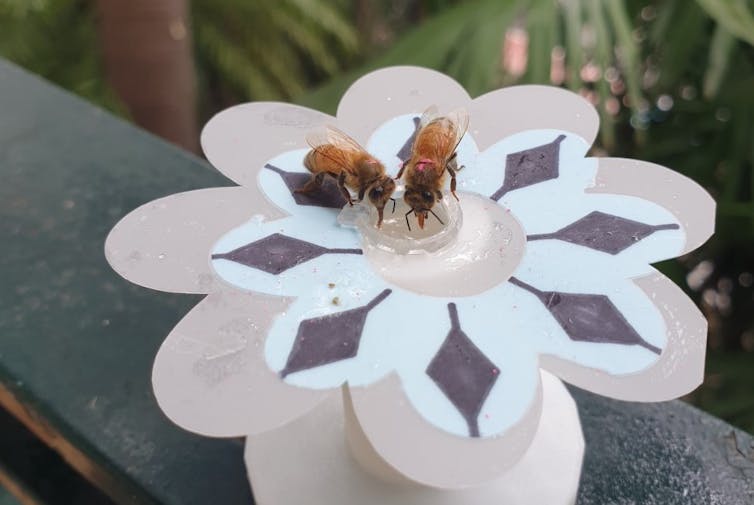 Honeybees feeding on fake flowers.
Caitlyn Forster
Honeybees feeding on fake flowers.
Caitlyn Forster
Getting creative and deploying many different types of fake flowers is a great way to test your local pollinators’ favourite floral colour and shape.
Get involved with the nature community
Children can make substantial contributions to citizen science by exploring nearby nature. Aussie kids have opportunities to collect real-time data for a variety of scientific projects happening in your area.
Read more: Birdwatching increased tenfold last lockdown. Don't stop, it's a huge help for bushfire recovery
Mobile apps such as Big City Birds, iNaturalist and Questagame are purpose-built for recording sightings of local flora and fauna.
Authors: Caitlyn Forster, PhD Candidate, School of Life and Environmental Sciences, University of Sydney


 Daily Bulletin


