

Would you do this at home? Why we are more likely to do stupid things on holidays
- Written by: Denis Tolkach, Senior Lecturer, James Cook University
As the COVID pandemic took hold in March, Ohio’s Brady Sluder went to Miami for spring break, despite urgent calls for people to stay home and socially distance.
Interviewed by CBS News, Sluder’s arrogant justfication for his trip went viral.
If I get corona, I get corona. At the end of the day, I’m not gonna let it stop me from partying […] about two months we’ve had this trip planned.
A week later — now an international “celebrity” for all the wrong reasons — he was forced to issue a grovelling apology.
If you think Sluder’s partying was stupid, we share your feelings.
With the festive season upon us, as the pandemic continues, we can only hope covidiots listen to the rules. As many of us also head off on summer breaks, now is also a good time to reflect on stupidity in tourism.
We may be tempted to think a stupid person has certain demographic or psychological characteristics. However, anyone can behave stupidly, especially in unfamiliar environments — like holidays — where it is difficult to judge the right course of action.
The laws of human stupidity
In our recently published journal article on stupidity in tourism, we see stupidity as an action without insight or sound judgement. This results in losses or harm to the perpetrator and others. In a holiday context, it can negatively affect tourists themselves, as well as other people, animals, organisations, or destinations.
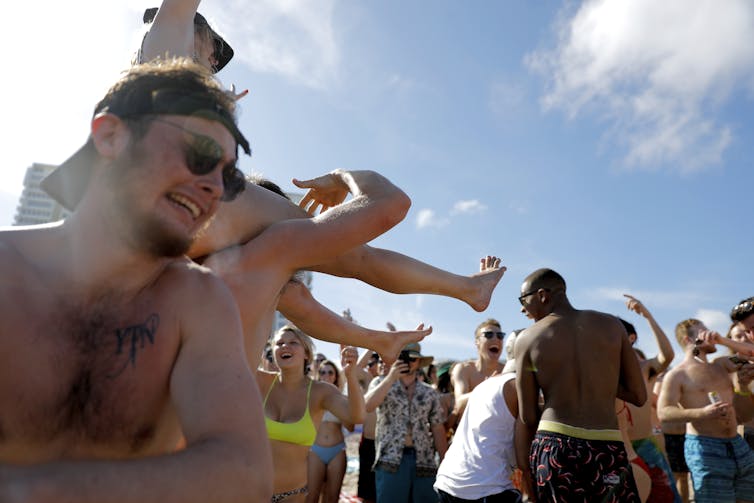 When bars were shut in Florida Spring Break revellers headed to the beach.
Julio Cortez/AP/AAP
When bars were shut in Florida Spring Break revellers headed to the beach.
Julio Cortez/AP/AAP
In 1976, Italian economist Carlo Cipolla published a definitive essay called The Basic Laws of Human Stupidity. Although we prefer to focus on stupid behaviour rather than stupid people, we agree with his five laws:
Always and inevitably, everyone underestimates the number of stupid individuals in circulation.
The probability that a certain person (will) be stupid is independent of any other characteristic of that person.
A stupid person is a person who causes losses to another person or a group of persons while himself deriving no gain and even possibly incurring losses.
Non-stupid people always underestimate the damaging power of stupid individuals. In particular, non-stupid people constantly forget dealing with or associating with stupid people always and everywhere turns out to be a costly mistake.
A stupid person is the most dangerous type of person.
Why is stupid behaviour so dangerous? Because it is irrational and so the outcome is unpredictable.
Who could have thought so many people would die when taking a selfie that you can now take out insurance on the act? Or that aeroplane passengers would throw coins into engines for good luck?
What causes stupidity?
How can we better understand our own stupid behaviour, or recognise it in others? Stupidity is generally caused by an excess of one or more of the following factors:
- the person believing they know everything
- the person believing they can do anything
- the person being extremely self-centred
- the person believing nothing will harm them
- the person’s emotions (for example, fear or anger)
- the person’s state (for example, exhausted or drunk).
Why stupid behaviour is more likely on holidays
Tourists can be affected by all of these factors.
Leisure tourism, by its nature, is a very self-centred and pleasure-seeking activity. People often travel to relax and enjoy themselves.
Read more: Memories overboard! What the law says about claiming compensation for a holiday gone wrong
In pursuit of trying something new or escaping their daily routine, people may go to places with very different cultures or practices than their own, or try things they wouldn’t normally do — such as adventure activities. As a result, individuals can act differently while on holidays.
There also seem to be fewer social constraints. Tourists may not follow rules and social norms while travelling, because relatives, friends, colleagues, bosses are less likely to find out. Of course, tourists may not be aware of the commonly-accepted rules of where they travelling, as well.
All of the above increases the likelihood of stupidity. And one certainly doesn’t need to travel overseas to be stupid. A case in point is a tourist who snuck into Uluru-Kata Tjuta National Park, which was closed-off in August due to COVID concerns in the local indigenous community. The woman injured her ankle and had to be rescued.
The importance of thinking first
So, what to do about stupid tourist behaviour?
Strict regulation, physical barriers, warning signs and other punitive measures alone may not work. This is seen in the case of a man who climbed over a zoo fence in 2017 to avoid the entry fee. He ended up being mauled to death by a tiger.
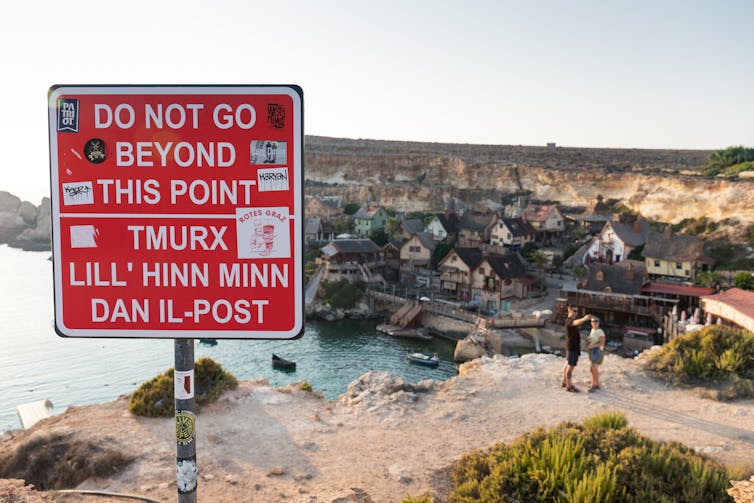 Physical barriers alone do not prevent stupid behaviour.
www.shutterstock.com
Physical barriers alone do not prevent stupid behaviour.
www.shutterstock.com
Education of tourists on how to behave during travels has some effect. But more importantly, tourists need to be self-aware. They need to consider what is likely to happen as a result of their behaviour, how likely is it that things will go wrong, and whether they would do this at home.
While stupidity is impossible to eliminate, it can be less frequent and do much less damage, if we take time to reflect on our behaviour and attitudes.
So, have fun during the holiday … but don’t be stupid!
Authors: Denis Tolkach, Senior Lecturer, James Cook University


 Daily Bulletin


