

A festive feast of fish and fruit: the creation of the Australian Christmas dinner
- Written by: Madeline Shanahan, Honorary Adjunct Lecturer, University of New England
In this new series, our writers explore how food shaped Australian history – and who we are today.
A traditional British meal of roast turkey and plum pudding may have once dominated Australia’s Christmas tables. But as our population has become more diverse, so has our menu.
While some may mark the day with a pepparkakor and others a panettone, it would now be a rare house where prawns and a bowl of cherries did not make an appearance.
But how did this distinctively Australian Christmas spread get its start?
The peculiarity of preparing a roast and pudding in high summer was amusing to colonials. In many ways its absurdity was celebrated, representing the ambiguity of emergent Antipodean identity. But there were soon calls for innovation.
In 1907, Henry Lawson described a “sensible Christmas dinner” in one of his short stories, celebrating a festive feast where all the food was cold.
His narrator observed:
Billy’s wife and her sister [were] fresh and cool-looking and jolly, instead of being hot and brown and cross like most Australian women who roast themselves over a blazing fire in a hot kitchen on a broiling day, all the morning, to cook scalding plum pudding and red-hot roasts, for no other reason than that their grandmothers used to cook hot Christmas dinners in England.
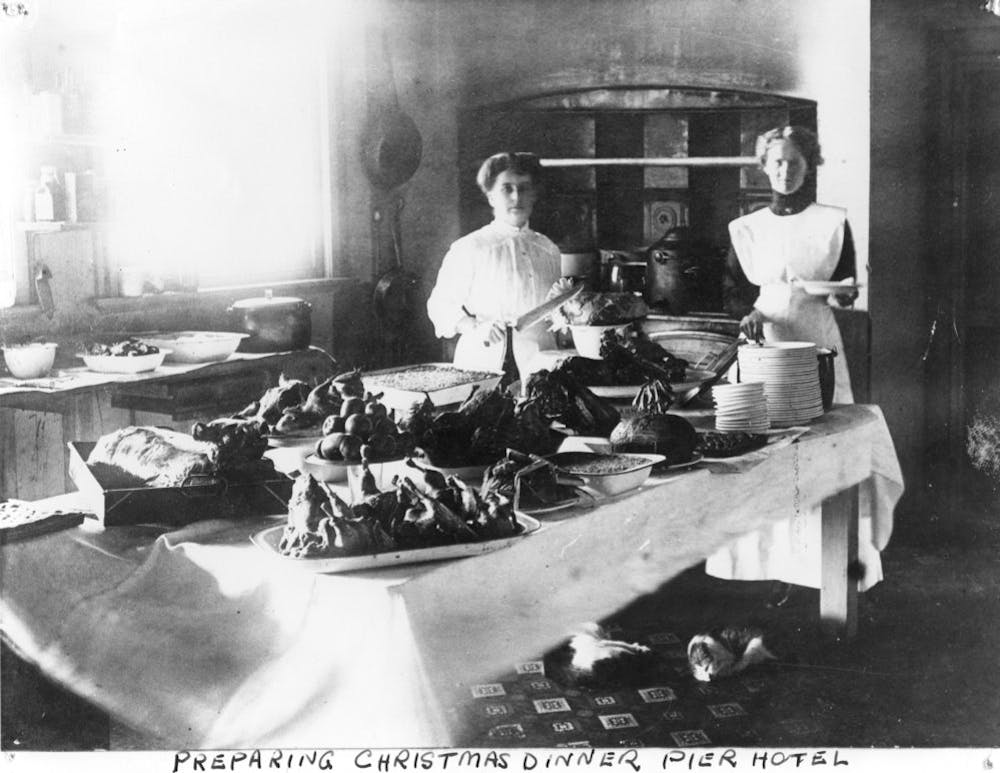 Australian Christmas dinners – like this one in 1910 – were once very British affairs.
Courtesy of Coffs Harbour City Council, CC BY-SA
Australian Christmas dinners – like this one in 1910 – were once very British affairs.
Courtesy of Coffs Harbour City Council, CC BY-SA
Cornucopias of festive fruits
From the late 19th century, new traditions developed celebrating summer. Tropical and stone fruits became increasingly popular as a seasonal addition to the festive spread.
While the heady scent of mangoes and piles of ruby-red cherries must have seemed extraordinary to migrants used to a winter Yuletide, the emphasis on fruit was far from novel — fruit had long played a role in British Christmases.
Read more: Decking the halls of history: the origins of Christmas decorations
The heavy use of dried fruits — luxury goods imported from the east — underpinned the celebratory status of traditional favourites like plum pudding and mince pies. Oranges and apples appeared in the stockings of Victorian children and as decorations on the tree.
In Australia, the bounty of colour was perfect for the Victorian tradition of festive window displays, and grocers competed to wow crowds with cornucopias of fruit and flowers.
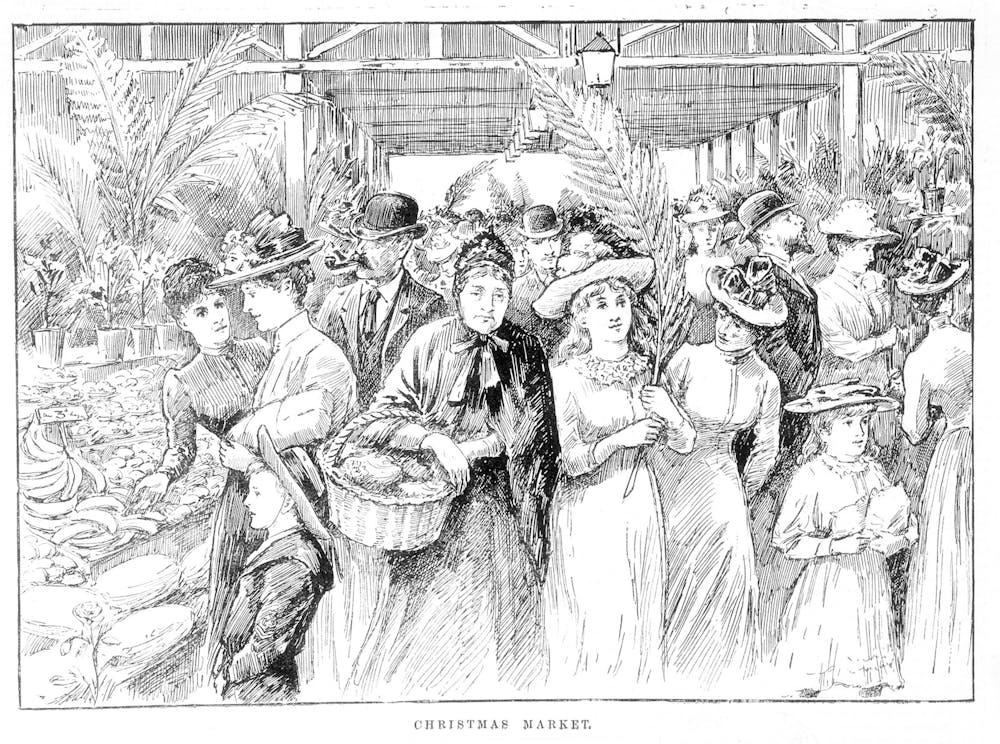 Victoria Markets at Christmas, as printed in the Illustrated Australian News, 1893.
State Library Victoria
Victoria Markets at Christmas, as printed in the Illustrated Australian News, 1893.
State Library Victoria
In 1890, The Daily Telegraph reported on the Christmas Eve spectacle in Sydney’s King Street Arcade:
great masses of beautiful flowers at the florists and the magnificent spread of fruit near by — the piles of oranges, lemons, mangoes, pineapples, apricots, nectarines, peaches, plums, cherries, red and white currants, grapes, gooseberries and other fruits — decked with Christmas bush making a picture worth travelling to see.
Boxes of mangoes became popular gifts, so common that, in 1945, a columnist for the Rockhampton Morning Bulletin decried:
if we get another Christmas box that includes mangoes, pineapples or a watermelon I’ll scream.
In the 20th century, the popularity of tropical fruits at Christmas was bolstered the development of another modern festive classic: the pavlova.
Rising in popularity in the decades following its fabled “invention” on one side of the Tasman or the other (a debate for another time), by the 1940s it was promoted by women’s magazines, newspapers and cookbooks as an alternative to pudding.
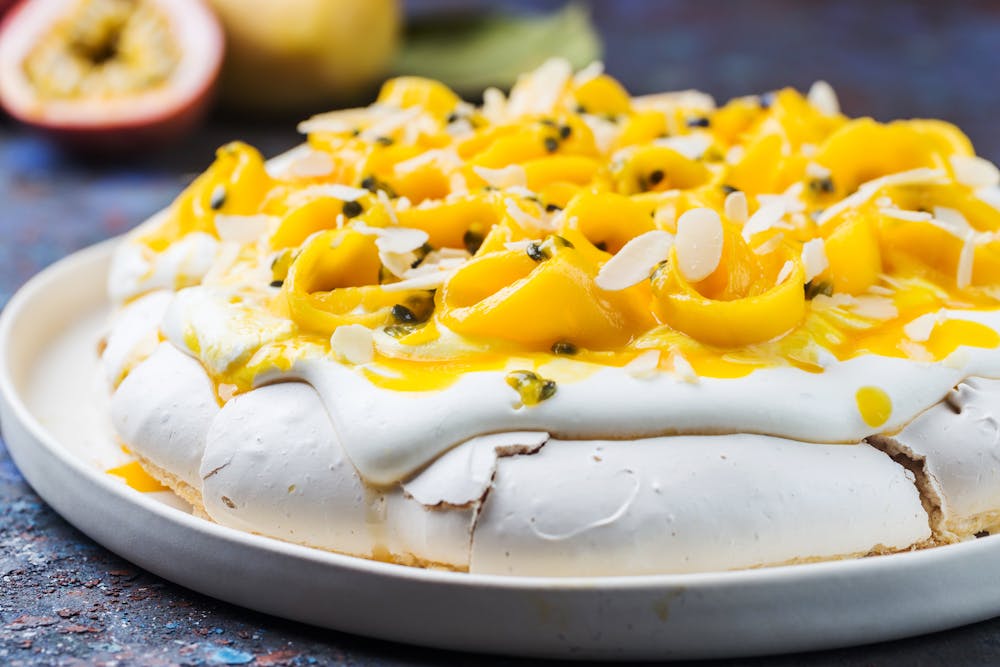 We are more likely to cook a pavlova than a pudding for Christmas dinner.
Shutterstock
We are more likely to cook a pavlova than a pudding for Christmas dinner.
Shutterstock
If the traditional pud was to be ousted, its rival needed a mythology of its own. The pav was a more than worthy opponent, and by December 2017, Australia’s recipe searches for pavlova far outstripped searches for pudding.
Out with the meat and in with the fish
The seafood feast is a decidedly more recent phenomenon.
In contrast to other parts of Europe, after Britain’s 16th century Reformation the seafood meal associated with Christmas Eve as a traditional Catholic fast day declined, and the festival became a decidedly meat-oriented affair.
Fish had no defined role in the menu the British brought with them to Australia, where roast fowl, beef and ham dominated Christmas tables for almost 200 years.
Read more: Tofu turkey? Paleo feast? Christmas culinary traditions are ever changing
Real change did not begin until the 1980s, gathering pace in the 1990s, as Australian culinary identity developed increasing confidence and embraced new flavours. Post-war migrants, especially from the Mediterranean, shaped change, too: bringing not just their seafood traditions, but also lessons in the art of cooking and eating al fresco.
In 1994, the Sydney Fish Market began their 36-hour seafood marathon.
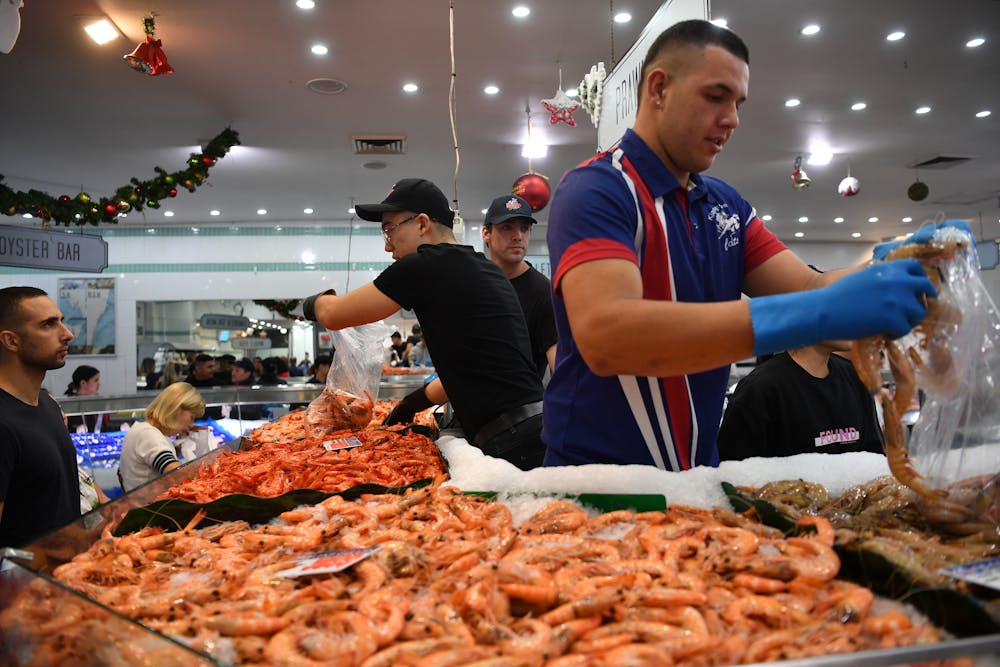 The 2019 Sydney Fish Market Christmas marathon saw 130 tonnes of prawns move out the door.
AAP/Dean Lewins
The 2019 Sydney Fish Market Christmas marathon saw 130 tonnes of prawns move out the door.
AAP/Dean Lewins
From 5am on 23 December until 5pm on Christmas Eve the market sells fish, squid, prawns and oysters to approximately 100,000 shoppers.
Last year, A$1.4 million was spent over the 36 hours — an estimated 700 tonnes of seafood, including 130 tonnes of prawns.
Just over a century ago, Henry Lawson marvelled at the innovation of a cold seasonal spread. Today, it is fair to say the prawn and mango have well and truly found their place on the festive table as hallmarks of a uniquely Australian Christmas.
Authors: Madeline Shanahan, Honorary Adjunct Lecturer, University of New England


 Daily Bulletin


