

Julian Assange's extradition victory offers cold comfort for press freedom
- Written by: Peter Greste, Professor of Journalism and Communications, The University of Queensland
When UK District Judge Vanessa Baraitser declared she was rejecting the US request to extradite Julian Assange, his partner Stella Moris wept with relief. In an emotional speech outside the court, Moris described the ruling as “the first step towards justice”, and called on President Donald Trump to halt further extradition efforts.
According to Baraitser’s ruling, Assange could not be extradited because he was depressed and at risk of committing suicide. Assange’s lawyers are planning to apply for bail, while lawyers for the US government say they are going to appeal.
Although he is by no means a free man, this crucial round goes to the Australian WikiLeaks founder.
But on every other point of law, the judge found in favour of the US. She rejected claims that Assange’s case was politically motivated, that he would not get a fair trial and that it was an assault on press freedom.
So, is this a victory for Assange and his supporters, or a blow to those who believe this case to be about protecting press freedom? A close reading of the verdict and its implications suggest it is both.
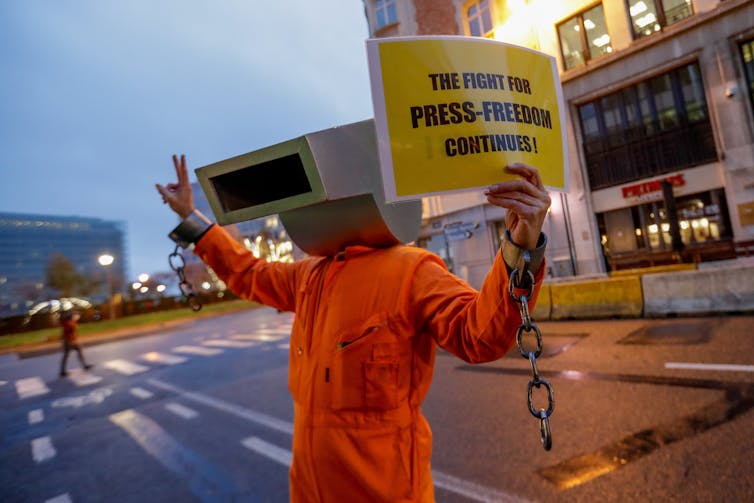 Protesters demanded Assange’s release in a rally outside the British embassy in Brussels, Belgium.
Stephanie Lecocq/EPA
Protesters demanded Assange’s release in a rally outside the British embassy in Brussels, Belgium.
Stephanie Lecocq/EPA
There is little doubt that Assange’s human rights have been abused. He has been held in appalling conditions in London’s Belmarsh prison, and the judge concluded his mental health is in a dangerous state.
Trump has also poisoned the political environment in the US in a way that would surely test the American judicial system’s ability to deliver a verdict in his case free of political influence.
Read more: Julian Assange on Google, surveillance and predatory capitalism
To be clear, I applaud much of WikiLeaks’ extraordinary work in exposing evidence of US war crimes. The shocking Collateral Murder video showing a US Apache helicopter gunning down a dozen unarmed civilians, for example, was one of the most important leaks in recent history.
But in the past, I have argued Assange did not apply ethical journalistic practices and standards to his work more broadly, and therefore cannot claim press freedom as a defence.
Soon after he published unredacted US diplomatic cables in 2011, a wide range of news organisations distanced themselves from WikiLeaks for that reason.
But this is where nuance is important. Baraitser’s judgement also has clear implications for press freedom that must concern anyone who believes in the oversight role journalists play in a democracy.
In rejecting the notion the case threatens press freedom, Baraitser was ignoring the way it exposes journalists and their sources who seek to hold governments to account.
The Obama administration was notoriously aggressive in attacking press freedom by using the Espionage Act. But even it baulked at prosecuting Assange because of what it came to think of as “The New York Times Problem”.
Read more: Assange’s new indictment: Espionage and the First Amendment
As former Justice Department spokesman Matthew Miller told The Washington Post in 2013,
The problem the department has always had in investigating Julian Assange is there is no way to prosecute him for publishing information without the same theory being applied to journalists.
And if you are not going to prosecute journalists for publishing classified information, which the department is not, then there is no way to prosecute Assange.
This may sound like splitting hairs, but it is a crucial distinction.
Journalists have a responsibility to uphold ethical principles, particularly if they are going to maintain public confidence in their watchdog role. However, we must also push back when press freedom is threatened either directly or indirectly.
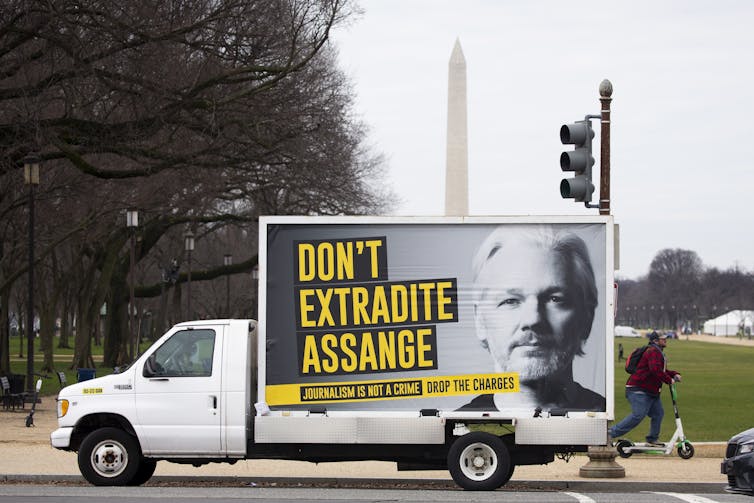 There are fears the Trump administration views Assange’s prosecution as a precedent-setting case.
Michael Reynolds/EPA
There are fears the Trump administration views Assange’s prosecution as a precedent-setting case.
Michael Reynolds/EPA
At Assange’s extradition hearing, Trevor Timm, the executive director of the US-based Freedom of the Press Foundation, said
every single expert witness has some sort of fear that a prosecution of Assange will lead to the prosecution of many other reporters.
This would specifically include the large number of reporters whose work might sometimes include secret documents. In other words, Timm said, US prosecutors seek a precedent that would “criminalise every reporter who received a secret document whether they asked for it or not”.
It is hard to overstate the significance of that problem. History tells us that governments will always try to hide their misdemeanours. One of journalism’s most important roles is to uncover them. It is how we hold governments to account in a democracy, but it also means there will always be a necessary tension between the press and the powerful.
Read more: Journalism's Assange problem
While I believe that anyone who claims “press freedom” as a right also has responsibilities, I also believe we must push back against anything that threatens the media’s oversight role.
Baraitser’s ruling did not set any legal precedent in that regard, and for that we should heave a sigh of relief. But she also missed a critically important opportunity to recognise what Assange’s prosecution means for press freedom — and its importance to all who live in a democracy.
Authors: Peter Greste, Professor of Journalism and Communications, The University of Queensland


 Daily Bulletin


