

How to cut emissions from transport: ban fossil fuel cars, electrify transport and get people walking and cycling
- Written by: Robert McLachlan, Professor in Applied Mathematics, Massey University
The Climate Change Commission’s draft advice on how to decarbonise New Zealand’s economy is refreshing, particularly as it calls on the government to start phasing out fossil fuels instead of relying on offsets and carbon trading.
Until now, New Zealand has relied heavily on its Emissions Trading Scheme, but the evidence is clear that it has failed to reduce emissions. The commission’s package includes carbon budgets out to 2035 and detailed pathways to achieve them across all sectors of the economy.
For the transport sector, which is responsible for half of New Zealand’s energy-related emissions, the commission suggests a sweeping set of changes to electrify the country’s car fleet and to replace imported fuels with local renewable electricity.
It’s exciting to see a national-level plan that actually cuts emissions. But it raises two questions: is it feasible, and is it the best or only option?
Transforming the transport sector
Land transport was always going to be squarely in the commission’s sights. Its emissions have doubled since 1990, and, unlike agriculture, it’s not a protected export industry.
The commission calls for cuts in transport emissions of 47% by 2035, achieved by:
a rapid shift to electric vehicles, with the market share for light vehicles rising from 2% today to 50% in 2027
an end to imports of pure petrol or diesel cars by 2032, and a similar but later transition for trucks
the development of an integrated national transport network that reduces travel by private car
changes to urban planning leading to 7% less travel per person
the development of policies to increase walking, cycling, and public transport by 25%, 95% and 120% respectively by 2030
scaling up low-carbon fuels, such as biofuels, to 3% of all liquid fuels by 2035
some decarbonisation of the rail network, lifting rail’s share of freight from 16% to 20%, and more coastal shipping.
To achieve this rapid electrification, New Zealand would need to produce more renewable electricity. Only one large wind farm, the 840 GWh/year Turitea wind farm near Palmerston North, is currently under construction.
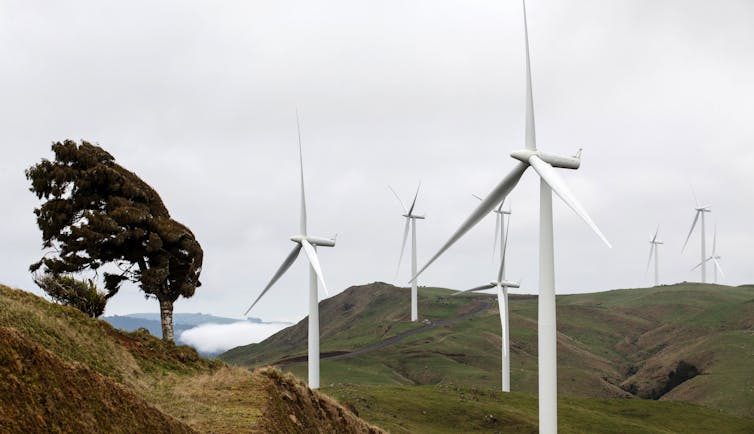 New Zealand would need to build more wind farms and scale up renewable electricity generation.
Brendon O'Hagan/Bloomberg via Getty Images
New Zealand would need to build more wind farms and scale up renewable electricity generation.
Brendon O'Hagan/Bloomberg via Getty Images
In the commission’s proposed scenarios, New Zealand would need another renewable electricity plant like this every year from now on. At the moment, New Zealand has only 690 MW of wind turbines, and no utility-scale solar generation. The industry would need to scale up considerably.
Other live issues are the planned 2024 closure of the Tiwai Point aluminium smelter, which would make a lot of renewable electricity available, and the NZ Battery pumped-hydro project.
The promise of deep cuts to fossil fuels
The proposed shift away from fossil fuels is clearly feasible technically, but would need a quick and radical change in policy. Unfortunately, New Zealand doesn’t have a good track record of carrying out the sweeping regulatory changes that will be needed.
Apart from the proposed import ban on petrol cars from 2032, the EV plan involves a system of subsidies and fuel efficiency standards. Last week, the government introduced a refreshed fuel efficiency standard, with a target of 105 gCO₂/km by 2025.
But the car industry appears to have won several concessions, including a halving of penalties (to NZ$50 per vehicle per gram of CO₂ over the target), a delay in the standard’s introduction until 2023 and a separate target for utes.
The EU did not begin to see rapid EV uptake until 2020, when a new 95 gCO₂/km target kicked in, along with fines of €100/gCO₂/km and generous incentives. Achieving the Norway-like transformation of the car fleet the commission envisages will likely require more incentives and stronger oversight of the market.
Is this the only way?
The commission’s plan doesn’t question the overall structure of the transport system. In the view of some critics, the present system is inequitable and disadvantages people who can’t or don’t want to drive, including children, older people and people living with disabilities.
It has contributed to poor health and safety outcomes, traffic congestion and car-dominated city streets. At an annual cost of NZ$17,000 per household (not counting greenhouse gas emissions), it is also expensive.
The commission’s technical advisory panel included representatives from the car importing industry and other road transport groups, but no experts on walking, cycling, public transport, public health or urban planning.
The massive road-building programme undertaken by both National and Labour governments, set to continue far into the future, is not mentioned, despite considerable evidence that it increases transport demand, sprawl and emissions.
There is no requirement to reduce parking, a topic currently contested in urban forums and already being studied by the government. Nor are there any plans for passenger rail or improvements to inter-city public transport.
Changing the way cities grow
New Zealand’s housing crisis has already prompted a rewrite of urban plans throughout the country to enable higher densities, especially near transport hubs. The commission recommends that, before 2025, all levels of government should embed links between urban planning, design and transport so that communities have integrated and accessible transport options, including safe cycleways.
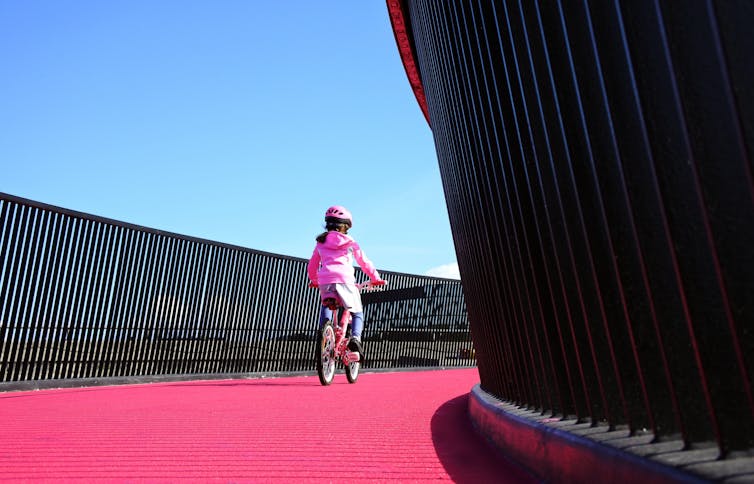 The commission wants to see policies that increase cycling by 95% by 2030.
Shutterstock/ChameleonsEye
The commission wants to see policies that increase cycling by 95% by 2030.
Shutterstock/ChameleonsEye
A glimpse of what can be possible comes from Ireland:
- walking and cycling receive 20% of the transport capital expenditure
- every local authority must develop a high-quality cycling policy, review road use and increase the number of children walking and cycling to school
- new public transport infrastructure must receive twice the funding of any new roads
- surburban and commuter rail is to be enhanced across the country, including high-speed intercity links.
You don’t need a complicated model to accept that these steps are more in tune with the required emission reductions.
Those who argue that infinite growth is not possible on a finite planet will not find much to agree with in the commission’s report. Other perspectives, such as those outlined in the recent book A Societal Transformation Scenario for Staying Below 1.5ºC critique the growth and technology biases in most climate scenarios.
Another model of the future could involve less energy, less travel and less consumption overall, but an equivalent or higher standard of living.
Authors: Robert McLachlan, Professor in Applied Mathematics, Massey University


 Daily Bulletin


