

In an age of digital disinformation, dropping level 1 media studies in NZ high schools is a big mistake
- Written by: Wayne Hope, Professor of Communication Studies, Auckland University of Technology
Primary and secondary school teachers engage with students who are constantly on devices — consuming, sharing and jointly creating texts, photos, videos and memes.
Across social media, hate speech, conspiracy threads and health disinformation swamp evidence-based material. Fabrications and fragmentations of reality cannot be challenged in real time.
Despite this massive influence on young minds, the government intends to remove one of the few teaching opportunities that might equip students to navigate their online world.
Along with several other subjects, secondary school media studies will be dropped from the level 1 curriculum of the National Certificate of Educational Achievement (NCEA) from 2023.
This is a backward step. Making sense of today’s hyper-mediated world depends on the availability of robust media studies courses in primary and secondary schools.
Young inhabitants of this world serve only to reproduce an “attention economy” shaped by the business models of social media and mass media corporations. They need the critical skills to understand this aspect of their lives.
Furthermore, recent medical research suggests excessive smartphone and social media use among adolescents is associated with mental distress. The social implications of this are disturbing.
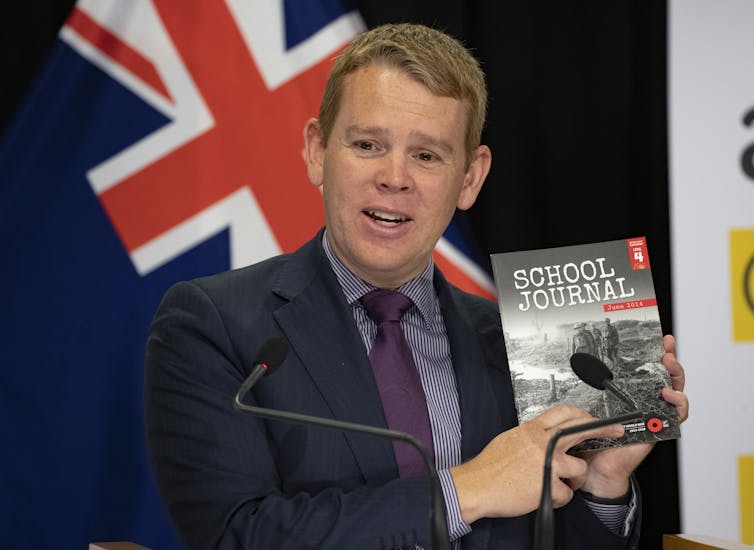 Chris Hipkins holds two portfolios, education and COVID response.
GettyImages
Chris Hipkins holds two portfolios, education and COVID response.
GettyImages
Media studies may disappear
At present, level 1 media studies students learn about regulation of media content, analyse media coverage of current events, examine and compare media genres and production technology.
Over the next two years, they evaluate media texts and representations, develop a range of journalism skills across different media and explore the workings of particular media industries.
The entire three-year curriculum advances critical thinking and foundational media literacy. Students appreciate how media texts are constructed and disseminated and how different experiences and viewpoints shape the readings of such texts.
After secondary school, media studies students are equipped for tertiary-level courses in communication studies, film production, journalism, radio, visual media, art and design, general humanities and the social sciences.
Without level 1 courses, the risk is that some schools may abandon the subject altogether. Fewer media studies courses will reduce the number of qualified teachers available. Media studies pathways will, inevitably, disappear.
This bleak scenario was outlined to me by a senior media studies teacher from the National Association of Media Educators (NAME). For her, the government’s decision is short-sighted and contradictory:
I find it hard to believe that Chris Hipkins, as minister of health and COVID response minister, can warn how everyone must avoid misinformation with regard to dealing with COVID, but then as education minister agree to remove the subject that most equips students with the skills to avoid misinformation — there is such a dissonance happening here.
I would add that Prime Minister Jacinda Adern’s accurate distillations of COVID-19 science reflect her own media education — a communications degree from Waikato University. This strengthens the case for robust media studies courses at secondary level.
No political debate
The Education Ministry’s rationale is certainly hard to fathom. Its December press release was headlined: “NCEA Level 1 changes give students a broader foundation” — the implication being media studies are a narrowly defined pathway.
Such an assumption ignores the disparate origins of media studies research and the range of knowledge available to student learners.
The growing pervasiveness of mass media and digital media communication has brought together the insights of journalism, history, literary studies, political studies, economics, sociology, anthropology and psychology. These are the raw materials for secondary school and tertiary media studies programs.
Alas, media educators’ criticism of the government’s proposals has not generated party-political debate. Rather, Hipkins’ unsupportable claims are complemented by National Party leader Judith Collins’ derogatory remarks:
The problem with secondary schools now is there’s too much photography and too much media and other woke subjects.
Clearly the government and opposition are of one mind — student media literacy is not a high priority.
The Eggplant: a government-funded project to help young New Zealanders navigate the internet safely.Losing historical memory
Meanwhile, New Zealand primary school pupils use digital technology throughout the curriculum to develop their knowledge, skills and cognitive understanding. No complaints here — immersive digital learning recognises the omnipresence of networked screens, online platforms and computational intelligence.
However, an historical appreciation of communication technologies is also required. Phonetic alphabets, manuscripts, printing presses and telegraph/telephone networks necessarily prefigure the internet and social media.
Without this background knowledge primary school pupils risk becoming ciphers of a hyper-mediated present in which transitory information and imagery annul historical memory.
Without a sense of past and present pupils will struggle to separate verifiable journalism from clickbait, infotainment and orchestrated propaganda.
Yes, there is digital education available for both parents and pupils, including internet safety programs to counteract stalkers, scanners, cyberbullies and porn merchants. While crucial, this kind of media literacy is insufficient.
Read more: COVID-19 misinformation on Chinese social media – lessons for countering conspiracy theories
Greater media literacy is vital
The fundamental reality is that social media are not a neutral means of communication, content creation or information transfer. From late primary school, digitally aware students should be investigating the origins, motivations and tactics of disinformation networks such as QAnon and COVID or climate change denial.
Classroom activities might reveal how we spread disinformation inadvertently by sharing videos, using hashtags and adding to comment threads. As a recent Scientific American editorial reflected, “Each one of us is a node on the battlefield for reality.”
Correspondingly, students might share their experiences of Google and Facebook advertising and consider why users are encouraged to spend more time on sites. Final-year secondary students will, ideally, have answers to the following questions:
why did Twitter belatedly terminate Donald Trump’s account?
how does Facebook profit from extreme violent content?
how does one obtain reliable information about the COVID-19 pandemic?
Finally, a question for the education minister and his officials on behalf of media educators everywhere: should aspiring citizens be more or less media-literate than they are now?
Authors: Wayne Hope, Professor of Communication Studies, Auckland University of Technology


 Daily Bulletin


