

The Dig's romanticisation of an Anglo-Saxon past reveals it is a film for post-Brexit UK
- Written by: Louise D'Arcens, Professor of English, Macquarie University
In 1939, a 7th century Saxon ship was uncovered at Sutton Hoo, the Suffolk property of Edith Pretty. The discovery of this ship would transform modern understandings of early medieval England, shedding light on the sophistication of its funerary practices, its accomplished artistry and craftsmanship, and its wide-ranging connections across Europe and beyond.
The new Netflix film The Dig dramatises the uncovering of the stunning find. Based on John Preston’s 2007 historical novel and directed by Australian Simon Stone, the film follows Edith (Carey Mulligan) who, pursuing her intuition about some large mounds on her property, engages Basil Brown (Ralph Fiennes) to excavate them.
But while telling a fascinating story of archaeology, The Dig also reflects a more insular aspect of Britain’s recent zeitgeist, nostalgically appealing to an idea of continuity with a deep past.
Appearing at a time of increased hostility toward Britain’s minority populations and toward Europe as a perceived threat to British sovereignty, The Dig can be seen as a Brexit film: its romanticising of an imagined continuity between the Anglo-Saxons and modern British people does not speak to the complexity of Britain today.
For love or money
The Dig pits Basil, the untrained excavator from farming stock, against the arrogant professionals of Britain’s cultural institutions.
Over the last quarter century, medieval scholarship has increasingly paid tribute to amateur scholars working especially in the 19th century, whose vital contributions were sidelined as the discipline professionalised.
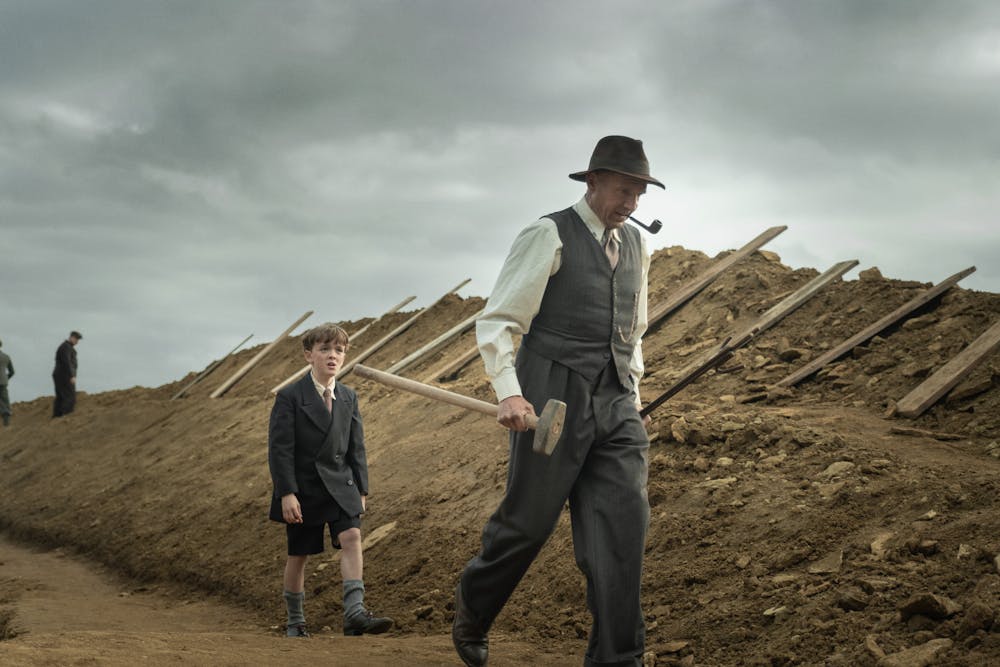 Ralph Fiennes plays Basil Brown, the jobbing, self-taught archeologist who finds himself at odds with representatives of the British Museum.
Larry Horricks/Netflix
Ralph Fiennes plays Basil Brown, the jobbing, self-taught archeologist who finds himself at odds with representatives of the British Museum.
Larry Horricks/Netflix
Played with quiet magnetism by Fiennes, Basil is the epitome of an amateur: one whose devotion arises from love. But the Cambridge archaeologist C.W. Phillips (Ken Stott) is determined to wrest both control and credit from Basil, in a face-off highlighting ongoing tensions between Britain’s rural counties and its metropolitan centre.
Suffolk might be where Saxon kings and their priceless grave goods are buried, but Phillips scorns the “ad hoc” excavational efforts of the “provincials”, believing the British Museum is the natural destination for the treasures.
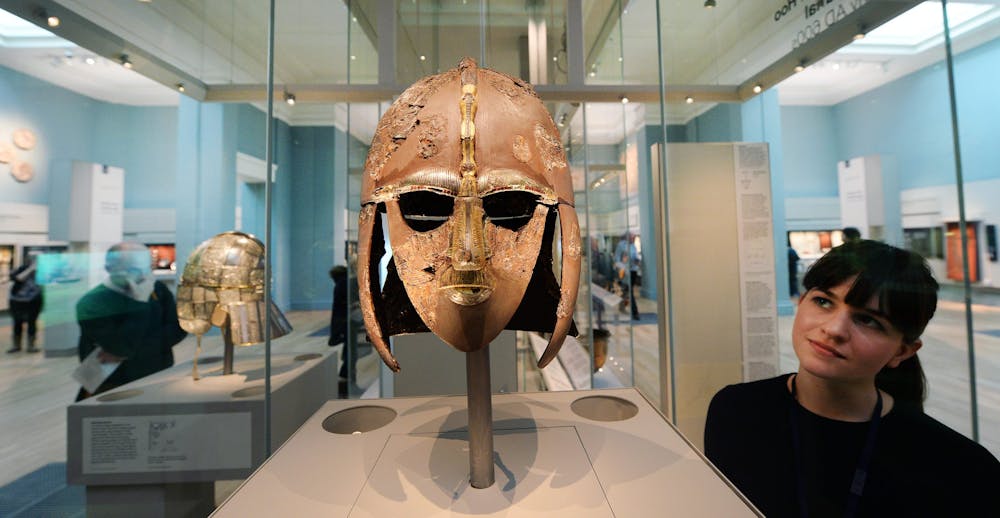 The Sutton Hoo helmet is one of only four complete Anglo-Saxon helmets to survive.
Andy Rain/EPA
The Sutton Hoo helmet is one of only four complete Anglo-Saxon helmets to survive.
Andy Rain/EPA
Basil, an in-demand but underpaid jobbing excavator, values his nose ahead of his eyes or hands: “the past speaks” to him not through book knowledge but through the soil.
He makes discoveries due to his intimate acquaintance with the Suffolk soil, knowledge bequeathed from his farming father and grandfather.
The ‘Anglo-Saxon’ myth
The film’s depiction of Basil is deeply attractive, but in the current political climate it warrants closer scrutiny. The Dig reanimates key tropes from the persistent 19th century British and American ideology of Anglo-Saxonism.
After the end of Roman rule, Britain was the destination for groups of Germanic migrants who later became known as the Anglo-Saxons. While they were historical people, their identity has been subject to nationalistic and romanticised constructions.
Read more: Why the idea that the English have a common Anglo-Saxon origin is a myth
By the 19th century, historians, educators, and politicians used the “Anglo-Saxon period” to loosely refer to the period spanning from the first settlement of these Northern Europeans in the 5th century to the Norman conquest in the mid-11th century.
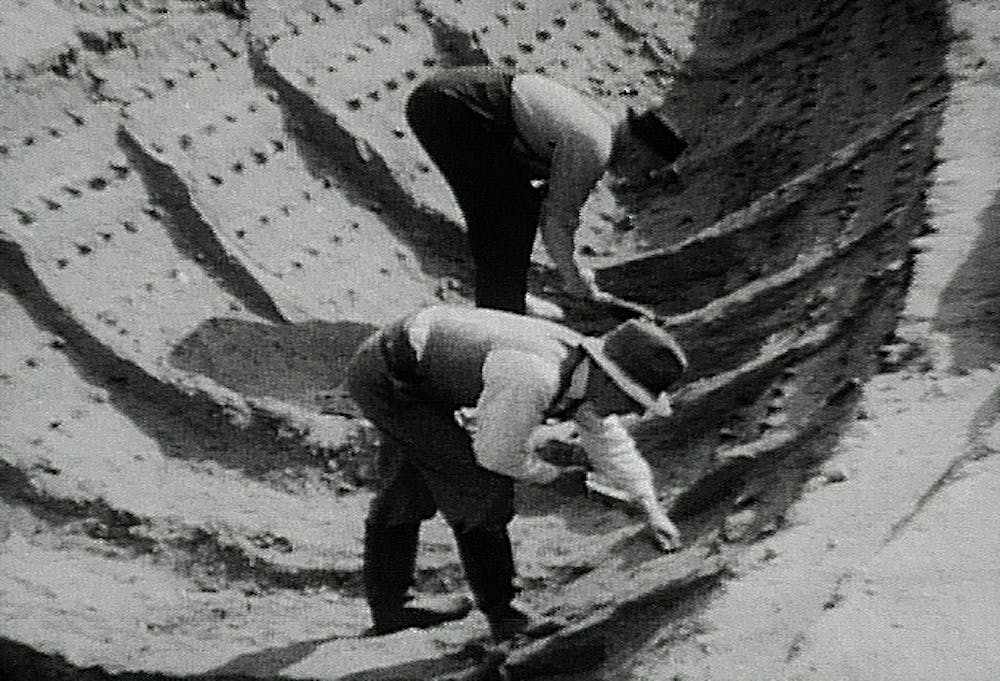 A still from a home movie shows Basil Brown (front) excavating the burial ship at Sutton Hoo in 1939.
Wikimedia Commons
A still from a home movie shows Basil Brown (front) excavating the burial ship at Sutton Hoo in 1939.
Wikimedia Commons
These 19th century commentators used the term “Anglo-Saxon” to invoke a broad conception of the English as a continuation of the Anglo-Saxon race: freedom-loving people whose egalitarian social and political institutions, the argument went, were destroyed by the imposition of the “Norman Yoke”.
The Dig presents Basil as an inheritor of this “freedom-loving” people, defying the authority imposed on him by the professional archaeologists.
The Anglo-Saxon period was also idealised as a time when England was free from nefarious “Romance” continental occupation. This is reflected in Edith and Basil declining to support Ipswich Museum’s excavation of a local Roman villa at Stanton Chair.
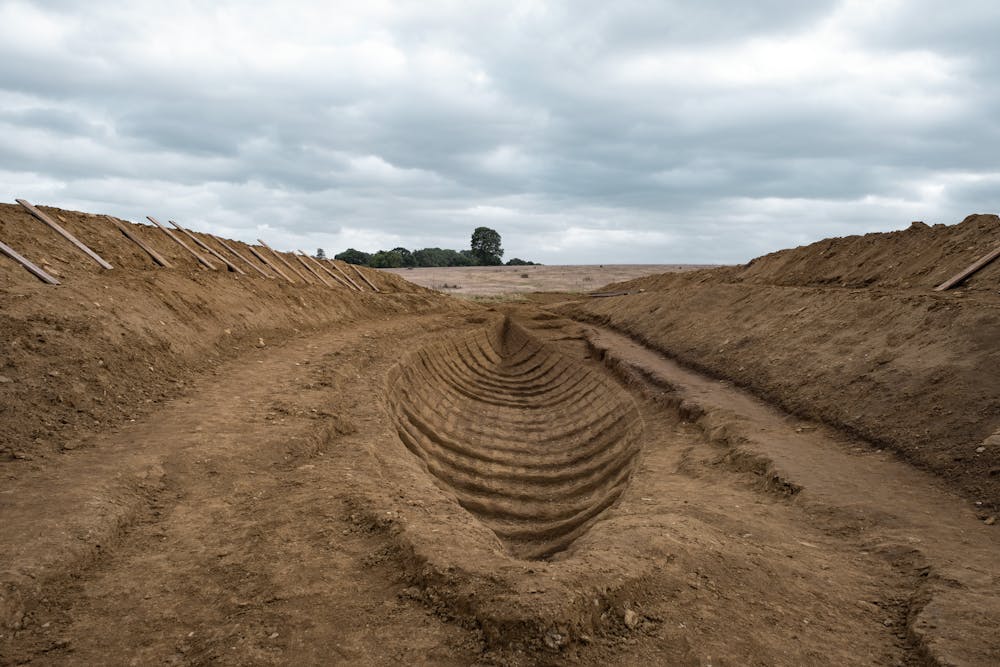 The excavation revealed the imprint of a decayed 27m long ship, with a burial chamber full of riches.
Larry Horricks/Netflix
The excavation revealed the imprint of a decayed 27m long ship, with a burial chamber full of riches.
Larry Horricks/Netflix
Anglo-Saxonism was vital to underwriting white racial supremacy as a mandate for Britain’s imperial power and the expansionist concept of Manifest Destiny, based on the belief that the British and white settlers in the colonies inherited a drive for expansion from their Anglo-Saxon ancestors.
When Edith’s rocket-obsessed son Robert (Archie Barnes) compares Vikings to “space pilots” because they both “explore new lands”, we see the film drawing uncritically on a historical tropes of expansionism — despite the fact the violence of colonialism and occupation is well understood today.
Looking back, not forward
One of the great reckonings in the film comes when Basil’s wife, May (Monica Dolan), urges her disaffected husband to return to the dig. She tells him:
you’ve always said your work isn’t about the past or even the present. It’s for the future, so that the next generations can know where they came from. The line that joins them to their forebears.
This appeal to the idea of genetic continuity is rousing and profound, but also exclusionary and insular. May assumes racial and cultural uniformity in Britain, and shared forebears for all.
But her statement is not just intended to move Basil. She speaks to the film’s 21st century viewers, many of whom would not see an unearthed Saxon as a forebear, and might rightly wonder what “future generations” the film has in mind for Britain.
The Dig is a beautifully made and compelling drama about a game-changing archaeological find. But as cinematic archaeology it looks far more to the past than to the future.
Read more: Ammonite: the remarkable real science of Mary Anning and her fossils
Authors: Louise D'Arcens, Professor of English, Macquarie University


 Daily Bulletin


