

With five countries set to quit, is it curtains for the Pacific Islands Forum?
- Written by: Tess Newton Cain, Adjunct Associate Professor, Griffith Asia Institute, Griffith University
It has been a bruising couple of weeks for the Pacific Islands Forum after five Micronesian countries announced they were leaving the region’s key intergovernmental body. But rumours of its demise have been somewhat exaggerated.
We may also look back at February 2021 as a turning point in Pacific regionalism , or the processes that foster cooperation and solidarity among Pacific island countries.
With increased attention on the forum and how it works, this could prompt change for the better.
What is the Pacific Islands Forum?
The Pacific Islands Forum has 18 members, including Australia and New Zealand.
Founded in 1971, it was established by Pacific leaders who were denied a space to talk politics by the colonial powers in what was then the South Pacific Commission (now the Pacific Community).
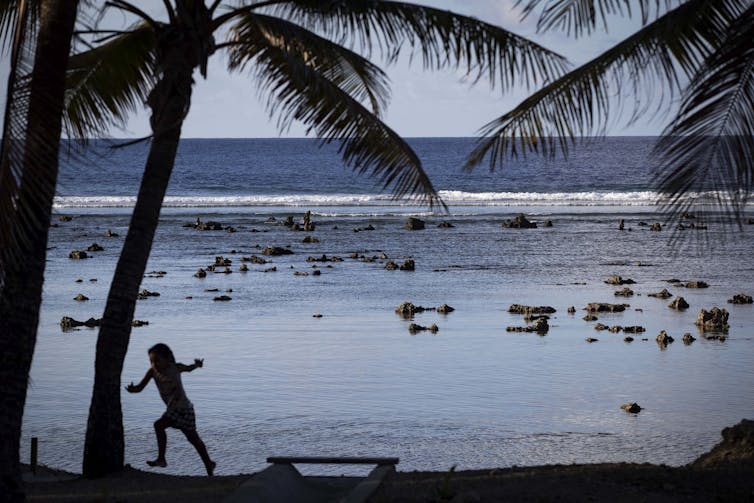 The Pacific Islands Forum is fifty years old.
James Oxenham/AP/AAP
The Pacific Islands Forum is fifty years old.
James Oxenham/AP/AAP
The forum is where leaders meet as equals to address the biggest issues affecting individual nations and the Pacific as a whole, such as the response to COVID-19 and climate change.
In 2018, the leaders signed the Boe Declaration, which established climate change as the most important threat to the security of the region.
The Regional Assistance Mission to Solomon Islands was conducted with the backing of the forum. The collective political will of its membership also delivered the Treaty of Rarotonga, making the Pacific a nuclear-free zone.
The Pacific Islands Forum is run by a secretariat based in Suva, headed up by a secretary-general. Since 2014, that position has been held by Papua New Guinea’s Dame Meg Taylor.
Determining her successor is the spark that led to the current conflict.
What caused the split?
Normally the secretary-general position is determined by informal exchanges and possibly some horsetrading, with focus on consensus.
But because of COVID-19, this was all reduced to a Zoom meeting. A marathon session, involving two rounds of confidential voting, was used to decide the new secretary-general.
After this, former Cook Islands Prime Minister Henry Puna narrowly beat diplomat Gerald Zackios of Marshall Islands by nine votes to eight (New Caledonia was unable to take part thanks to the government having resigned a few days earlier).
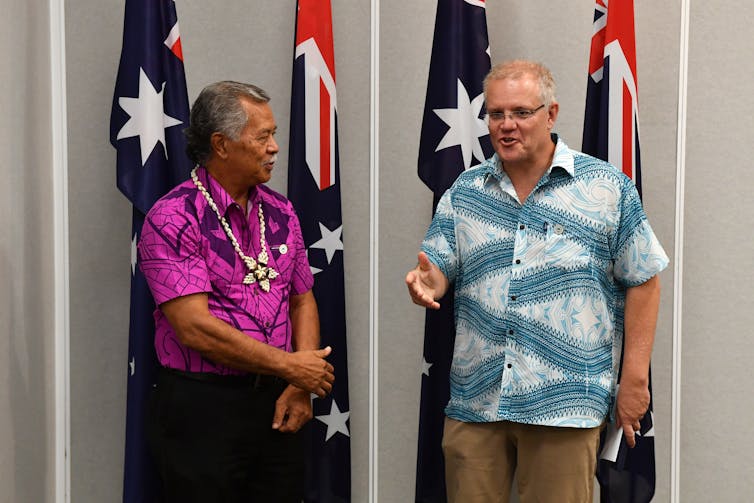 Former Cook Islands Prime Minister Henry Puna - seen here with Australian Prime Minister Scott Morrison in 2019 - was narrowly elected secretary-general.
Mick Tsikas/AAP
Former Cook Islands Prime Minister Henry Puna - seen here with Australian Prime Minister Scott Morrison in 2019 - was narrowly elected secretary-general.
Mick Tsikas/AAP
This triggered a rapid and explosive response, with the Micronesian grouping – Palau, Marshall Islands, the Federated States of Micronesia, Kiribati, and Nauru — announcing they will quit the forum.
This should not have come as a surprise. Ahead of the meeting, the Micronesian leaders had stated that under the terms of a “gentlemen’s agreement” the position of secretary-general should rotate among the sub-regions, and this was their turn.
Not only that, they had clearly warned if they did not get their way, they would see no value in staying with the forum.
Transform Aqorau, a legal adviser to Marshall Islands, says the rest of the region may have underestimated Micronesia’s resolve here and as a result, the forum now has a “totally unprecedented situation” to deal with.
This is not the first time regional cooperative action has been tested, but it is probably the most serious existential threat yet to the Forum, and a major test for our leaders.
What happens now?
All is not lost. The Micronesian leadership has left the door ajar as each country will pursue its own exit strategy according to their national processes. This means that each of the five can pursue their own path and have the option to change position if they see fit.
Importantly, the forum agreement sets out 12 months from when an intention to leave is announced to when it actually takes effect.
It is clear the forum wants all members to stay inside the tent. And work is already underway to ensure communication remains open.
As forum chair, Tuvalu Prime Minister Kausea Natano, said last week,
The Forum Family will not be complete without its Micronesian brothers and sisters […] For the sake of our Pacific people, we should remain open to all opportunities for talanoa or dialogue as has always been the Pacific Way.
We can expect a lot of conversations and use of experts and advisers to seek a way forward over the coming weeks and months.
There is no doubt this puts an added wrinkle in the geopolitical fabric of the region.
Read more: How might coronavirus change Australia's 'Pacific Step-up'?
It also creates added hurdles for members of the forum (including Australia and New Zealand) and other partners (such as China, the United States, and the United Kingdom) who are seeking to increase their influence and range of Pacific relationships.
And it places an additional burden on the forum ahead of the expected meeting in August, where critical issues such as the regional position for COP 26 (the United Nations climate change conference) and the Blue Pacific 2050 strategy (the region’s shared priorities) need to be front of mind.
What does this mean for Australia?
The Pacific Islands Forum is too easily written off as a “talkfest” with colourful shirts.
But when it comes to the security of our region, there is much to be gained by acting collectively. For that, political debate and accommodation is required. And it is through the forum that these things happen.
Australia’s membership of the forum gives it privileged access to the leaders of the near neighbourhood. But this has not always been valued as highly as it should have been. In the region, there continues to be a healthy degree of scepticism about just how committed Australia is to the region.
Read more: Pacific Island nations will no longer stand for Australia's inaction on climate change
This situation now requires Australia to work with other nations, not on its own.
Australia therefore needs to act with humility and listen to those with more knowledge about regional and sub-regional dynamics. Across the region there are people whose experience, credibility, and “mana” qualify them to take delicate negotiations forward. Some of them are leaders and ministers and others are not.
This is an opportunity for some creative diplomacy.
A turning point?
The forum leaders have already asked the secretariat to review the secretary-general appointment/selection process.
This may well be a starting point for some bigger, deeper conversations about the purpose and objectives of the Pacific Islands Forum and regional cooperation, and how they can be better articulated for the benefit of Pacific peoples.
Let’s hope that with some commitment and energy, the forum actually becomes stronger as a result of these latest ructions.
Authors: Tess Newton Cain, Adjunct Associate Professor, Griffith Asia Institute, Griffith University


 Daily Bulletin


