

The WeChat model: how Facebook's ban could change the business of news
- Written by: Fan Yang, PhD candidate at Deakin University, Deakin University
Facebook’s “news ban” in response to Australia’s proposed media bargaining code, has been hard to miss if you’ve spent any time on social networks in the past day or so. The social media platform has effectively halted all posting of links from Australian news pages and stopped people in Australia from posting or viewing international news as well.
Read more: Facebook's news is gone. Here's where to turn for trusted information
The change happened overnight, and may be undone if either Australia or Facebook backs down. But if the current situation continues, it may leave Facebook operating much more like the Chinese platform WeChat, where news is ruled by platform-specific content houses cranking out huge volumes of low-quality articles. And that might suit Facebook quite well — if not the public.
What is WeChat?
WeChat is the major social media platform in the People’s Republic of China. It’s also used by many people around the world, including in Australia. While the PRC and Australia have very different political systems, this shouldn’t stop us paying attention to their similarities.
WeChat is as privately owned as a company can be in China, and is often described as the Chinese Facebook. But WeChat is an even more pervasive platform, combining its own set of built-in tools, payment services and communications networks with a range of optional apps and utilities from messaging services to games and more.
Read more: Thinking of taking up WeChat? Here's what you need to know
In short, WeChat does everything. Because of this, entire news organisations have set up inside the platform. These are known as WeChat Official Accounts (WOAs), and are roughly equivalent to “blue tick” accounts on other platforms such as Twitter.
If Facebook’s Australian news embargo continues, we think something like the WeChat model might develop here. In our research, we have shown it’s very common for features and interface elements to move between English and Mandarin digital media.
People might have a general idea that some aspects of US-based social media have been reproduced by Mandarin language services (such as WeChat’s Instagram-copying “Moments” product) but the copying goes both ways. The stickers, GIFs, QR codes, live commenting, and direct messaging used by the likes of Faceboook, Twitter and LinkedIn were copied from WeChat, Weibo and Bilibili.
How news works on WeChat
Countless media entrepreneurs have set up WOAs since they were launched in August 2013. These accounts produce millions of news posts every day, and unlike traditional media outlets posting on Facebook, these posts are not accompanied by external links to a version of the article hosted elsewhere. WeChat is their whole audience, and they make money by renting out advertising space within their articles.
One of us (Fan Yang) conducted research with 24 Australian-Chinese employees of WOAs. These organisations appear to employ far fewer journalists than traditional media — and sometimes none at all. There are already many Australian-run WOAs operating almost entirely with short-term interns, most of whom do not identify themselves as professional journalists. Instead they are content producers translating published English news into Mandarin and reappropriating stories with editorial spin.
Read more: How Australia’s Mandarin speakers get their news
These organisations largely rehash existing news content, often with clickbait headlines and exaggerated accounts of events. Stories are often aggregated from multiple news sources, or simply copied entirely, perhaps being passed through an automated translation service twice to avoid directly reproducing sentences.
From the fringes to the mainstream
If we were to see the development of platform-specific Facebook news services modelled on the WeChat system, only a handful of media workers would be needed. They would perform multiple roles as writers, editors, marketers, content producers and translators.
As these jobs might only require marginal professional experience in a specific field (such as politics, lifestyle, sports, or nature and environment), the work could be outsourced to places or regions where the labour cost is lower.
With the shrinking readership and advertising revenue in the traditional news industry, content farms and outsourced journalism have already become a common way to churn out a high volume of speedy and inexpensive content. Many fringe groups already operate this way on Facebook, run by anti-vaxxers, flat-Earthers, white supremacists and more. In the absence of more traditional news on Facebook, there is no reason this model couldn’t spread further.
Information control
When comparing China and Australia, we often think of divisions such as China’s shutdown of the “foreign” internet since 2009 and the current diplomatic and trade tensions. However, both nations have seen similar shifts in the way that information is controlled on their dominant platforms, and both have high levels of media concentration.
Whether the changes to Facebook will lead to increased levels of WeChat-style platform-specific news production houses, or an increased visibility of those that already exist, remains to be seen. This may depend on how independent and start-up media find a way forward, although we believe the WeChat model may be successful for some.
We would suggest, however, that there are already two key messages to take away from the current situation. The first is to note that while regulation of social media is possible, political will is largely absent without the support of incumbent media organisations. This can be seen in the deals Google has recently established with several media companies.
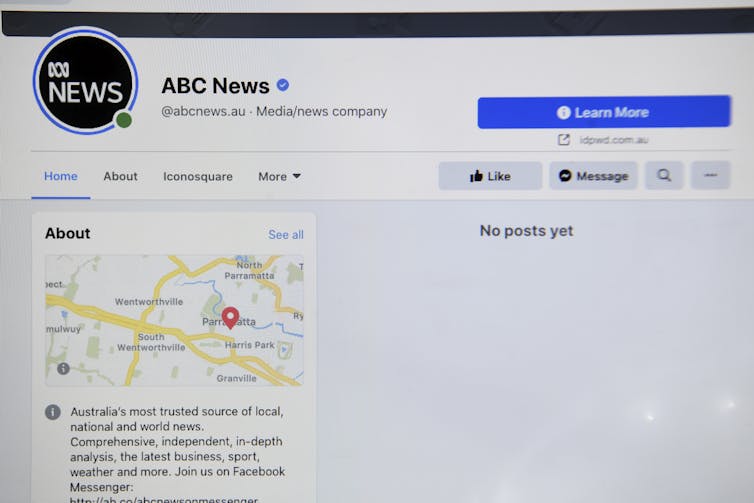 Posts on the Facebook pages of Australian news sites disappeared overnight.
Lukas Koch / AAP
Posts on the Facebook pages of Australian news sites disappeared overnight.
Lukas Koch / AAP
Also, only Google and Facebook have been the focus of the media bargaining code so far. Can we expect regulation of Reddit, Discord, TikTok, WeChat, Twitter, or even MySpace and Ello? What about news platforms that link to other news platforms? These developments have not yet played out.
The second is that Facebook will defend its capacity to operate on its own terms, and will fight hard to prevent either states or competitors dictating how its services operate or how it governs content. Despite Facebook refusing to accept journalistic outlets as formal competitors (as this would likely invoke various national oversight mechanisms for journalistic content), they are nonetheless in competition for audiences and advertising.
Anything that could shift people into Facebook-specific news-advertising contexts with independent editorial teams would be a highly desirable outcome for the platform.
Authors: Fan Yang, PhD candidate at Deakin University, Deakin University


 Daily Bulletin


