

Half of our unis don't have bullying policies for students. This is what they need to protect them
- Written by: Zoe Vaill, PhD Candidate Faculty of Education, Queensland University of Technology
Students are heading off to universities around Australia, whether for the first time or as returning students, with expectations of a year of learning, making friends and enjoyable socialising. For some students this will not be the case. Bullying by other students continues to be a serious but neglected problem at Australian universities.
Our recent study of 39 Australian universities found 20 did not have an anti-bullying policy relating to students. The other 19 had a mix of student-specific policies and staff policies with students added on.
Read more: Bullying in regional universities is a serious problem that needs addressing
Internationally, researchers have identified bullying at universities as a problem. Students have reported both traditional bullying and cyberbullying.
With growing numbers learning online, it is more important than ever to ensure universities are properly protecting their students. Students need accurate, relevant and usable information to counter bullying.
First, a little context
Despite the evidence of the harm bullying in universities does, it hasn’t received the same attention as bullying in schools or workplaces.
Australia has laws to ensure workplaces and schools have anti-bullying policies for employees and students. Each state’s department of education provides a template and guidelines on what must be included in school policy and how it should be communicated to staff, students and parents.
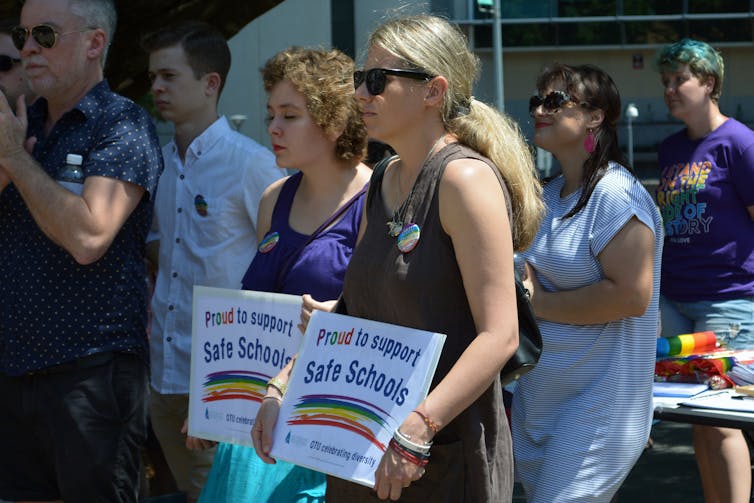 Bullying in schools has attracted much more public and political attention.
Ed Jackson/AAP
Bullying in schools has attracted much more public and political attention.
Ed Jackson/AAP
Read more: Not every school's anti-bullying program works – some may actually make bullying worse
Policies are a great prevention and intervention strategy as part of efforts to stop student bullying. The problem is this government-based approach to bullying has not included tertiary education.
So what are universities doing?
The support provided for students who are bullied varies from university to university. But, overall, policy-based support is lacking.
The numbers found in our recent study are worrying. Only 66% of university policies defined bullying and 69% mentioned cyberbullying. Only 23% provided contact details for students to report the bullying to their university.
The study assessed universities’ policies for quality and usability of content. This revealed an important problem in addition to the overall lack of information. Where these policies exist, they lack accurate and usable information.
 Cyber bullying is on the rise but it isn’t mentioned in nearly a third of university anti-bullying policies.
aslysun/Shutterstock
Cyber bullying is on the rise but it isn’t mentioned in nearly a third of university anti-bullying policies.
aslysun/Shutterstock
How useful are these policies?
We checked the information provided against a list of 37 items, including:
definitions of bullying
practical information on how to report and what support is available
usability of information – is the policy easy to find and understand?
overall prevention and intervention strategies.
On average, universities in Australia included only 15 of the 37 items in their anti-bullying policies. This means the existing policies are not providing important information to students about bullying and what to do if they are bullied.
Analysis of the content universities provided to students in each state and territory clearly shows how widespread the issue is. All on average included less than half of the items they should have included. The averages were:
9 of 37 in Australian Capital Territory, Northern Territory and Tasmania
14 of 37 in Victoria and Western Australia
17 of 37 in Queensland and New South Wales
18 of 37 in South Australia.
As well as the information left out, the information provided by anti-bullying policies was often incorrect or contradicted by the university’s other policies, procedures or information pages. This is especially true of the definitions of bullying. The words bullying, harassment and discrimination are often used interchangeably.
Read more: Sexual abuse, harassment and discrimination 'rife' among Australian academics
The usability of these policies is another issue. Some are hard to find. The policies also do not use student-friendly language and are difficult to understand.
Many policies do not use student-specific examples of bullying behaviour. This is especially true of staff policies that have had students added on. Information about reporting the bullying, and who they should talk to for advice and support, is often relevant for staff only.
How can this situation be fixed?
These problems should be tackled on several fronts, including:
state governments mandating that each university has a student-specific anti-bullying policy using a provided template so information is accurate and consistent across all universities
universities drawing on well-developed policies and practices such as those in the UK, which use online reporting forms and have student advice lines
universities actively promoting a bully-free culture on campus and online, and ensuring students know of the policies and their options.
Universities have a duty of care to students. This mean they must make sure students can learn in a safe and supportive environment. Universities must take a firm stance on bullying and ensure students know how to identify and report bullying, and trust their university to believe and support them when bullying does occur.
Read more: Brutal rituals of hazing won't go away — and unis are increasingly likely to be held responsible
Authors: Zoe Vaill, PhD Candidate Faculty of Education, Queensland University of Technology


 Daily Bulletin


