

Genuine about climate action, Mr Cormann? Here's how to turn over a new leaf
- Written by: Christian Downie, Associate professor, Australian National University
Former Australian finance minister Mathias Cormann was last week elected Secretary-General of the Organisation for Economic Co-operation and Development (OECD), after campaigning on a platform with climate action as a central plank.
In a statement following his appointment, Cormann pledged to “drive and promote global leadership on ambitious and effective action on climate change to achieve global net-zero emissions by 2050”.
Cormann’s selection came despite concerns his climate track record in federal parliament made him an unsuitable candidate.
It’s said the best predictor of future behaviour is past behaviour. If that proves correct with Cormann, we shouldn’t expect much on climate change. But his new gig does present an opportunity for Cormann to change his stripes.
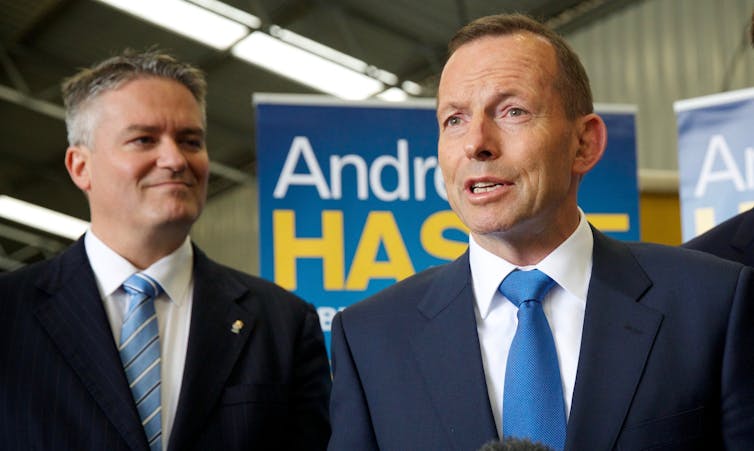 Mathias Cormann was a key member of the Abbott government when it dismantled Labor’s carbon price.
Richard Wainwright/AAP
Mathias Cormann was a key member of the Abbott government when it dismantled Labor’s carbon price.
Richard Wainwright/AAP
A poor climate record
From 2013 to 2020, Cormann was finance minister in the Abbott-Turnbull-Morrison governments – an administration with arguably one of the worst records on climate change of any OECD government.
Just last week, Australia ranked last on a list of the world’s 50 largest economies for “green” spending to aid economic recovery after the COVID pandemic, according to a United Nations report.
The litany of the Coalition’s indictments is too long to list in full here. But dubious highlights include:
- abolishing Labor’s carbon price in 2014
- abolishing the Climate Commission
- unsuccessfully seeking to kill off the Clean Energy Finance Corporation.
And Cormann has also discouraged the climate action of others. For example, in 2017 he described Westpac’s lending restrictions on coal projects as “very, very disappointing”.
The OECD itself has condemned Australia as “one of the most carbon-intensive OECD countries and one of the few where greenhouse gas emissions (excluding land use change and forestry) have risen in the past decade”.
It is not hard to see why many around the globe lobbied against Cormann’s new appointment, including the British Labour Party.
In stark contrast to his political record, Cormann embraced the need for climate action during his campaign for the OECD job. This included an opinion piece in support of net-zero emissions by 2050 – a target Prime Minister Scott Morrison has yet to commit to.
So if Cormann really has had a genuine change of heart, what can he do on climate action in his new role?
 Cormann campaigned on the need for climate action when vying for his new job.
Cormann’s climate opportunity
Cormann may be used to being a cabinet minister, but his new role is more like a departmental secretary, but with new political masters.
The Paris-based OECD consists of 37 member states which run the organisation. Cormann answers to them, and many – including the United States and the United Kingdom – have adopted strong climate targets.
With a budget of around A$600 million and a permanent secretariat of more than 2,500 staff, the OECD has at its disposal significant resources to set international agendas and standards that can shape climate policies around the globe.
It regularly does so in other domains. For example, since the global financial crisis in 2008 the OECD has led the way on taxation reform. It helped forge new rules governing how national tax authorities share information, and how they might address multinational tax avoidance.
 The OECD has an environment directorate, through which climate policy could be advanced.
Shutterstock
The OECD has an environment directorate, through which climate policy could be advanced.
Shutterstock
Cormann in a tight spot
If Cormann is genuine about his climate action agenda, he may be forced to take positions at odds with the Morrison government.
The first potential pressure point involves carbon prices and carbon tariffs, for which the OECD could be called upon to play a coordinating role.
A carbon price sets a price on carbon pollution at home. Carbon tariffs do so at the border. Crudely speaking, these are taxes on imports that produce considerable carbon pollution, and which originated in countries not pulling their weight on climate change.
The agenda of US President Joe Biden includes a “carbon adjustment fee” for countries failing to meet climate and environmental obligations. The European Union is also pressing ahead with a similar proposal.
Given even the OECD has concluded Australia is a climate action laggard, we look likely to be slugged. Predictably, Energy Minister Angus Taylor has declared his government is “dead against” such tariffs, and there are early signs Cormann will back his former colleagues on the tariff issue.
He last week urged caution, saying the measure entailed “many downside implications for global trade and the world economy”.
Read more: No point complaining about it, Australia will face carbon levies unless it changes course
The second pressure point is fossil fuel subsidies. In 2009, G20 countries agreed to phase out trillions of dollars in government handouts that prop up the oil, gas and coal industries. Since then, the OECD has campaigned against the subsidies, describing them as “environmentally harmful, costly, and distortive”.
OECD countries may come under growing international pressure to eliminate the handouts. This includes Australia which, according to IMF estimates, maintains US$29 billion in fossil fuel subsidies each year.
The third, lesser known point involves the rules governing export financing for fossil fuel infrastructure. In 2015 the US Obama administration pushed for OECD countries to restrict financing for new coal power plants in overseas countries. The bid succeeded, despite opposition from Australia and a handful of other nations.
While not perfect, the rules were a first step in phasing out coal. Many environmental groups are now campaigning for these rules to be tightened and to extend to oil and gas. It is not hard to guess what Australia’s position will be.
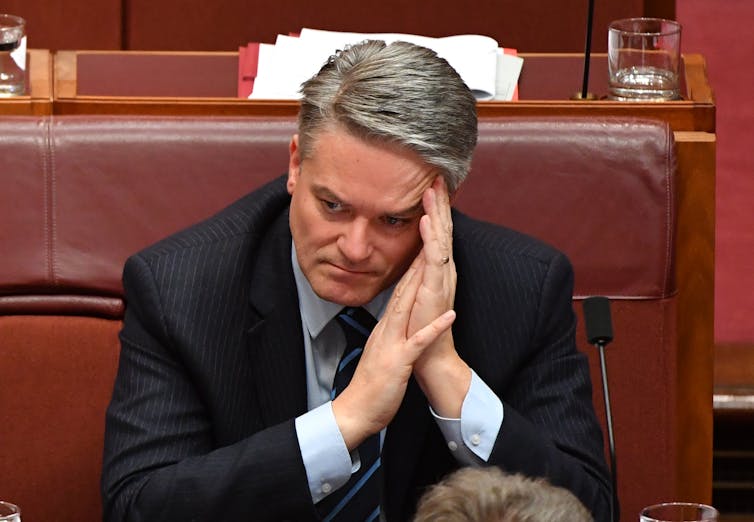 The Morrison government’s stance on climate and energy measures departs starkly from the OECD’s.
AAP
The Morrison government’s stance on climate and energy measures departs starkly from the OECD’s.
AAP
A new chapter?
The outgoing head of the OECD, Ángel Gurría, last month said tackling the world’s environmental crises was “the single most important intergenerational responsibility […] We are on a collision course with nature and we have to change course for future generations”.
He urged countries to “put a big fat price on carbon” – a position clearly at odds with the Morrison government.
Unsurprisingly, Cormann’s rhetoric so far has been more restrained. But if he is to match the climate ambition of the OECD’s biggest member states, his future behaviour will have to be very different to that of his past behaviour.
Read more: Six questions about Mathias Cormann, newly appointed Secretary General of the OECD
Authors: Christian Downie, Associate professor, Australian National University


 Daily Bulletin


